The following articles will be an detailed account of the most important and most attractive illustrated editions of the novels of Jane Austen. In this first part, I will simply list the editions that will be covered and give a brief summary of the illustrator and the edition. These editions will be listed in the order of first publication. This page will therefore be an index page for the following pages as they are developed. I will mostly focus on English editions, but there will be some notable exceptions. For every book that I cover, a reference will be given from the second revised 1997 edition of the magisterial bibliography of Jane Austen published by the late David Gilson, in the form of a “Gilson number” (eg. “Gilson D1”, which refers to the first Bentley edition of Sense and Sensibility published in December 1832). Each of the individual articles will present many examples of the illustrations, scanned from my own copies where possible. Where there are illustrated dust wrappers, I will show these as well.
In the Beginning…
None of the first English or American editions of the Austen novels were illustrated, so the story of illustrated editions of Austen begins surprisingly in France. The first French edition of a Jane Austen novel to appear was Raison et Sensibilité, translated from Sense and Sensibility by Mme Isabelle de Montelieu and published in Paris by Arthus Bertrand in 1815 in four volumes. It did not have any illustrations. The second French edition to appear was La Famille Elliot, translated by Mme de Montelieu from Persuasion and published by Arthus Bertrand in two volumes in 1821. It had two illustrations, a frontispiece to each volume. This is the first edition of any Austen novel to have any illustrations. Second editions of both of these books were published by Bertrand in Paris in 1828. This time, the Raison et Sensibilité (in three volumes) had a frontispiece in each of the three volumes. The two illustrations from the 1821 edition of La Famille Elliot were reissued in the 1828 second edition.
My listing of the illustrated editions of the Jane Austen Novels therefore begins with these two entries:
The next Austen novels to be published with illustrations were the individual volumes and the five volume set offered by Richard Bentley with frontispieces and title page vignettes:
1833 Mansfield Park, Richard Bentley, London, Gilson D3.
1833 Northanger Abbey and Persuasion, Richard Bentley, London, Gilson D4.
1833 Pride and Prejudice, Richard Bentley, London, Gilson D5.
1833 Works of Jane Austen, 5 vol., Richard Bentley, London, Gilson D6
These were the first English illustrated editions of Jane Austen’s novels. The novels were reprinted many times before being reissued in a new edition by Bentley starting in 1870. The details of the reprints and the second Bentley edition of 1870 will be given in the individual articles.
The first Austen novel to have illustrations throughout the text block was the edition of Mansfield Park published by Richard Groombridge and Sons in 1875. It had 7 full page illustrations engraved from pictures by A.F. Lydon.
Published by Groombridge and Sons, London. Gilson E43
Illustrated by Andrew Francis Lydon.
The First Illustrated edition of Mansfield Park
Mansfield Park by Jane Austen was first published in 1814 by T. Egerton as a three volume novel. A second edition, also in three volumes, was published in 1816 by John Murray. Neither of these two editions had any illustrations. The next edition to be published was a single volume edition published in 1833 by Richard Bentley (Gilson D3). It had an engraved frontispiece and an engraved title page with a vignette illustration. Technically, the Bentley edition is the first edition of Mansfield Park to have any illustrations, but in most collector’s opinions this would not count as an illustrated edition, as there are no illustrations either embedded or interleaved in the text.
Several other editions of Mansfield Park were published following the Bentley edition, particularly editions by Simms and M’Intyre (1846), Routledge (1857), Derby and Jackson (1857), Ticknor and Fields (1863) and Tauchnitz (1867). None of these were illustrated, even with a frontispiece.
The first illustrated edition of Mansfield Park was an undated edition published by Groombridge and Sons, 5 Paternoster Row, London. It is generally accepted that this edition was published in October 1875. The book contains 7 full-page engraved illustrations of drawings by Andrew Francis Lydon. Not only is this the first edition of Mansfield Park with a set of illustrations, it is the first edition of any Jane Austen novel to be published in English with a set of illustrations. The top board, engraved title page and letterpress title page of my copy of the Groombridge Mansfield Park are shown in Figure 1 below. Note the unusual rendering of “a” in the engraved page.
Figure 1 The Groombridge edition of Mansfield Park 1875
A F Lydon, the illustrator and B Fawcett, the printer
The seven illustrations were all engraved by the firm of Benjamin Fawcett (1808-1893), a fine printer and engraver, from original drawings by Alexander Francis Lydon (1836-1917), an Anglo-Irish watercolourist and engraver. The pictures are all signed “A F Lydon” as the artist, but they also have small and indistinct second signatures or marks by the individual engravers. This is underlined by the statement on the printed title page “Illustrated from Drawings by A.F.Lydon”. Indeed, much of the firm’s work was engraved by Benjamin Fawcett himself. Lydon was in fact an employee of Benjamin Fawcett (1808-1893), and had served his appenticeship as an engraver with Fawcett. This was mutually convenient as Driffield, a town in East Yorkshire, was both Lydon’s family home and the site of Fawcett’s business. There is a modern pub in Driffield today called “The Benjamin Fawcett”.
Lydon and Fawcett worked together over many years to produce mainly illustrations of wildlife, landscapes or architectural subjects. Lydon excelled in fine watercolour paintings of birds and plants, and also of grand houses in landscaped parks.
The binding is a standard one used by Groombridge and Sons for some of their published fiction. The last page of the text block of my Groombridge edition of Mansfield Park is numbered 440, and bears the name of the printer, “B Fawcett, Engraver and Printer, Driffield.” The page height is 18.7 cm. These three characteristics all support the idea that this edition was printed de novo, rather than being a reprint of an earlier known edition, as no other known edition of Mansfield Park fits this description. David Gilson gives this book the designation E43 in his ABibliography of Jane Austen, where he reports a publication date of October 1875, derived from the English Catalogue of Books. WorldCat also gives the date 1975, which comes from the deposit copy held by the British Library, the only copy listed on WorldCat. This is a very rare book, which means that few people have seen the illustrations. I will show all seven on them in the following section.
The Lydon illustrations for Mansfield Park
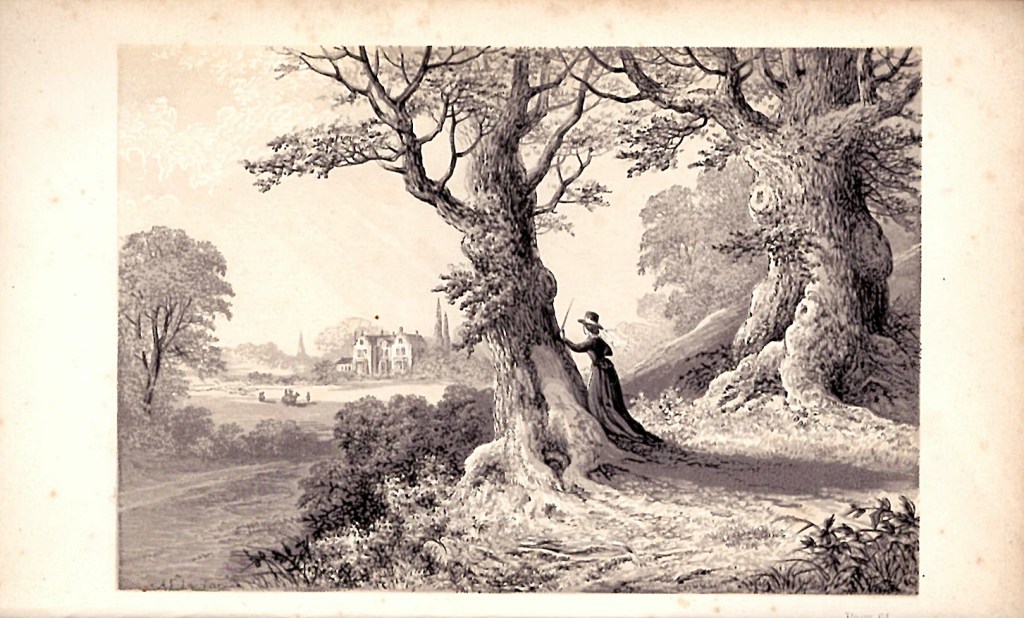
The illustrations for the Groombridge edition of Mansfield Park are all black and white printings of finely executed engravings on woodblocks of line drawings by Lydon. Several of them show off the artist’s skill in landscapes. This starts with the frontispiece, shown below in Figure 2.
Figure 2. Frontispiece to Mansfield Park
This shows the heroine, Fanny Price, looking back towards the riding party of Edmund Bertram and Miss Crawford in front of the house at Mansfield Park. The incident is from chapter 7. Lydon’s expertise in the depiction of landscape is very much to the fore in this design.
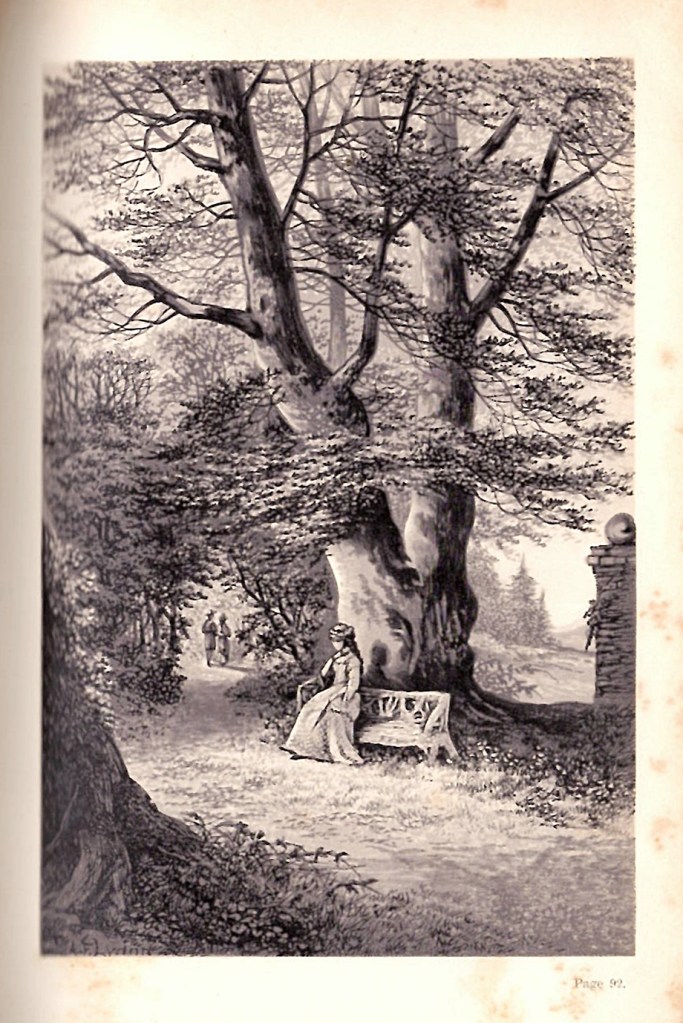
The second illustration (Figure 3, left) shows an incident from chapter 9, where Fanny, Edmund and Miss Crawford have rested on a seat during a walk in the woods. Edmund and Miss Crawford then walk on together to the end of the wood, leaving Fanny still on the seat to watch them disappear together down the path.
Figure 3. Illustrations of scenes from Chapters 9 (left) and 16 (right)of Mansfield Park
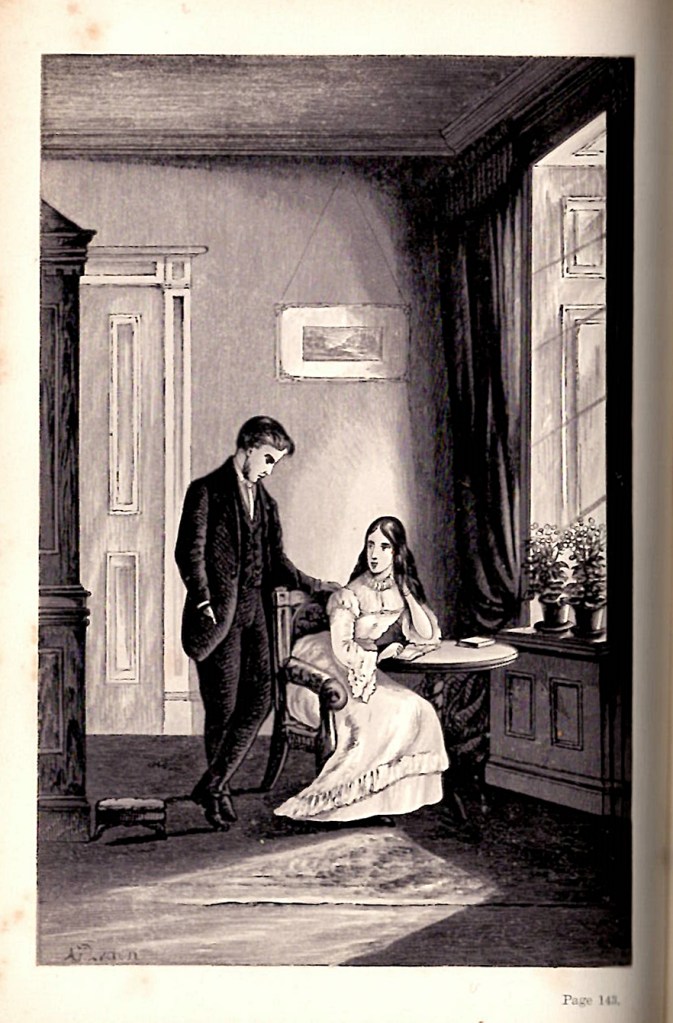
The illustration shown on the right of Figure 3 depicts Edmund explaining to Fanny his concerns about the propriety of the amateur dramatics that the house party is engaged in.
In the next illustration (Figure 4), which is from chapter 25, we return to Lydon’s love of landscape as he depicts Henry Crawford’s story of stumbling across the village of Thornton Lacey, his promised living, while walking his lame horse back to Mansfield Park.
Figure 4 Henry Crawford views Thornton Lacey.
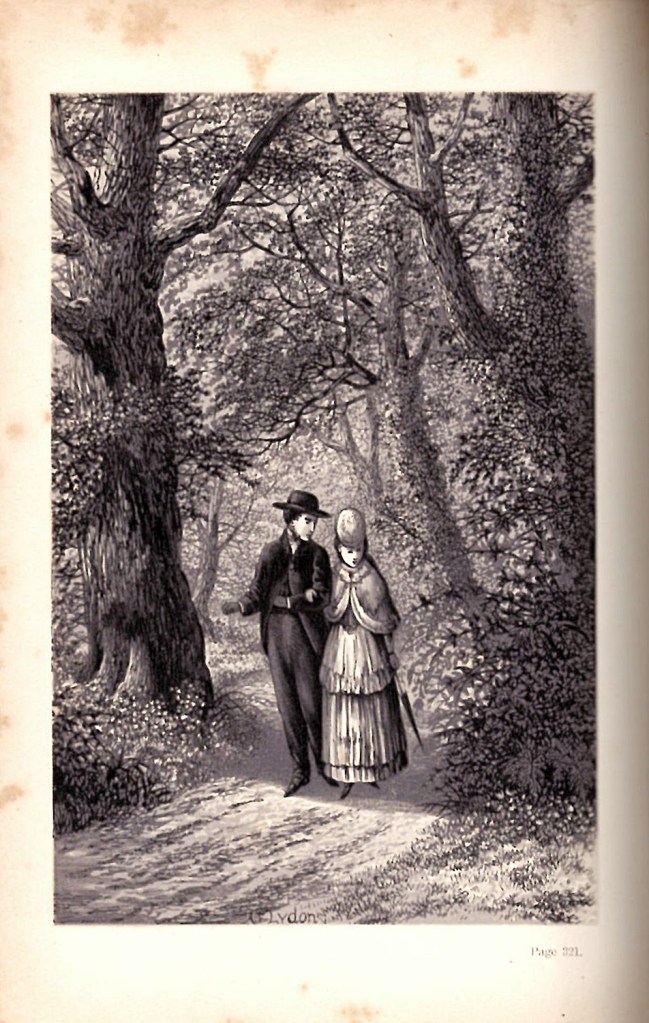
In the next illustration (Figure 5 left), taken from chapter 35, we see Edmund and Fanny walking together arm in arm as Edmund tries to find out what feelings she might have for Henry Crawford. In Figure 5 (right), we have moved on to chapter 41, where Henry Crawford is talking about his future prospects to Fanny Price at Portsmouth docks, rather wishing that Fanny’s younger sister, Susan, was not present.
Figure 5 (left) Edmund and Fanny; (right) Mr. Crawford and the two Price sisters
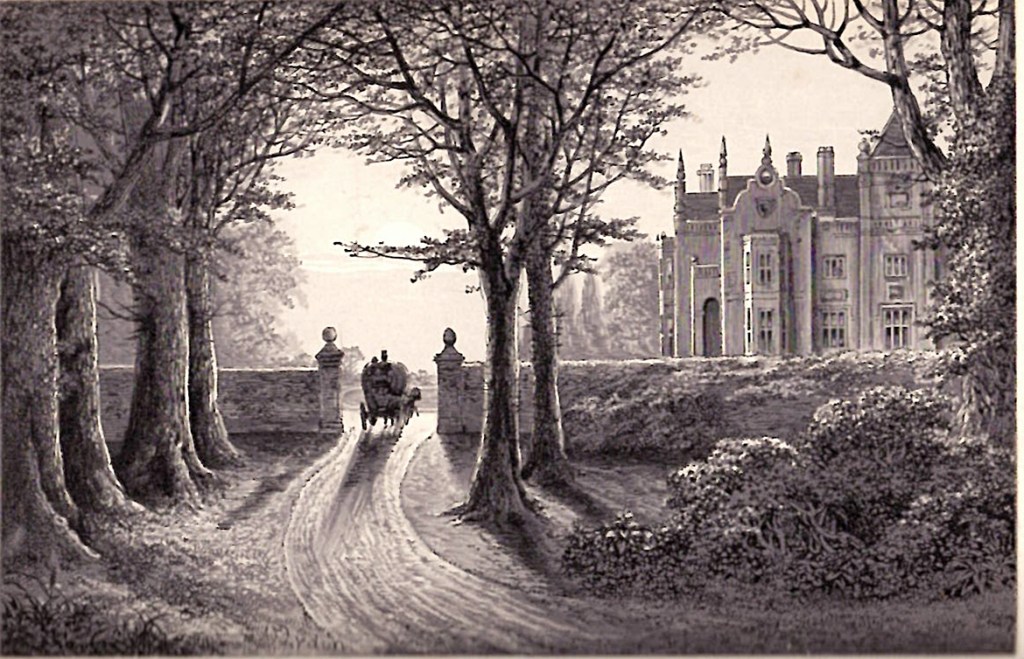
The final illustration, shown in Figure 6 below, comes from an event in chapter 46, when Fanny, accompanied by her excited sister Susan and a nervous Edmund Bertram, returns to Mansfield Park by carriage from Portsmouth. This picture shows off Lydon’s facility in drawing country houses and landscaped grounds.
Figure 6 Fanny’s return to Mansfield Park
These seven drawings give an interesting view of an Austen novel through the eyes of a landscape and wildlife artist. Although the clothes depicted are decidedly from the 1860s and 1870s rather than Regency period, the drawings offer an interesting contrast to the classic illustrations of Austen by some other illustrators, whom tended to concentrate on fine drawings of interiors, with accurate depictions of costume, manners and decor of paramount importance.
This is the only novel of Jane Austen known to be illustrated by A. F. Lydon.
A few comments on the publisher, Groombridge and Sons
Richard Groombridge started as a publisher in 1833, when he operated out of his home, 6 Panyer Alley, using the imprint of Richard Groombridge or R. Groombridge. Four of his sons served as his apprentices and joined the firm to work as publishers and booksellers. In 1845, when his two eldest sons were 28 and 25 years old respectively, the imprint of the firm was changed to “Groombridge and Sons”, usually followed by “5, Paternoster Row” on the title page. Following Richard Groombridge’s death in 1855 the firm was run jointly by the two oldest sons. Sadly, the three oldest sons all died between 1860 and 1868, leaving the youngest, Charles Groombridge, as the last surviving son of the founder. He seems to have lost interest in publishing sometime during the 1860s, and by the 1870s, the firm was run by three grandsons of Richard Groombridge until it ceased to trade sometime around 1900.
R. Groombridge and Groombridge and Sons were best known as publishers of books on religion, agriculture and natural history, although they did also reprint several of the novels of Grace Aguilar (1816-1847), a popular writer on themes of Jewish history and religion. The Groombridges worked closely with Benjamin Fawcett, publishing many of his finely illustrated books between 1844 and 1890.
It is not known why Groombridge and Sons decided to publish an illustrated edition of Mansfield Park in 1875. It is even possible that the genesis of the book came from the printer, Benjamin Fawcett or the illustrator A F Lydon. We shall probably never know. For more details about the Groombridge family of publishers, read my Groombridge, Publishers page.




 Book Collecting World