1833 Emma; 2nd UK edition

Richard Bentley, London, Gilson D2

The first edition of Emma, the fourth novel to be published by Jane Austen, was published in 3 volumes in December 1815 by John Murray. Like all of the first editions of Austen it was not illustrated. It was the first Austen title published by John Murray, following some dissatisfaction with Thomas Egerton, who had published the first three Austen novels. The first edition of Emma was issued as 2000 copies, which all sold within one year of publication. Following Jane Austen’s death on 18th July 1817, John Murray resisted efforts by the Austen family, notably the author’s brother Henry and sister Cassandra, to publish a second edition of Emma.

Richard Bentley (1794-1871) had been born into a distinguished family of three generations of printers and publishers. After initially working in partnership with his brother Samuel as “S. and R. Bentley” for ten years, Richard formed a new partnership with Henry Colburn in 1829. Colburn and Bentley had started to publish a series of cheap, illustrated reprints of English novels as “Colburn and Bentley’s Standard Novels” in 1831. They offered reprints of novels in a single volume for six shillings. Each volume had two illustrations, an engraved frontispiece illustration and an engraved title page which had a smaller “vignette” illustration. The first novel in the series was The Pilot by James Fennimore Cooper, published in February 1831 and the highlight of the early titles was Frankenstein by Mary Shelley published on 31st October 1831. After an acrimonious dissolution of the partnership in mid-1832, by which point 19 Standard Novels had been printed and published, Richard Bentley continued with his own series of “Standard Novels”.

Emma, along with the other five novels of Jane Austen that had been published between 1811 and 1817, did not appear in a new English edition until Richard Bentley decided to reprint all of the Austen novels as “Standard Novels” in 1832. Emma was published by Richard Bentley on 27th February 1833, following his purchase of the Austen copyrights from Cassandra Austen via Henry Austen. Emma was numbered “XXV” (25 ) in the Standard Novel series. It was the second edition of Emma to be published in the UK, the first single volume edition, the first edition to have any illustrations and the first to have Jane Austen’s name as author on the title page(s). It was the second of Austen’s novels to be published by Bentley, following Sense and Sensibility (Gilson D1), which was published as Standard Novel number XXIII (23) on 28th December 1932, although it was dated 1833. Standard Novel XXIV (24) was a translation of Madame de Stael’s Corinne, which appeared on February 1st 1833.

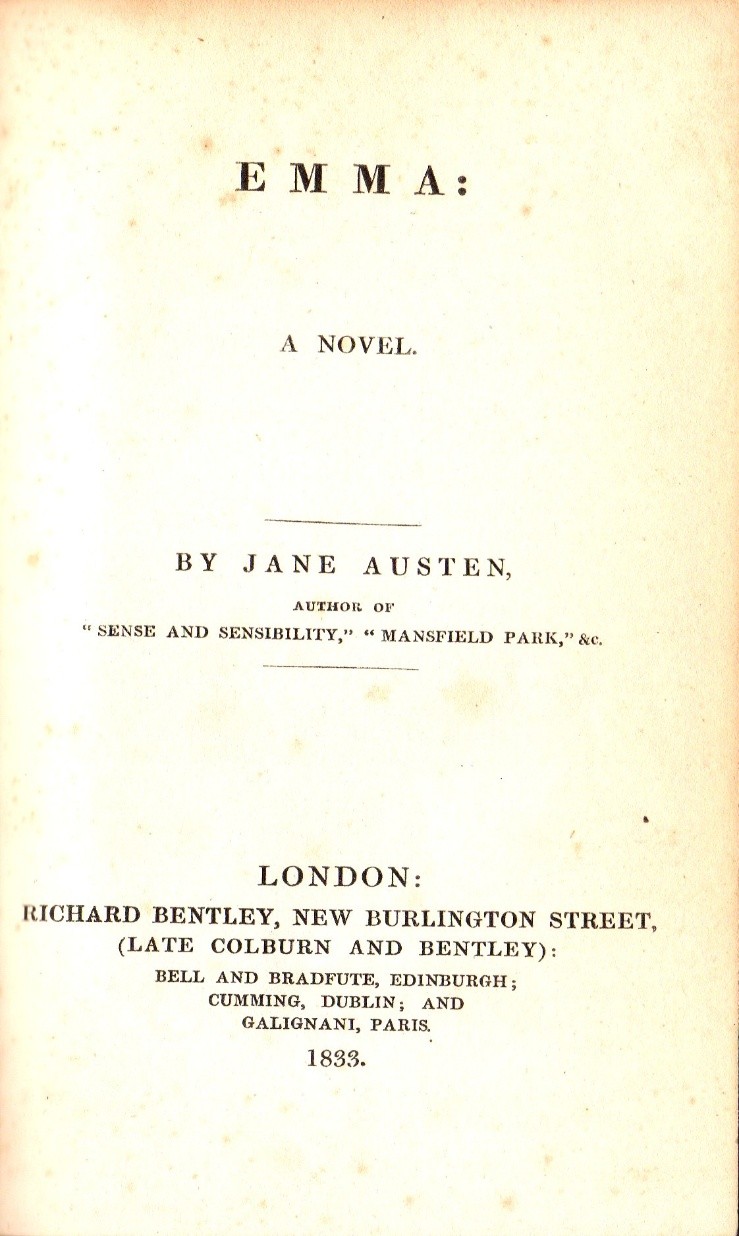
The format of Bentley’s Standard Novels was indeed standardised, so that each volume had a “series title page”, which identified it as a part of the Bentley’s Standard Novels series with a date of publication and a series number, a full page engraved frontispiece, an engraved title page, normally with an engraved date, and a letterpress or printed title page which had the title, authors name, Bentley’s name and address and a publication date. These four pages for first Bentley edition of Emma are shown in figure 1.
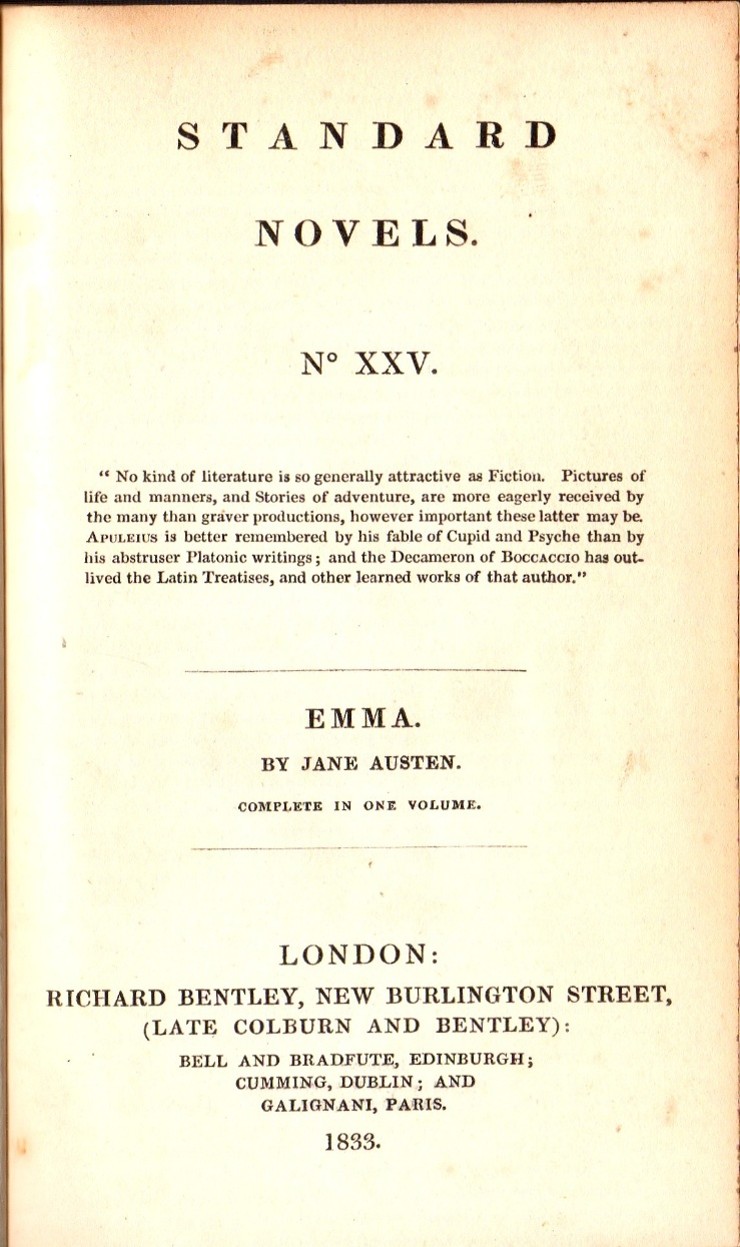
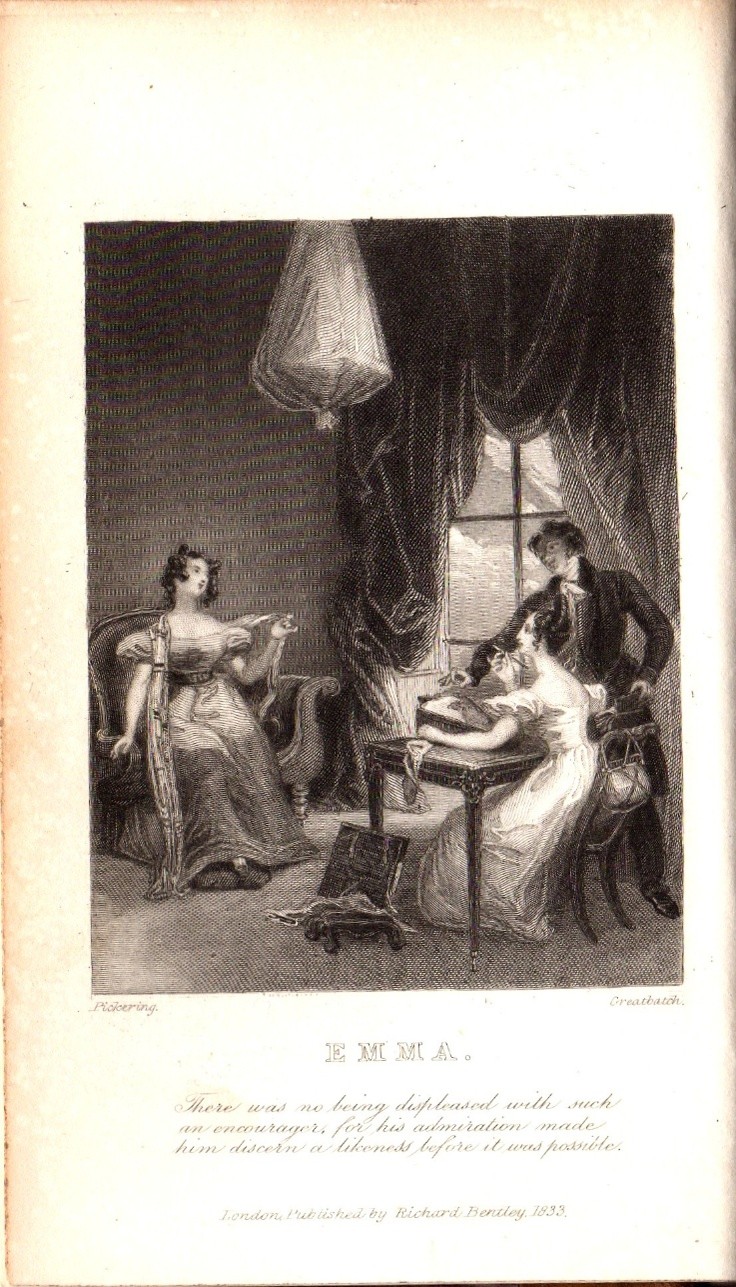
Figure 1. Series Title, Frontispiece, Engraved Title and Letterpress Title pages

Bentley published Emma in the same volume and chapter format as the original three volume first edition published by John Murray in December 1815. The novel starts with Emma | Volume the First | Chapter I. on page 1, and finishes Volume the First with the end of Chapter XVIII (18) on page 134 with the line “End of the First Volume”. Volume the Second begins with Chapter I of the second volume on page 135 and ends on page 279 at the end of Chapter XVIII (19) of the second volume, with the line “End of the Second Volume”. Volume the Third then begins on page 280 and the novel ends on page 435 with the last page of Chapter XIX (19) of Volume three with the simple words “The End”. By maintaining the volume and chapter structure of the first edition, Bentley has ensured that any sentence from any chapter of any book will be found in the same chapter and book in the Bentley edition as it was in the Murray first edition.

The book ends with the printer’s colophon on the verso of page 435. It reads “London: Printed by A. & R, Spottiswoode, New-street-Square.” on three lines. The only page missing from the Bentley edition of Emma is the dedication page that was included in the first edition of 1815, where Jane Austen dedicated Emma to the Prince Regent with these words: “To His Royal Highness, The Prince Regent, this work is, by His Royal Highness’s permission, most respectfully dedicated, by His Royal Highness’s dutiful and obedient humble servant, The Author.” It is not clear why Bentley chose not to include the dedication. It may be due to the fact that the Bentley edition of Emma was first published in 1833, in the reign of King William IV, younger brother and successor to the late, former Prince Regent, who had eventually reigned in his own right from 1820 to 1830 as King George IV. Perhaps respect to the present king outweighed respect to his predecessor.

Illustrations in Bentley’s 1833 edition of Emma

The two illustrations in this edition of Emma were drawn by Ferdinand Pickering (1810-1889) and engraved on wood by William Greatbatch (1802-1872). The identity of the artist had been uncertain for many years. The illustrations in Emma are clearly signed “Pickering”, which led David Gilson to suggest that they were by George Pickering (ca 1794-1857). However, other illustrations in the Standard Novel series that have many similarities of style to those in Emma are clearly signed “F. Pickering”, which has led to the corrected identification of Ferdinand Pickering as the artist. An enlarged version of the frontispiece is shown in Figure 2.
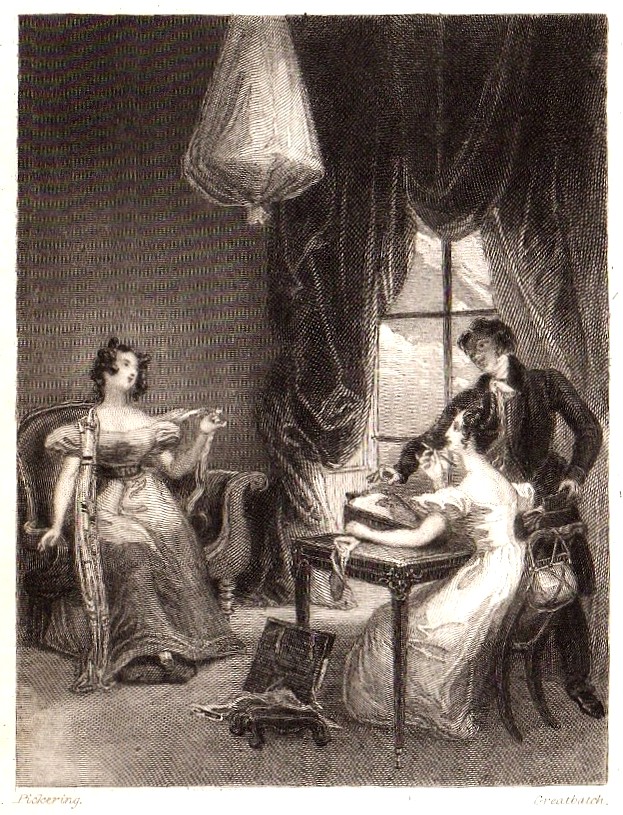
Figure 2. Frontispiece of Emma from Gilson D2.

The name “Pickering” can be clearly seen at the bottom left of the image and “Greatbatch” at the bottom right. The picture depicts Emma Woodhouse drawing a portrait of her friend Harriet Smith, while Mr. Elton is playing very close attention to Emma. The style of the costumes is from the 1830s rather than being correct for the late 18th century to Regency period. The legend of the frontispiece is shown below as Figure 3.
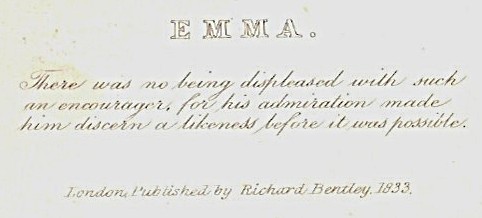
Figure 3. Text below the frontispiece of Emma

The text reads “There was no being displeased with such an encourager, for his admiration made him discern a likeness before it was possible.” It is a direct quotation from Chapter 6 of Emma. Mr. Elton is lavishing praise on Emma, who he greatly admires, despite Emma’s attempts to deflect his attentions to Harriet. The final line in a smaller font reads “London, Published by Richard Bentley. 1833.” This is the publisher asserting his ownership of the copyright of the image, which he commissioned from Pickering and Greatbatch.

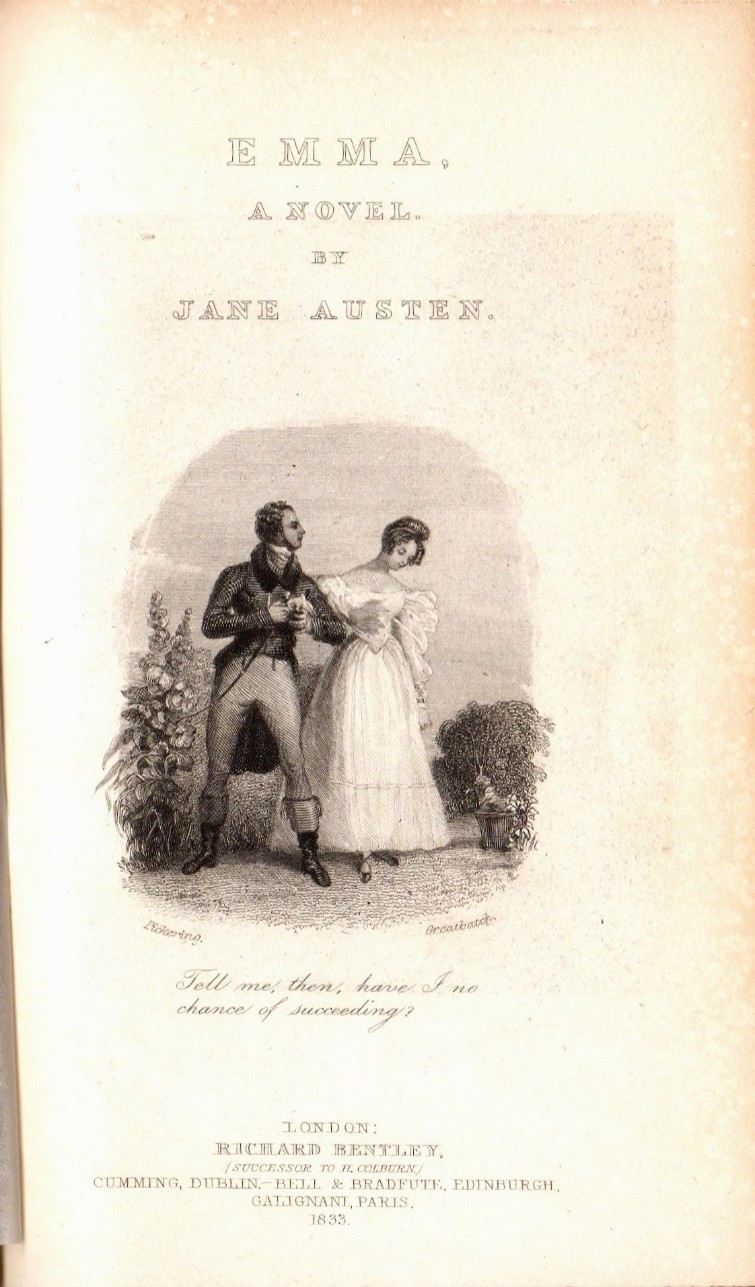
The engraved title page, together with an enlarged picture of the illustration, are shown below in Figure 4.

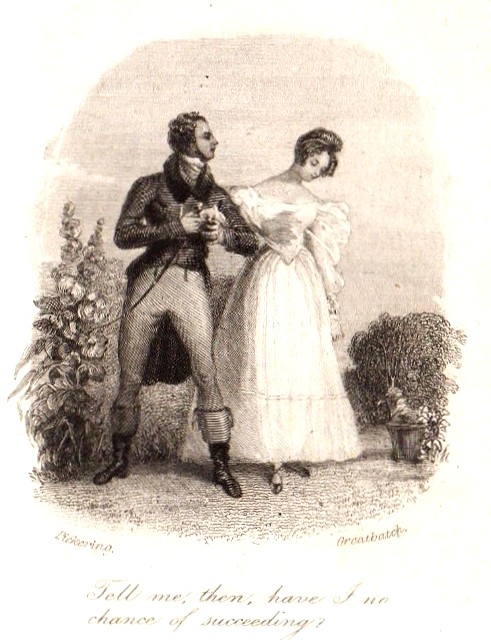
Figure 4. Engraved title page and vignette image from Emma

The engraved title page announces at the top that this is “EMMA. | A NOVEL. | BY | JANE AUSTEN.”. At the bottom of the page the publishers details are given thus: LONDON | RICHARD BENTLEY | (SUCESSOR TO H. COLBURN) | CUMMING, DUBLIN BELL & BRADFUTE, EDINBURGH | GALIGNANI, PARIS | 1833 . In the vignette, in the right hand panel, we see Emma out walking with Mr. Knightley, who has just declared his love for her. He then asks her “Tell me, then, have I no chance of succeeding?” which is the text below the image. This is taken directly from Chapter 49 of Emma. You can also see the names of Pickering and Greatbatch on the left and right lower corners of the image.

Reprints of the Bentley 1833 edition of Emma (Gilson D7)

Bentley’s edition of Emma was reprinted several times in the subsequent 35 years. Stereotype plates were created and used for reprints of Emma (Gilson D2) for the Standard Novels series that were published in 1836, 1841, 1851, and 1854. Emma was also reprinted as a part of five volume sets of “The Novels of Miss Austen” that were published in 1833, 1853, 1856 and 1866. All of the reprinted Bentley editions of the Austen novels were designated D7 by David Gilson. I have copies of the 1833, 1836 and 1854 issues of Emma and of the 1856 five volume set of the six novels. In Figure 5 below, I show the printed title pages for my Emma editions of 1836, 1854 and 1856. As well as having a different date from the 1833 edition, these are differences in the page layout, Bentley’s address and the Edinburgh and Dublin publisher’s details.
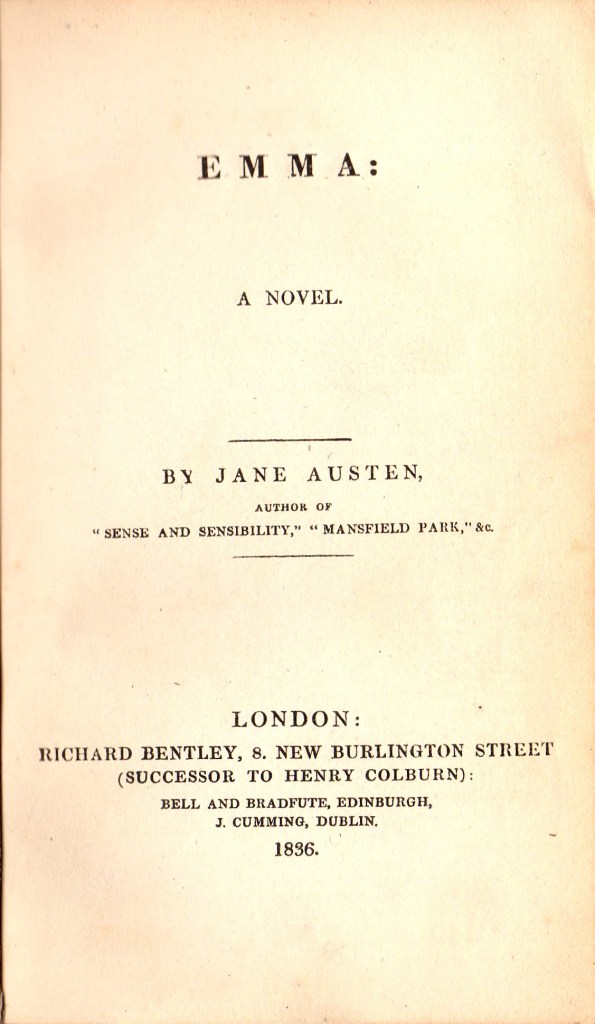
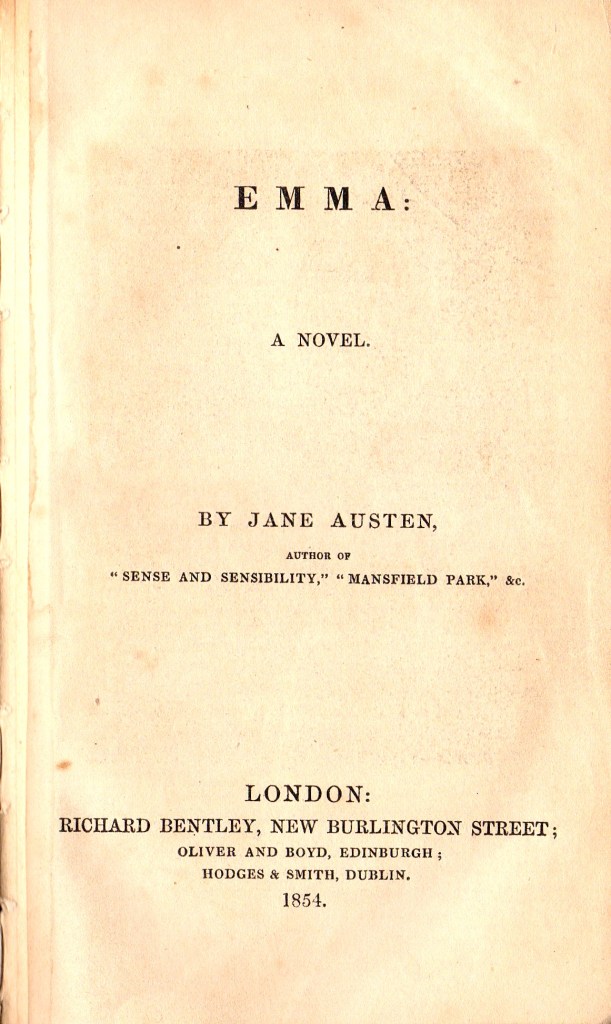
Figure 5. Emma Title pages from Gilson D7 editions of 1836, 1854 and 1856

All these three reprinted editions also contain the original engraved frontispiece from 1833. The 1836 and 1856 editions also contain the engraved title page that was first published in the 1833 edition, shown in Figure 1 above. The engraved pages all still show the date 1833.

The two Standard Novel reprints of 1836 and 1854 do not have a series title page, whereas the 1856 reprint from The Novels of Miss Austen set has a half title which just bears the single word “EMMA”. The page and chapter layout for the three reprinted editions are all identical to that of the 1833 first Bentley edition. However, the printers colophons on the verso of page 435 are all different from the 1833 edition. All editions have “London:” on the first line and “New-street-Square” on the third line but are all different in the second line. These are shown below.

  • 1833 edition: Printed by A.& R. Spottiswoode,
  • 1836 edition: Printed by A. Spotiswoode,
  • 1854 edition: A. & G. A. Spottiswoode,
  • 1856 edition: Printed by Spottiswoode and Co.,

Provenance of my Bentley Emma edition of 1854

In Figure 6 below, the front endpapers of my 1854 Bentley edition of Emma are shown. They show the provenance of this book in more recent years.

Figure 6. Front endpapers of my 1854 copy of Emma (Gilson D7)

The most obvious and prominent feature in Figure 6 is the bookplate of David John Gilson on the front pastedown. This is the Gilson who compiled the standard bibliography of Jane Austen and its is an absolute privilege for me to have this copy in my Austen collection. Gilson actually mentions this copy on page 229 of the Oak Knoll Press second edition of A Bibliography of Jane Austen. Above the Gilson bookplate there is an inscription in pencil which reads: ” D7: 1854 | Given to me by | David G | 3/8/85″. This was written by Gilson’s friend John Jordan, whose bookplate is on the lower right of the free front endpaper. The two other inscriptions are: “T. Lindsay, 1914″, doubtless a previous owner of the book, and the lower line which reads ” Rebound: Ferney-Voltaire; 1953″. The book is bound in an obviously 20th century ivory textured cloth binding.

Ferney-Voltaire is a small commune of around 10,000 in south-eastern France, close to the Swiss border. It was the residence of Voltaire from 1758-1778 and his Chateau can still be visited there. As well as the Voltaire museum in the Chateau Voltaire, there is a small workshop and museum of printing and bookbinding in Ferney-Voltaire called Atelier du Livre. It is currently run by an Englishman, Andrew Brown. This may be where the 1854 Emma was rebound in 1953, by a previous owner.

Return to the Index page for Illustrated Editions of Jane Austen.

The Routledge and Warne publishing families: Part 4

The start of Routledge’s Railway Library

George Routledge continued to operate as a publisher at 36 Soho Square through the mid 1840s, and published an eclectic mixture of titles, mainly reprints of English and American fiction and non-fiction. He continued to publish the very successful biblical commentaries of the American Reverend Barnes that he had started selling in the early 1840s. He introduced the world at large to the unconventional, socially-concerned fiction of Henry Cockton (1807-1853), by reprinting “The Life and Adventures of Valentine Fox, the Ventriloquist”, an expose of the parlous state of British mental asylums and lunacy laws, first published in 1840, and “The Life and Adventures of George St. Julien, the Prince of Swindlers” (1841). Both were first reprinted by Routledge in 1844. He was probably able to publish these books because of the bankruptcy of Cockton in 1842. Routledge continued to publish reprints of “Valentine Fox” for many years, and more than 400,000 copies of this now mostly forgotten title were published by the end of the 19th century.

Most of the Routledge reprints of Cockton’s books reproduced the illustrations by Thomas Onwhyn from the first editions. Onwhyn had gained notoriety following his publication of pirated versions of Charles Dickens’ Pickwick Papers and Nicholas Nickleby containing his own illustrations; Dickens famously complained of “the singular vileness of the illustrations.”

Routledge also published reprints of some of the novels of William Harrison Ainsworth during this period. Ainsworth, a friend and collaborator of Dickens, had come to the public’s notice with the publication by Richard Bentley of his first novel, “Rookwood”, in 1834. Just as with Cockton, Routledge republished Ainsworth’s novels with their original illustrations, many of which were by Dickens’ main illustrators, Cruikshank and “Phiz”.

George Cruikshank illustration from Ainsworth’s “The Tower of London” reprinted by Routledge

By the end of the 1840s, Routledge was trying to find a better way of publishing his reprints. He had noticed the reprinted novels published by Simms and McIntyre in Belfast in 1846 under the series title of “The Parlour Novels”, which in 1847 became “The Parlour Library”. These were low-price publications in attractive embossed cloth bindings. Routledge used to travel around the country selling his own books directly to provincial booksellers. He started doing this by stagecoach, but by the mid to late 1840s he travelled on the rapidly-developing British railway system, which had become both extensive and cheap in the period 1835-1845. During these journeys, he noticed the growing popularity of reading on trains, an activity which had become possible due to the much smoother ride that the railway offered, compared to the stagecoach.

Routledge put these two observations together and decided to produce high quality but low-cost reprints, specifically targeted at the growing population of railway travellers. This became Routledge’s Railway Library, which was launched in 1849. The books were mainly sold by the bookseller W.H. Smith, who had developed the first bookstalls in British railway stations in 1848. Routledge’s Railway Library was a huge success, and although it was soon copied by other publishers, it was the financial making of George Routledge. The series was launched with about a dozen titles available in 1849. By 1898, when the series ended, more than 1270 titles had been published in the Routledge Railway Library series.

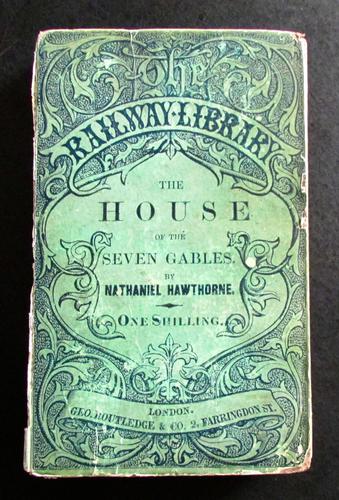
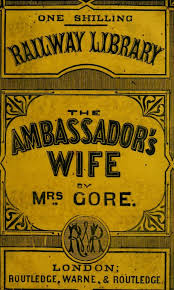
The changing styles of the card-bound books issued as part of the Railway Library over its first fifteen years are illustrated above. The left-hand panel shows James Fenimore Cooper’s “The Pilot”, published in 1849 as the first book in the series. The British copyright for Fenimore Cooper was held by Richard Bentley at this time, but Routledge ignored this, and in fact published six Fenimore Cooper titles in his first ten Railway Library books. Later on, after the success of the Railway Library had been assured, Routledge belatedly paid Bentley his royalties for the copyright infringements, and entered into an arrangement with Bentley to reprint thirty-six of Bentley’s Standard Novels as Routledge’s Standard Novels, a series that ran from 1851 to 1860.

The middle panel shows another American book, this time by Nathaniel Hawthorne, reprinted by Routledge in the Railway Library series in 1852. You can see that by this time, the success of the Railway Library had allowed Routledge to move his publishing business to 2 Farringdon Street, a much better address than 36 Soho Square, although Soho Square remained the family home until the late 1850s. The business move to Farringdon St. happened in the second half of 1851.

In the right-hand panel, we can see that by 1863, the firm had matured into Routledge, Warne and Routledge, by the inclusion into the partnership of George Routledge’s brother in law, Frederick Warne, and Routledge’s eldest son Robert Warne Routledge. The firm was still operating at 2 Farringdon Street at this time, and the book shown is by an English author, Mrs. Catherine Gore, who was one of the most prolific and popular writers of the 19th century. Her obituary in The Times in 1861 described her as “the best novel writer of her class and the wittiest woman of her age.”

Note that the price of the Railway Library books had been kept at one shilling for all three of these books issued over a 14 year period. The basic price remained at one shilling for the card-bound books until the 1870s, although cloth-bound versions, which shamelessly copied the binding style of the Simms and McIntyre Parlour Library, were also available at 1s 6d.

The first ten books issued in the Railway Library series were:

1The PilotJames Fenimore Cooper
2Jane SinclairWilliam Carleton
3The Last of the MohicansJames Fenimore Cooper
4The PioneersJames Fenimore Cooper
5The PrairieJames Fenimore Cooper
6The Dutchman’s FiresideJames Kirke Paulding
7The SpyJames Fenimore Cooper
8Sense and SensibilityJane Austen
9The Water WitchJames Fenimore Cooper
10Pride and PrejudiceJane Austen

An almost complete list of the first 100 titles can be found here.

The success of The Railway Library series encouraged George Routledge to take a considerable financial gamble in 1853. On December 27th of that year, he signed a contract with the author Sir Edward Bulwer Lytton for the right for ten years to publish reprints of nineteen of Lytton’s novels in The Railway Library series, for what Routledge described as “the immense sum of twenty thousand pounds.” It turned out to be a successful investment, so much so that when the contract expired in 1863, Routledge agreed to pay a further ten thousand pounds to extend the publication rights for another ten years. The outcome of these arrangements is that novels by Sir Edward, later Lord Lytton, are the commonest titles from Routledge’s Railway Library to be found in the secondhand book world today.

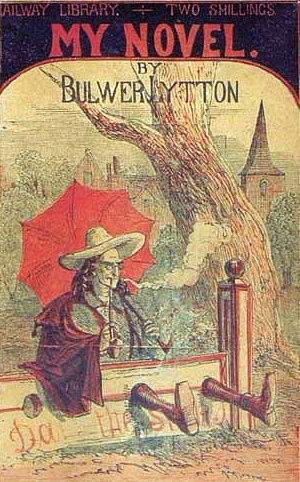
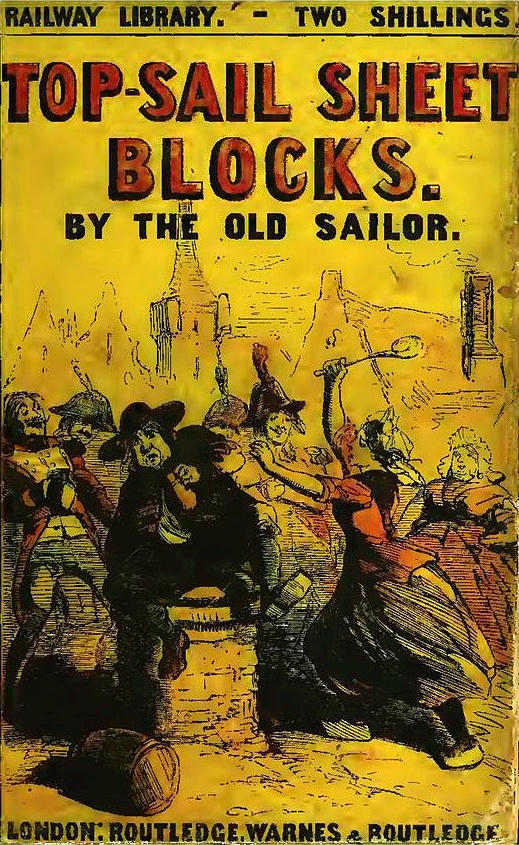
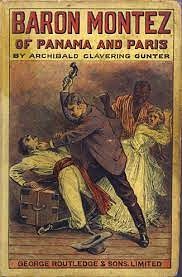
In later years, the appearance of the Railway Library series continued to change. By the mid 1850’s the very popular “Yellowback” binding style had been adopted by Routledge for the Railway Library, which made the books look rather similar to books from several other publishers of cheap reprints at that time. Some examples of these Routledge Railway Library Yellowbacks, which were priced at 2 shillings, are shown below.

In the next installment of this series I will look at the changes that occurred in George Routledge’s family and his business in the years 1850 to 1870.

The Routledge and Warne publishing families: Part 3

Starting out together in the book trade.

In Part 1 of this series, the Cumberland origins of George Routledge and how he started as a Soho bookseller are described. In Part 2, the Gloucestershire origins of the Warne family and how Frederick Warne became a neighbour of George Routledge is explained. This post, Part 3, will cover how the Routledge and Warne families started working together in the book trade.

The Beginnings of George Routledge, Publisher

George Routledge arrived in London in October 1833, having just completed his apprenticeship as a bookseller in Carlisle. He rented 11 Ryder’s Court in Soho as his home. For the next three years, he worked for an established bookseller/publisher, Baldwin and Craddock of Paternoster Row. In September 1836, following the failure of the firm of Baldwin and Craddock, George Routledge set himself up as a bookseller at 11 Ryder’s Court. He published his first book from that address just before the end of 1836.

In 1827, Frederick Warne, then aged 2, together with his five year old brother, William Henry Warne (1822-1859) moved with their parents and siblings from 5 Ryder’s Court to live literally just around the corner at 41 Lisle Street where Frederick was to remain until 1852. The move allowed his father Edmund to separate his family home from his business by also renting 42 Lisle Street as a workshop and showroom. The first known interaction between the Warne family and George Routledge was the witnessing of the will of Frederick’s oldest and short-lived brother Robert Alexander Warne (1808-1834) by George Routledge in 1834. This was followed by three other much more significant events.

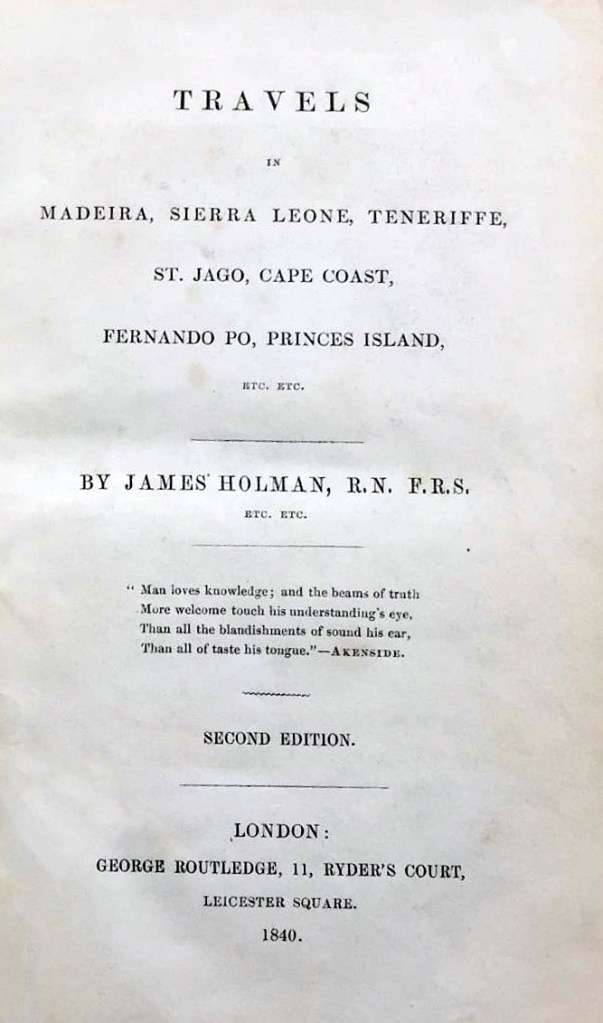
Shortly after he opened his bookshop at 11 Rider’s Court in 1836, George Routledge engaged the fourteen year old William Henry Warne as his assistant and apprentice. Although the main business from 11 Ryder’s Court was selling books, George Routledge began to publish books in 1836 and these early Routledge publications from Ryder’s Court are now very scarce. Shown below are two early Routledge title pages, both published from Ryder’s Court in 1840.

It was very common in the 18th and 19th century for booksellers to become publishers. This made a lot of sense, as it provided a ready supply of books for sale, both through retail via a bookshop, but also to the wholesale market, the circulating libraries and within the book trade to other booksellers. These last three activities helped to mitigate some of the economic risks of publishing. Sometimes two or more booksellers would combine to publish a book in order to share the risks, and the profits.

George Routledge marries.

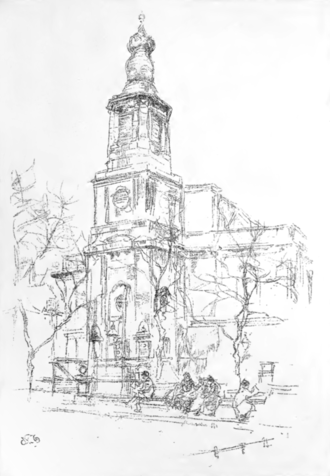
The ties between the Warne family and George Routledge became even closer on 25th January 1837, when George Routledge married Marie Elizabeth Warne (1814-1855), the sister of Frederick and William Henry Warne. The wedding took place at the church of St. Anne’s Soho, in Westminster. This was the local parish church for the Warne family and for George Routledge and, despite being largely destroyed in 1940 in the Blitz, it was rebuilt and is still the parish church today.

St Anne’s Soho in the 19th century by J. McN. Whistler

In 1839, the links between the Warne family and George Routledge strengthened, when the fourteen year old Frederick Warne joined his older brother William Henry as an assistant to George Routledge, bookseller. George and Marie Routledge lived above the bookshop at 11 Ryder’s Court, where the first four of their eight children were born. These included the two oldest sons of George Routledge, Robert Warne Routledge (1837-1899) and Edmund Routledge (1843-1899), who were both to play important parts in Routledge publishing history.

36 Soho Square

In May 1843, the Routledge family and business were still at 11 Ryder’s Court. Sometime in the second half of 1843, George Routledge, his wife and four children, and business, all moved from Ryder’s Court to much larger premises at 36 Soho Square, about 300 metres north of Ryder’s Court. George continued to refer to himself as a bookseller for the next few years, but gradually changed his description in the later 1840s to “Bookseller and Publisher”.

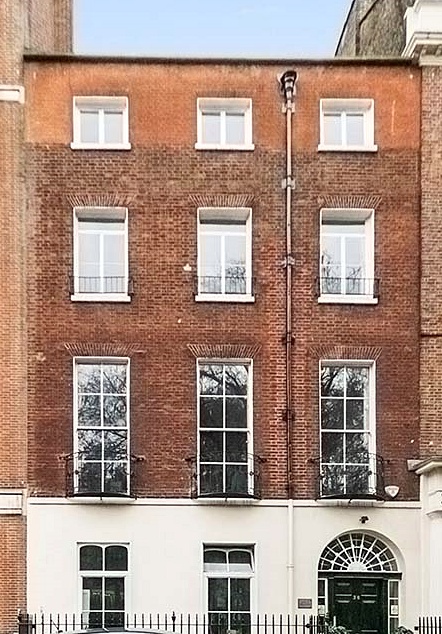
The next three Routledge children, Maria, William Henry and George, were all born at 36 Soho Square. The building has survived in good shape into the 21st century, where it is a Grade II listed building that is rented for office space. For much of the 20th century, it housed the music publishing department of Oxford University Press. It clearly provided good accommodation in the upper floors for a growing family, while providing the bookshop and publishing spaces on the ground floor.

36 Soho Square today

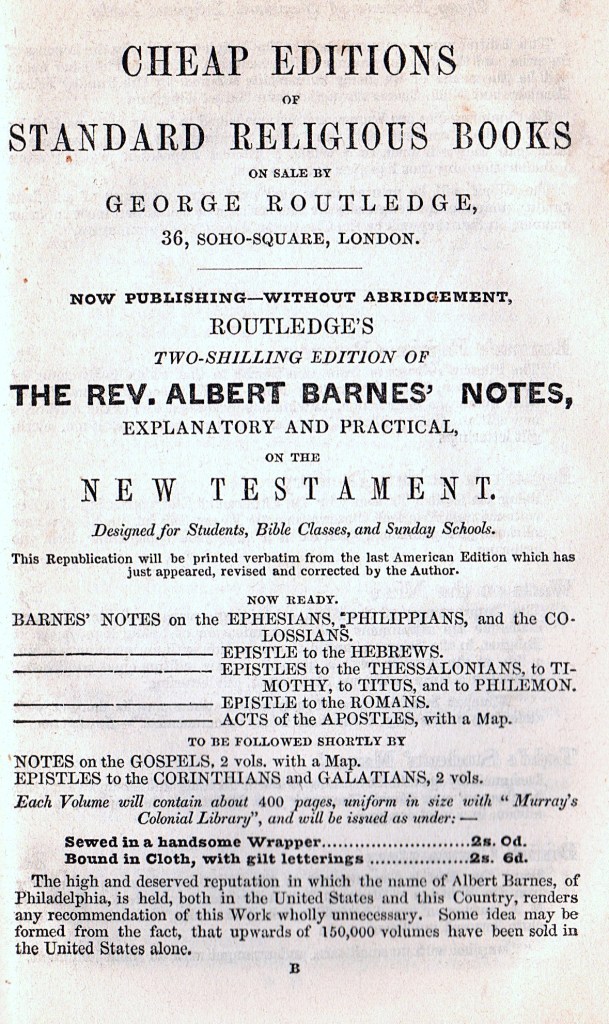
The page below is from one of the most profitable series of books published by Routledge from Soho Square in the 1840s. It is one of twenty-one volumes of Rev. Albert Barnes’ commentaries on the bible. Barnes was an American pastor who was a prolific author of religious books. Routledge published all 21 volumes of Barnes’ commentaries, starting in 1845. The page shown is an advertisement for the series from my copy of the Thessalonians commentary published in 1846.

Advertisement page from 1846

In Part 4 of this series of posts, the development and expansion of Routledge’s publishing activities from 1845 to 1865 will be discussed.