1833 Emma; 2nd UK edition

Richard Bentley, London, Gilson D2

The first edition of Emma, the fourth novel to be published by Jane Austen, was published in 3 volumes in December 1815 by John Murray. Like all of the first editions of Austen it was not illustrated. It was the first Austen title published by John Murray, following some dissatisfaction with Thomas Egerton, who had published the first three Austen novels. The first edition of Emma was issued as 2000 copies, which all sold within one year of publication. Following Jane Austen’s death on 18th July 1817, John Murray resisted efforts by the Austen family, notably the author’s brother Henry and sister Cassandra, to publish a second edition of Emma.

Richard Bentley (1794-1871) had been born into a distinguished family of three generations of printers and publishers. After initially working in partnership with his brother Samuel as “S. and R. Bentley” for ten years, Richard formed a new partnership with Henry Colburn in 1829. Colburn and Bentley had started to publish a series of cheap, illustrated reprints of English novels as “Colburn and Bentley’s Standard Novels” in 1831. They offered reprints of novels in a single volume for six shillings. Each volume had two illustrations, an engraved frontispiece illustration and an engraved title page which had a smaller “vignette” illustration. The first novel in the series was The Pilot by James Fennimore Cooper, published in February 1831 and the highlight of the early titles was Frankenstein by Mary Shelley published on 31st October 1831. After an acrimonious dissolution of the partnership in mid-1832, by which point 19 Standard Novels had been printed and published, Richard Bentley continued with his own series of “Standard Novels”.

Emma, along with the other five novels of Jane Austen that had been published between 1811 and 1817, did not appear in a new English edition until Richard Bentley decided to reprint all of the Austen novels as “Standard Novels” in 1832. Emma was published by Richard Bentley on 27th February 1833, following his purchase of the Austen copyrights from Cassandra Austen via Henry Austen. Emma was numbered “XXV” (25 ) in the Standard Novel series. It was the second edition of Emma to be published in the UK, the first single volume edition, the first edition to have any illustrations and the first to have Jane Austen’s name as author on the title page(s). It was the second of Austen’s novels to be published by Bentley, following Sense and Sensibility (Gilson D1), which was published as Standard Novel number XXIII (23) on 28th December 1932, although it was dated 1833. Standard Novel XXIV (24) was a translation of Madame de Stael’s Corinne, which appeared on February 1st 1833.

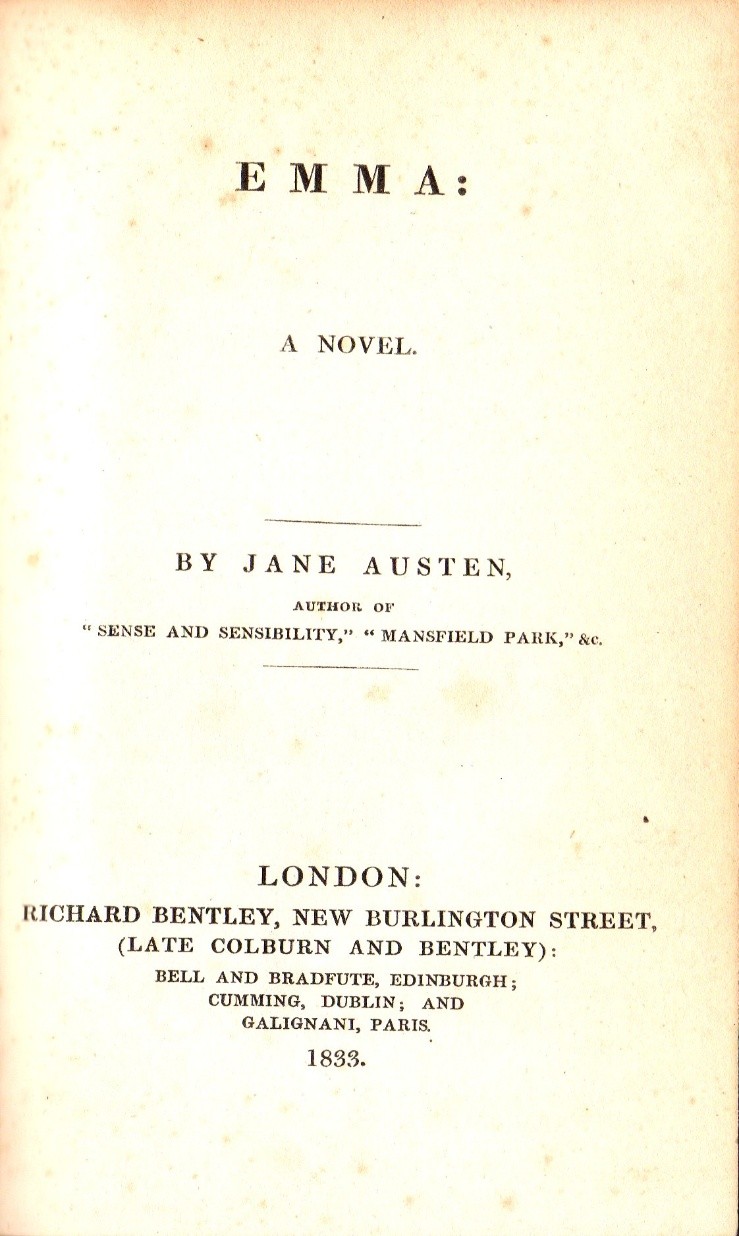
The format of Bentley’s Standard Novels was indeed standardised, so that each volume had a “series title page”, which identified it as a part of the Bentley’s Standard Novels series with a date of publication and a series number, a full page engraved frontispiece, an engraved title page, normally with an engraved date, and a letterpress or printed title page which had the title, authors name, Bentley’s name and address and a publication date. These four pages for first Bentley edition of Emma are shown in figure 1.
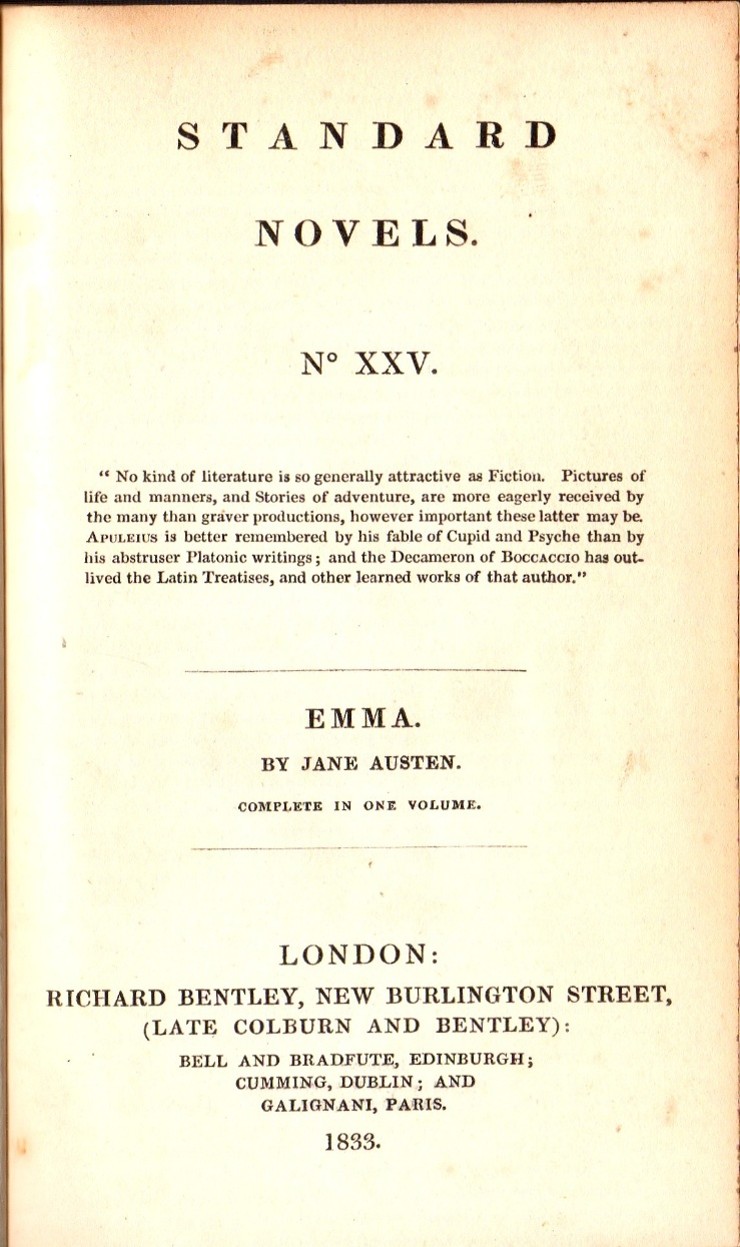
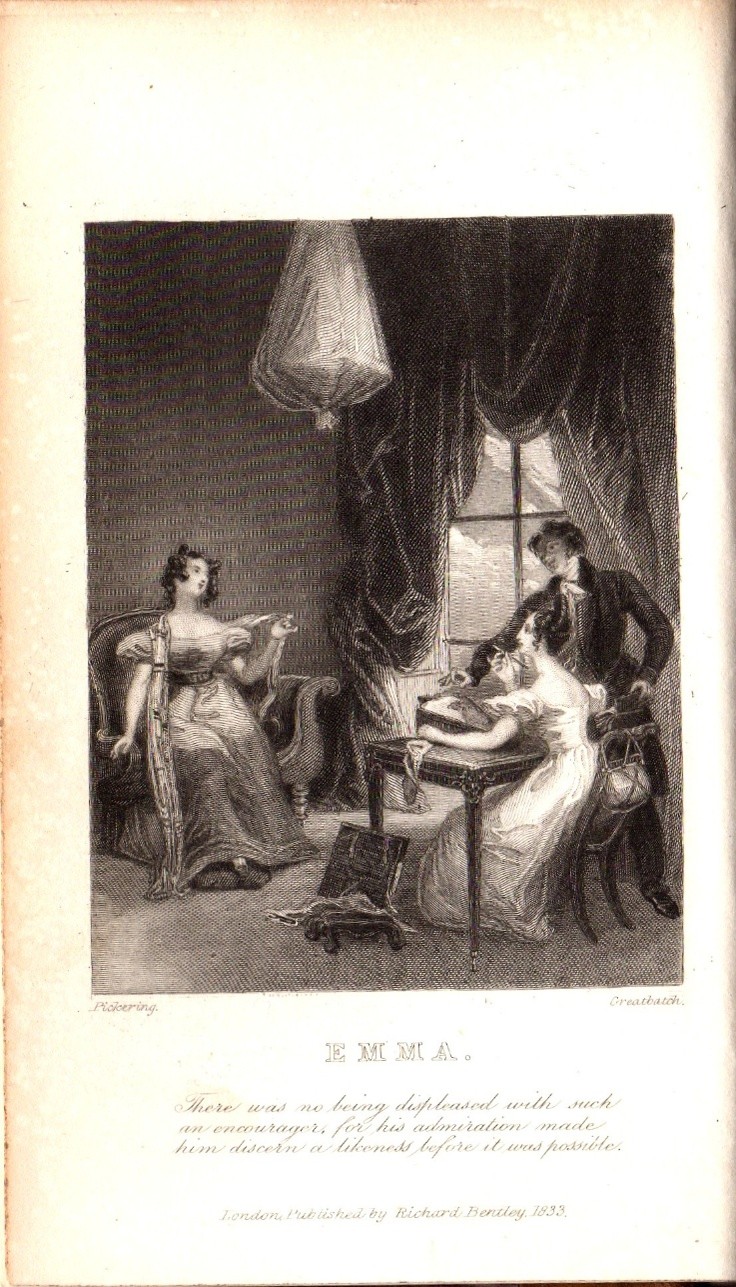
Figure 1. Series Title, Frontispiece, Engraved Title and Letterpress Title pages

Bentley published Emma in the same volume and chapter format as the original three volume first edition published by John Murray in December 1815. The novel starts with Emma | Volume the First | Chapter I. on page 1, and finishes Volume the First with the end of Chapter XVIII (18) on page 134 with the line “End of the First Volume”. Volume the Second begins with Chapter I of the second volume on page 135 and ends on page 279 at the end of Chapter XVIII (19) of the second volume, with the line “End of the Second Volume”. Volume the Third then begins on page 280 and the novel ends on page 435 with the last page of Chapter XIX (19) of Volume three with the simple words “The End”. By maintaining the volume and chapter structure of the first edition, Bentley has ensured that any sentence from any chapter of any book will be found in the same chapter and book in the Bentley edition as it was in the Murray first edition.

The book ends with the printer’s colophon on the verso of page 435. It reads “London: Printed by A. & R, Spottiswoode, New-street-Square.” on three lines. The only page missing from the Bentley edition of Emma is the dedication page that was included in the first edition of 1815, where Jane Austen dedicated Emma to the Prince Regent with these words: “To His Royal Highness, The Prince Regent, this work is, by His Royal Highness’s permission, most respectfully dedicated, by His Royal Highness’s dutiful and obedient humble servant, The Author.” It is not clear why Bentley chose not to include the dedication. It may be due to the fact that the Bentley edition of Emma was first published in 1833, in the reign of King William IV, younger brother and successor to the late, former Prince Regent, who had eventually reigned in his own right from 1820 to 1830 as King George IV. Perhaps respect to the present king outweighed respect to his predecessor.

Illustrations in Bentley’s 1833 edition of Emma

The two illustrations in this edition of Emma were drawn by Ferdinand Pickering (1810-1889) and engraved on wood by William Greatbatch (1802-1872). The identity of the artist had been uncertain for many years. The illustrations in Emma are clearly signed “Pickering”, which led David Gilson to suggest that they were by George Pickering (ca 1794-1857). However, other illustrations in the Standard Novel series that have many similarities of style to those in Emma are clearly signed “F. Pickering”, which has led to the corrected identification of Ferdinand Pickering as the artist. An enlarged version of the frontispiece is shown in Figure 2.
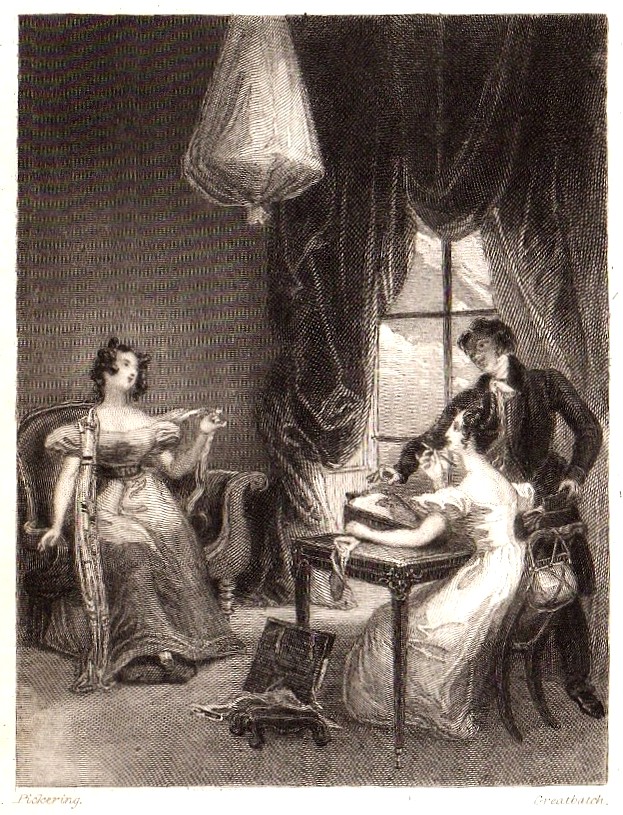
Figure 2. Frontispiece of Emma from Gilson D2.

The name “Pickering” can be clearly seen at the bottom left of the image and “Greatbatch” at the bottom right. The picture depicts Emma Woodhouse drawing a portrait of her friend Harriet Smith, while Mr. Elton is playing very close attention to Emma. The style of the costumes is from the 1830s rather than being correct for the late 18th century to Regency period. The legend of the frontispiece is shown below as Figure 3.
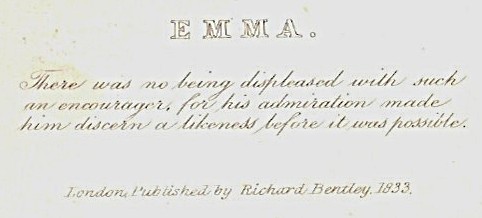
Figure 3. Text below the frontispiece of Emma

The text reads “There was no being displeased with such an encourager, for his admiration made him discern a likeness before it was possible.” It is a direct quotation from Chapter 6 of Emma. Mr. Elton is lavishing praise on Emma, who he greatly admires, despite Emma’s attempts to deflect his attentions to Harriet. The final line in a smaller font reads “London, Published by Richard Bentley. 1833.” This is the publisher asserting his ownership of the copyright of the image, which he commissioned from Pickering and Greatbatch.

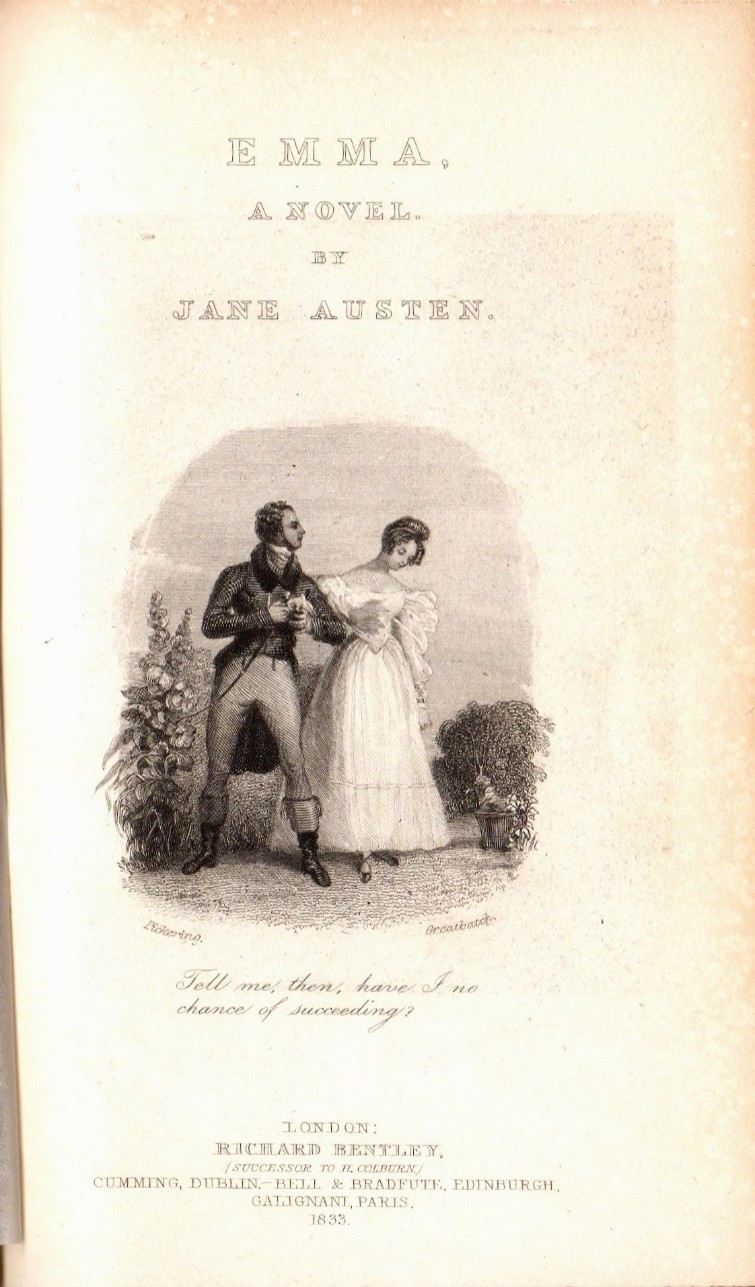
The engraved title page, together with an enlarged picture of the illustration, are shown below in Figure 4.

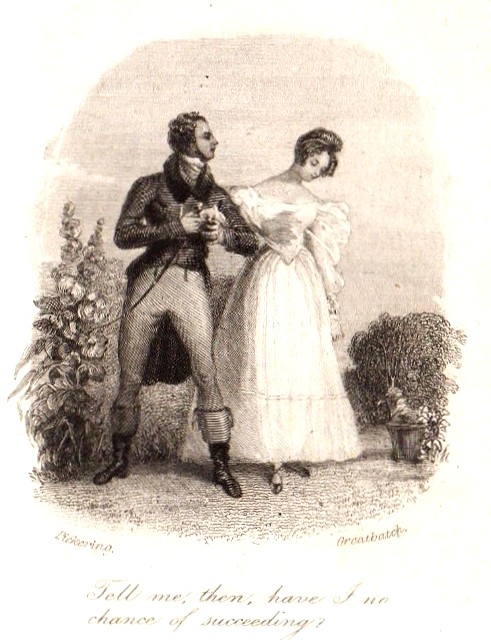
Figure 4. Engraved title page and vignette image from Emma

The engraved title page announces at the top that this is “EMMA. | A NOVEL. | BY | JANE AUSTEN.”. At the bottom of the page the publishers details are given thus: LONDON | RICHARD BENTLEY | (SUCESSOR TO H. COLBURN) | CUMMING, DUBLIN BELL & BRADFUTE, EDINBURGH | GALIGNANI, PARIS | 1833 . In the vignette, in the right hand panel, we see Emma out walking with Mr. Knightley, who has just declared his love for her. He then asks her “Tell me, then, have I no chance of succeeding?” which is the text below the image. This is taken directly from Chapter 49 of Emma. You can also see the names of Pickering and Greatbatch on the left and right lower corners of the image.

Reprints of the Bentley 1833 edition of Emma (Gilson D7)

Bentley’s edition of Emma was reprinted several times in the subsequent 35 years. Stereotype plates were created and used for reprints of Emma (Gilson D2) for the Standard Novels series that were published in 1836, 1841, 1851, and 1854. Emma was also reprinted as a part of five volume sets of “The Novels of Miss Austen” that were published in 1833, 1853, 1856 and 1866. All of the reprinted Bentley editions of the Austen novels were designated D7 by David Gilson. I have copies of the 1833, 1836 and 1854 issues of Emma and of the 1856 five volume set of the six novels. In Figure 5 below, I show the printed title pages for my Emma editions of 1836, 1854 and 1856. As well as having a different date from the 1833 edition, these are differences in the page layout, Bentley’s address and the Edinburgh and Dublin publisher’s details.
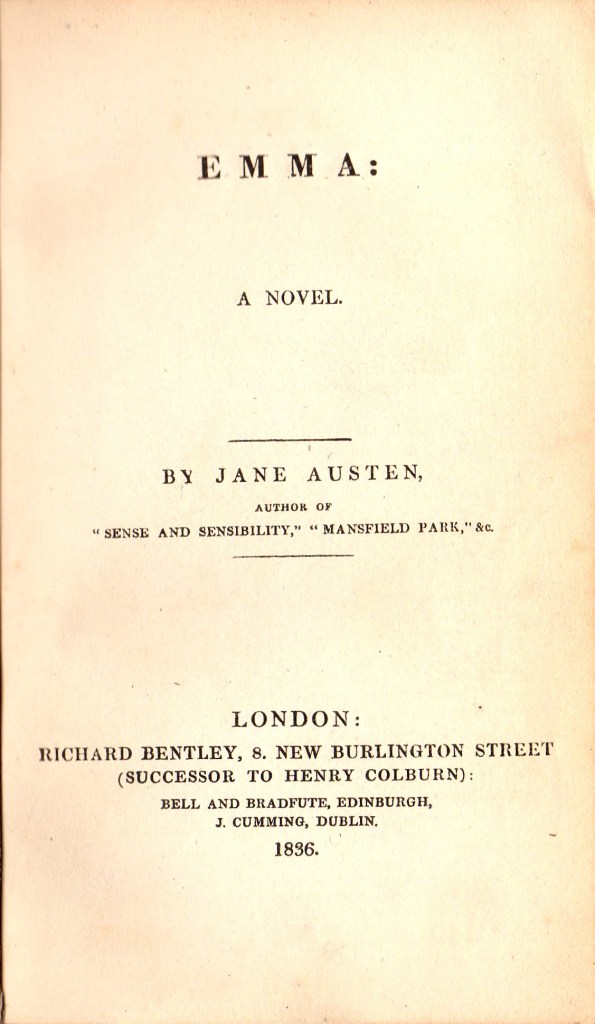
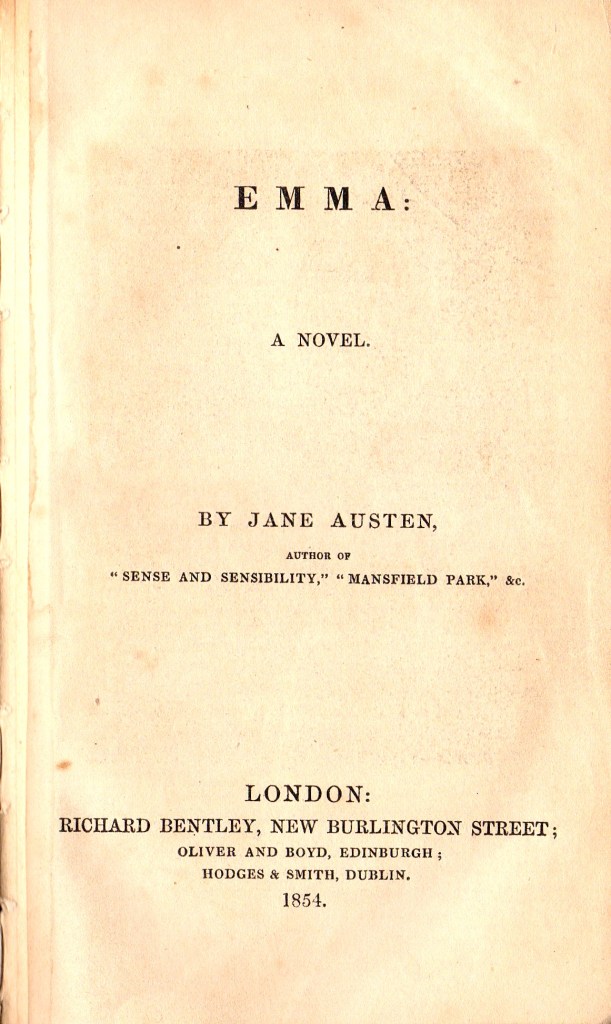
Figure 5. Emma Title pages from Gilson D7 editions of 1836, 1854 and 1856

All these three reprinted editions also contain the original engraved frontispiece from 1833. The 1836 and 1856 editions also contain the engraved title page that was first published in the 1833 edition, shown in Figure 1 above. The engraved pages all still show the date 1833.

The two Standard Novel reprints of 1836 and 1854 do not have a series title page, whereas the 1856 reprint from The Novels of Miss Austen set has a half title which just bears the single word “EMMA”. The page and chapter layout for the three reprinted editions are all identical to that of the 1833 first Bentley edition. However, the printers colophons on the verso of page 435 are all different from the 1833 edition. All editions have “London:” on the first line and “New-street-Square” on the third line but are all different in the second line. These are shown below.

  • 1833 edition: Printed by A.& R. Spottiswoode,
  • 1836 edition: Printed by A. Spotiswoode,
  • 1854 edition: A. & G. A. Spottiswoode,
  • 1856 edition: Printed by Spottiswoode and Co.,

Provenance of my Bentley Emma edition of 1854

In Figure 6 below, the front endpapers of my 1854 Bentley edition of Emma are shown. They show the provenance of this book in more recent years.

Figure 6. Front endpapers of my 1854 copy of Emma (Gilson D7)

The most obvious and prominent feature in Figure 6 is the bookplate of David John Gilson on the front pastedown. This is the Gilson who compiled the standard bibliography of Jane Austen and its is an absolute privilege for me to have this copy in my Austen collection. Gilson actually mentions this copy on page 229 of the Oak Knoll Press second edition of A Bibliography of Jane Austen. Above the Gilson bookplate there is an inscription in pencil which reads: ” D7: 1854 | Given to me by | David G | 3/8/85″. This was written by Gilson’s friend John Jordan, whose bookplate is on the lower right of the free front endpaper. The two other inscriptions are: “T. Lindsay, 1914″, doubtless a previous owner of the book, and the lower line which reads ” Rebound: Ferney-Voltaire; 1953″. The book is bound in an obviously 20th century ivory textured cloth binding.

Ferney-Voltaire is a small commune of around 10,000 in south-eastern France, close to the Swiss border. It was the residence of Voltaire from 1758-1778 and his Chateau can still be visited there. As well as the Voltaire museum in the Chateau Voltaire, there is a small workshop and museum of printing and bookbinding in Ferney-Voltaire called Atelier du Livre. It is currently run by an Englishman, Andrew Brown. This may be where the 1854 Emma was rebound in 1953, by a previous owner.

Return to the Index page for Illustrated Editions of Jane Austen.

1821 La Famille Elliot.

First Illustrated Austen Novel

Published by Arthus Bertrand, Paris. 2 vols. Gilson C12

Illustrated by Charles-Abraham Chasselat

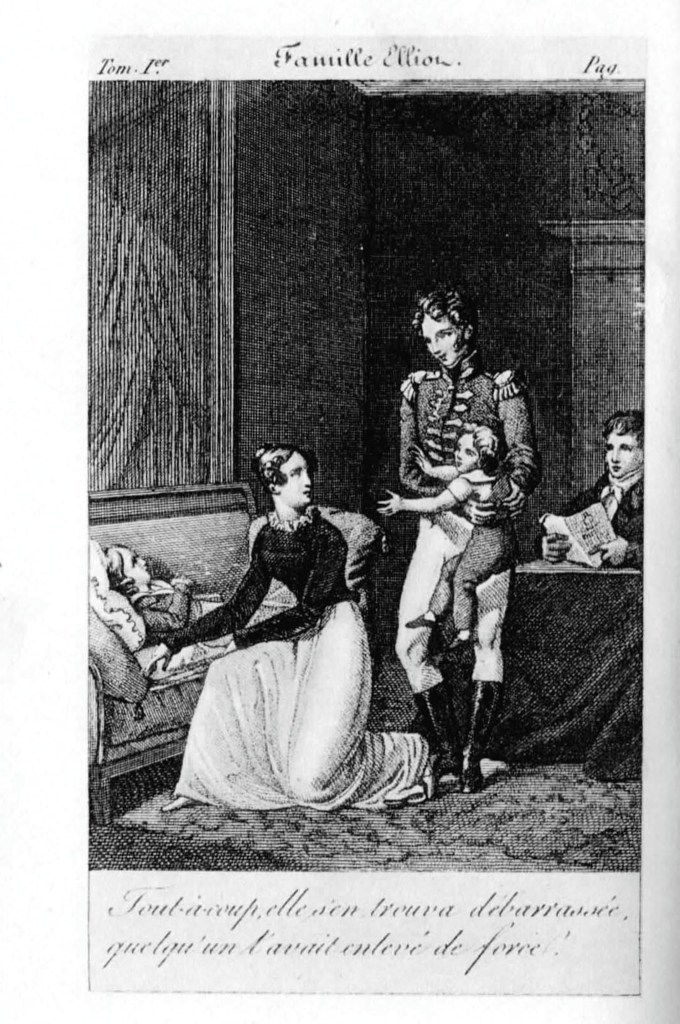
It seems ironic that the first illustrated edition of any novel by Jane Austen, that most English of authors, was published in France, but here it is. The first editions of the canonic six great novels of Jane Austen were published in London between 1811 and 1817 without any illustrations. Following Austen’s death in July 1817 and the posthumous publication of Northanger Abbey and Persuasion by John Murray in December 1817, there were no further editions of Austen’s novels published in Britain for 15 years. However in 1821, four years after the author’s death, a French translation of Persuasion was published by Arthus Bertrand in Paris in two volumes, under the title “La Famille Elliot” which translates to “The Elliot Family” in English. Each volume has a frontispiece illustration by Charles-Abraham Chasselat (1782-1843), a well-known painter of historical subjects, who also illustrated books by Voltaire, Racine and Moliere. The engraver of these frontispieces is given as “Delvaux”, which was Auguste Delvaux, (1786-1836), who was one of a pair of brothers, both of whom were fine engravers. Figure 1 shows the title page from volume 1 and the two frontispieces from La Famille Elliot.

Figure 1. Title page of Vol. 1 (left), frontispieces of Vol. 1 (centre) and Vol. 2 (right).

The title page headings read as follows (in French followed by English):

La Famille Elliot ou L’Ancienne Inclination. —– The Elliot Family or The Old Inclination

Traduction Libre de L’Anglais ———- Free Translation from English

D’Un Roman Posthume de Miss Jane Austen ——-From a posthumous novel by Jane Austen

Par Mme de Montolieu —— By Madame (Isabelle) de Montolieu.

This 1821 edition of a translation of Jane Austen’s Persuasion is not only the first Austen novel to have any illustrations; it is also the first time that the name “Jane Austen” is printed on the title page of any of her novels.

The translator, Madame de Montolieu had been born Jeanne-Isabelle-Pauline Polier de Botten in Lausanne in the French speaking part of Switzerland in 1751. After her first husband, Benjamin de Crousaz, has died in 1775, the year of Jane Austen’s birth, she remarried Baron Louis de Montolieu in 1786. After the baron died in 1800, she lived on for more than 30 years as a widow, publishing under the names Madame de Montolieu, Isabelle de Montolieu or La Baronne Isabelle de Montolieu, until her death in 1832. Her other translation of an Austen novel was Raison et Sensibilité, which was also published by Arthus Bertrand in Paris in 1815. This four volume edition was not illustrated, but a second edition in three volumes was published in 1828 with three frontispieces by the same illustrator as La Famille Elliot.

Legends for the two Frontispieces

The frontispiece to Volume One of La Famille Elliot has a text caption below the image which identifies the incident depicted. It reads: “Tout à coup elle s’en trouva debarrasseé, quelqu’ un l’avait enlevé de force.” This can be translated as: “Suddenly she found herself free of him; someone had taken him by force.” This refers to an incident where Anne Elliot is consoling her nephew Charles Musgrove, who is ill, but while she is trying to do this, Charles’ younger brother Walter Musgrove is climbing all over Anne’s back to get some attention, and is making a nuisance of himself. Captain Wentworth removes Walter Musgrove from Anne Elliot’s back. (Persuasion, Vol 1, Chapter IX p80.) This incident demonstrates the protective care that Wentworth feels that he should offer the young woman who he admires.

The frontispiece to Volume Two of La Famille Elliot also has a text caption below the image which identifies the incident depicted. It reads: “Il s’approcha de la table, montre la lettre à Alice, et sortit sans dire un mot!” This is easily translated to “He walked over to the table, showed Alice the letter, and left without saying a word!” This is the incident towards the end of the story, where Captain Wentworth presents a letter to Anne Elliot to explain his feelings (Persuasion, Vol 2, Chapter XI, p. 236).

You will note that the text refers to Anne Elliot as “Alice”. For some reason, the only name that Mme. de Montolieu alters in the book is Anne Elliot, who she renames Alice Elliot. Ironically, the translator has chanced upon the correct title for the book, as we learn from Jane Austen’s letters, published more than 50 years after the death of Mme. de Montolieu, that her working name for Persuasion was “The Elliot Family.” The name Persuasion was almost certainly coined by Jane Austen’s brother Henry Austen, who arranged the posthumous publication of the text by John Murray in 1817.

La Famille Elliot was reissued by Arthus Bertrand in 1828 in a complete edition of the works of Mme. de Montolieu. The text and illustrations were retained from the 1821 edition.

Return to the Index page for Illustrated Editions of Jane Austen.
Illustrated editions of Jane Austen

A summary and list

The following articles will be an detailed account of the most important and most attractive illustrated editions of the novels of Jane Austen. In this first part, I will simply list the editions that will be covered and give a brief summary of the illustrator and the edition. These editions will be listed in the order of first publication. This page will therefore be an index page for the following pages as they are developed. I will mostly focus on English editions, but there will be some notable exceptions. For every book that I cover, a reference will be given from the second revised 1997 edition of the magisterial bibliography of Jane Austen published by the late David Gilson, in the form of a “Gilson number” (eg. “Gilson D1”, which refers to the first Bentley edition of Sense and Sensibility published in December 1832). Each of the individual articles will present many examples of the illustrations, scanned from my own copies where possible. Where there are illustrated dust wrappers, I will show these as well.

In the Beginning…

None of the first English or American editions of the Austen novels were illustrated, so the story of illustrated editions of Austen begins surprisingly in France. The first French edition of a Jane Austen novel to appear was Raison et Sensibilité, translated from Sense and Sensibility by Mme Isabelle de Montelieu and published in Paris by Arthus Bertrand in 1815 in four volumes. It did not have any illustrations. The second French edition to appear was La Famille Elliot, translated by Mme de Montelieu from Persuasion and published by Arthus Bertrand in two volumes in 1821. It had two illustrations, a frontispiece to each volume. This is the first edition of any Austen novel to have any illustrations. Second editions of both of these books were published by Bertrand in Paris in 1828. This time, the Raison et Sensibilité (in three volumes) had a frontispiece in each of the three volumes. The two illustrations from the 1821 edition of La Famille Elliot were reissued in the 1828 second edition.

My listing of the illustrated editions of the Jane Austen Novels therefore begins with these two entries:

The next Austen novels to be published with illustrations were the individual volumes and the five volume set offered by Richard Bentley with frontispieces and title page vignettes:

These were the first English illustrated editions of Jane Austen’s novels. The novels were reprinted many times before being reissued in a new edition by Bentley starting in 1870. The details of the reprints and the second Bentley edition of 1870 will be given in the individual articles.

The first Austen novel to have illustrations throughout the text block was the edition of Mansfield Park published by Richard Groombridge and Sons in 1875. It had 7 full page illustrations engraved from pictures by A.F. Lydon.

More books will be added to the list as new articles are developed.

Keep watching.

The Routledge and Warne publishing families: Part 4

The start of Routledge’s Railway Library

George Routledge continued to operate as a publisher at 36 Soho Square through the mid 1840s, and published an eclectic mixture of titles, mainly reprints of English and American fiction and non-fiction. He continued to publish the very successful biblical commentaries of the American Reverend Barnes that he had started selling in the early 1840s. He introduced the world at large to the unconventional, socially-concerned fiction of Henry Cockton (1807-1853), by reprinting “The Life and Adventures of Valentine Fox, the Ventriloquist”, an expose of the parlous state of British mental asylums and lunacy laws, first published in 1840, and “The Life and Adventures of George St. Julien, the Prince of Swindlers” (1841). Both were first reprinted by Routledge in 1844. He was probably able to publish these books because of the bankruptcy of Cockton in 1842. Routledge continued to publish reprints of “Valentine Fox” for many years, and more than 400,000 copies of this now mostly forgotten title were published by the end of the 19th century.

Most of the Routledge reprints of Cockton’s books reproduced the illustrations by Thomas Onwhyn from the first editions. Onwhyn had gained notoriety following his publication of pirated versions of Charles Dickens’ Pickwick Papers and Nicholas Nickleby containing his own illustrations; Dickens famously complained of “the singular vileness of the illustrations.”

Routledge also published reprints of some of the novels of William Harrison Ainsworth during this period. Ainsworth, a friend and collaborator of Dickens, had come to the public’s notice with the publication by Richard Bentley of his first novel, “Rookwood”, in 1834. Just as with Cockton, Routledge republished Ainsworth’s novels with their original illustrations, many of which were by Dickens’ main illustrators, Cruikshank and “Phiz”.

George Cruikshank illustration from Ainsworth’s “The Tower of London” reprinted by Routledge

By the end of the 1840s, Routledge was trying to find a better way of publishing his reprints. He had noticed the reprinted novels published by Simms and McIntyre in Belfast in 1846 under the series title of “The Parlour Novels”, which in 1847 became “The Parlour Library”. These were low-price publications in attractive embossed cloth bindings. Routledge used to travel around the country selling his own books directly to provincial booksellers. He started doing this by stagecoach, but by the mid to late 1840s he travelled on the rapidly-developing British railway system, which had become both extensive and cheap in the period 1835-1845. During these journeys, he noticed the growing popularity of reading on trains, an activity which had become possible due to the much smoother ride that the railway offered, compared to the stagecoach.

Routledge put these two observations together and decided to produce high quality but low-cost reprints, specifically targeted at the growing population of railway travellers. This became Routledge’s Railway Library, which was launched in 1849. The books were mainly sold by the bookseller W.H. Smith, who had developed the first bookstalls in British railway stations in 1848. Routledge’s Railway Library was a huge success, and although it was soon copied by other publishers, it was the financial making of George Routledge. The series was launched with about a dozen titles available in 1849. By 1898, when the series ended, more than 1270 titles had been published in the Routledge Railway Library series.

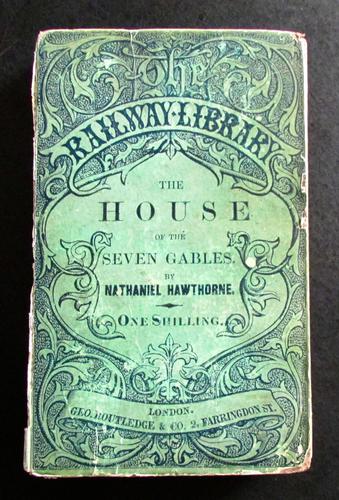
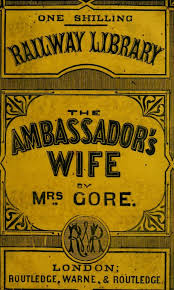
The changing styles of the card-bound books issued as part of the Railway Library over its first fifteen years are illustrated above. The left-hand panel shows James Fenimore Cooper’s “The Pilot”, published in 1849 as the first book in the series. The British copyright for Fenimore Cooper was held by Richard Bentley at this time, but Routledge ignored this, and in fact published six Fenimore Cooper titles in his first ten Railway Library books. Later on, after the success of the Railway Library had been assured, Routledge belatedly paid Bentley his royalties for the copyright infringements, and entered into an arrangement with Bentley to reprint thirty-six of Bentley’s Standard Novels as Routledge’s Standard Novels, a series that ran from 1851 to 1860.

The middle panel shows another American book, this time by Nathaniel Hawthorne, reprinted by Routledge in the Railway Library series in 1852. You can see that by this time, the success of the Railway Library had allowed Routledge to move his publishing business to 2 Farringdon Street, a much better address than 36 Soho Square, although Soho Square remained the family home until the late 1850s. The business move to Farringdon St. happened in the second half of 1851.

In the right-hand panel, we can see that by 1863, the firm had matured into Routledge, Warne and Routledge, by the inclusion into the partnership of George Routledge’s brother in law, Frederick Warne, and Routledge’s eldest son Robert Warne Routledge. The firm was still operating at 2 Farringdon Street at this time, and the book shown is by an English author, Mrs. Catherine Gore, who was one of the most prolific and popular writers of the 19th century. Her obituary in The Times in 1861 described her as “the best novel writer of her class and the wittiest woman of her age.”

Note that the price of the Railway Library books had been kept at one shilling for all three of these books issued over a 14 year period. The basic price remained at one shilling for the card-bound books until the 1870s, although cloth-bound versions, which shamelessly copied the binding style of the Simms and McIntyre Parlour Library, were also available at 1s 6d.

The first ten books issued in the Railway Library series were:

1The PilotJames Fenimore Cooper
2Jane SinclairWilliam Carleton
3The Last of the MohicansJames Fenimore Cooper
4The PioneersJames Fenimore Cooper
5The PrairieJames Fenimore Cooper
6The Dutchman’s FiresideJames Kirke Paulding
7The SpyJames Fenimore Cooper
8Sense and SensibilityJane Austen
9The Water WitchJames Fenimore Cooper
10Pride and PrejudiceJane Austen

An almost complete list of the first 100 titles can be found here.

The success of The Railway Library series encouraged George Routledge to take a considerable financial gamble in 1853. On December 27th of that year, he signed a contract with the author Sir Edward Bulwer Lytton for the right for ten years to publish reprints of nineteen of Lytton’s novels in The Railway Library series, for what Routledge described as “the immense sum of twenty thousand pounds.” It turned out to be a successful investment, so much so that when the contract expired in 1863, Routledge agreed to pay a further ten thousand pounds to extend the publication rights for another ten years. The outcome of these arrangements is that novels by Sir Edward, later Lord Lytton, are the commonest titles from Routledge’s Railway Library to be found in the secondhand book world today.

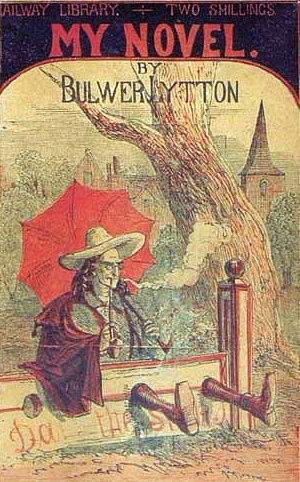
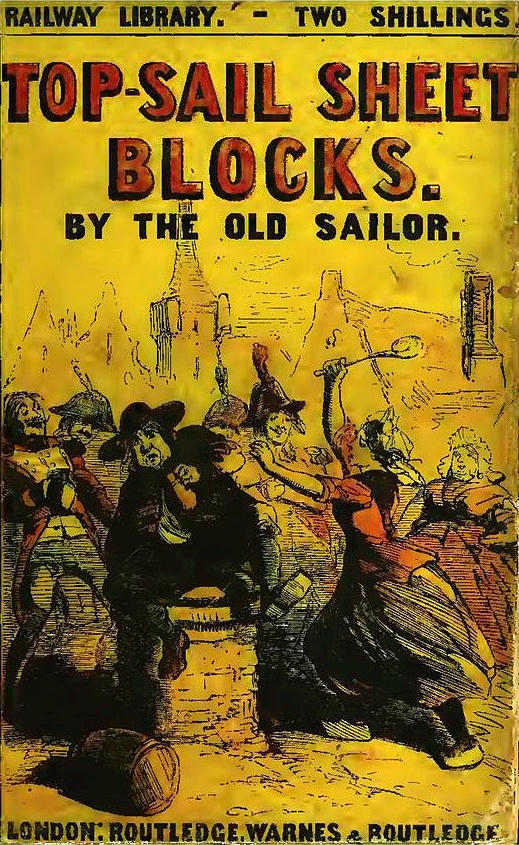
In later years, the appearance of the Railway Library series continued to change. By the mid 1850’s the very popular “Yellowback” binding style had been adopted by Routledge for the Railway Library, which made the books look rather similar to books from several other publishers of cheap reprints at that time. Some examples of these Routledge Railway Library Yellowbacks, which were priced at 2 shillings, are shown below.

In the next installment of this series I will look at the changes that occurred in George Routledge’s family and his business in the years 1850 to 1870.

The Routledge and Warne publishing families: Part 3

Starting out together in the book trade.

In Part 1 of this series, the Cumberland origins of George Routledge and how he started as a Soho bookseller are described. In Part 2, the Gloucestershire origins of the Warne family and how Frederick Warne became a neighbour of George Routledge is explained. This post, Part 3, will cover how the Routledge and Warne families started working together in the book trade.

The Beginnings of George Routledge, Publisher

George Routledge arrived in London in October 1833, having just completed his apprenticeship as a bookseller in Carlisle. He rented 11 Ryder’s Court in Soho as his home. For the next three years, he worked for an established bookseller/publisher, Baldwin and Craddock of Paternoster Row. In September 1836, following the failure of the firm of Baldwin and Craddock, George Routledge set himself up as a bookseller at 11 Ryder’s Court. He published his first book from that address just before the end of 1836.

In 1827, Frederick Warne, then aged 2, together with his five year old brother, William Henry Warne (1822-1859) moved with their parents and siblings from 5 Ryder’s Court to live literally just around the corner at 41 Lisle Street where Frederick was to remain until 1852. The move allowed his father Edmund to separate his family home from his business by also renting 42 Lisle Street as a workshop and showroom. The first known interaction between the Warne family and George Routledge was the witnessing of the will of Frederick’s oldest and short-lived brother Robert Alexander Warne (1808-1834) by George Routledge in 1834. This was followed by three other much more significant events.

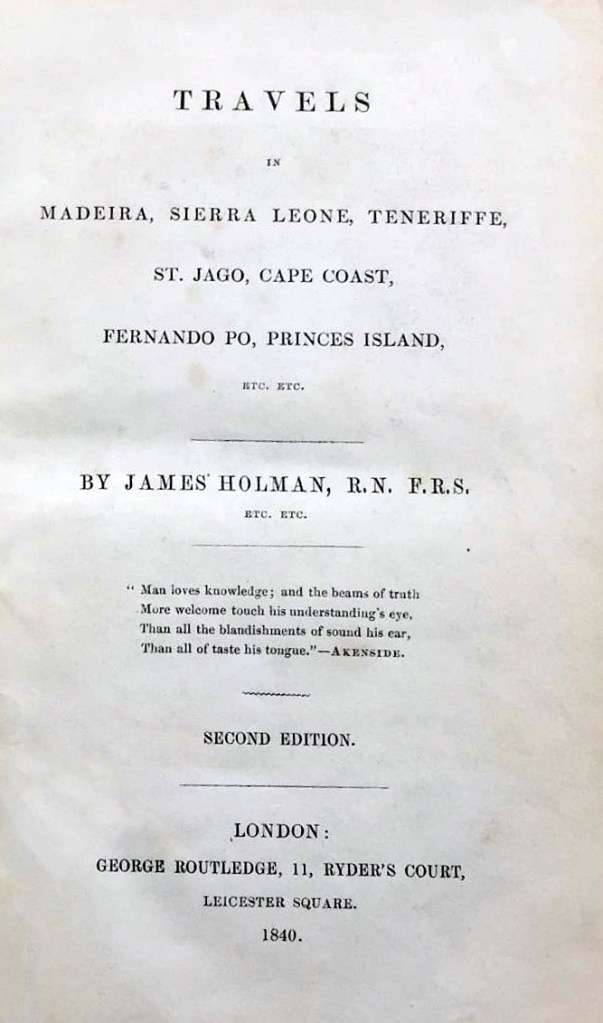
Shortly after he opened his bookshop at 11 Rider’s Court in 1836, George Routledge engaged the fourteen year old William Henry Warne as his assistant and apprentice. Although the main business from 11 Ryder’s Court was selling books, George Routledge began to publish books in 1836 and these early Routledge publications from Ryder’s Court are now very scarce. Shown below are two early Routledge title pages, both published from Ryder’s Court in 1840.

It was very common in the 18th and 19th century for booksellers to become publishers. This made a lot of sense, as it provided a ready supply of books for sale, both through retail via a bookshop, but also to the wholesale market, the circulating libraries and within the book trade to other booksellers. These last three activities helped to mitigate some of the economic risks of publishing. Sometimes two or more booksellers would combine to publish a book in order to share the risks, and the profits.

George Routledge marries.

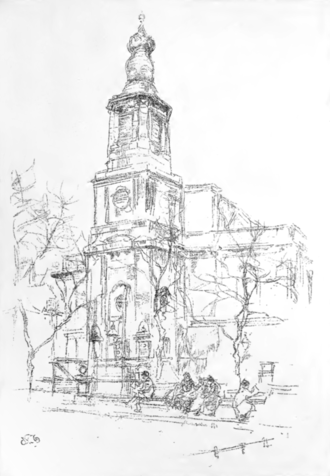
The ties between the Warne family and George Routledge became even closer on 25th January 1837, when George Routledge married Marie Elizabeth Warne (1814-1855), the sister of Frederick and William Henry Warne. The wedding took place at the church of St. Anne’s Soho, in Westminster. This was the local parish church for the Warne family and for George Routledge and, despite being largely destroyed in 1940 in the Blitz, it was rebuilt and is still the parish church today.

St Anne’s Soho in the 19th century by J. McN. Whistler

In 1839, the links between the Warne family and George Routledge strengthened, when the fourteen year old Frederick Warne joined his older brother William Henry as an assistant to George Routledge, bookseller. George and Marie Routledge lived above the bookshop at 11 Ryder’s Court, where the first four of their eight children were born. These included the two oldest sons of George Routledge, Robert Warne Routledge (1837-1899) and Edmund Routledge (1843-1899), who were both to play important parts in Routledge publishing history.

36 Soho Square

In May 1843, the Routledge family and business were still at 11 Ryder’s Court. Sometime in the second half of 1843, George Routledge, his wife and four children, and business, all moved from Ryder’s Court to much larger premises at 36 Soho Square, about 300 metres north of Ryder’s Court. George continued to refer to himself as a bookseller for the next few years, but gradually changed his description in the later 1840s to “Bookseller and Publisher”.

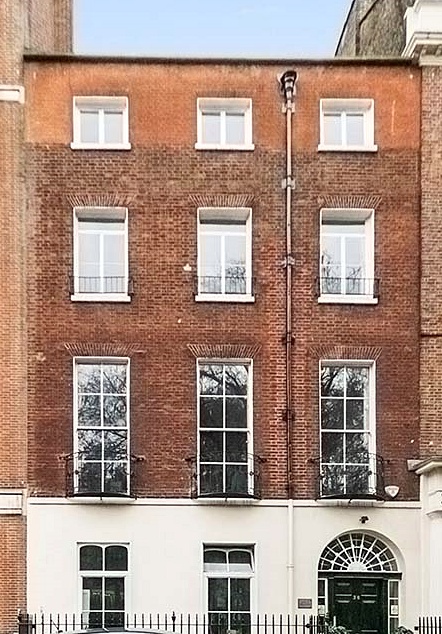
The next three Routledge children, Maria, William Henry and George, were all born at 36 Soho Square. The building has survived in good shape into the 21st century, where it is a Grade II listed building that is rented for office space. For much of the 20th century, it housed the music publishing department of Oxford University Press. It clearly provided good accommodation in the upper floors for a growing family, while providing the bookshop and publishing spaces on the ground floor.

36 Soho Square today

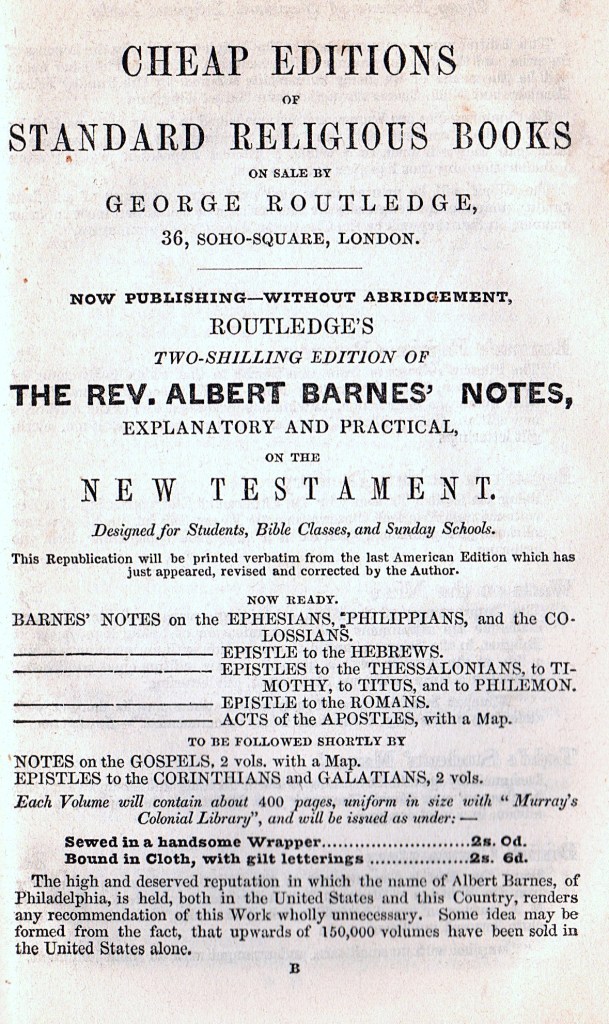
The page below is from one of the most profitable series of books published by Routledge from Soho Square in the 1840s. It is one of twenty-one volumes of Rev. Albert Barnes’ commentaries on the bible. Barnes was an American pastor who was a prolific author of religious books. Routledge published all 21 volumes of Barnes’ commentaries, starting in 1845. The page shown is an advertisement for the series from my copy of the Thessalonians commentary published in 1846.

Advertisement page from 1846

In Part 4 of this series of posts, the development and expansion of Routledge’s publishing activities from 1845 to 1865 will be discussed.

The Routledge and Warne publishing families: Part 2.

Frederick Warne (1825 – 1901)

Frederick Warne and his siblings

Frederick Warne was born at 5 Ryder’s Court in Soho, London on 13th October 1825. He was the eleventh of the thirteen children born to Edmund Warne (1783-1870) and his wife Matilda Stannard (1787 -1863). Only one of his twelve siblings, Maria Warne (1809-1810), died in infancy, while one other sister, Louisa Jane Warne (1818-1833), died at the age of 14. All of Frederick’s other ten siblings lived to reach adult life, with four of them dying relatively young, between the ages of 25 and 45, while four others lived beyond their 80th year, including Frederick’s closest sibling in terms of birth year, Stannard Warne (1824-1919), who lived for over 95 years. The life expectancy for Frederick and his siblings would have been 33 years according to London records. Their actual average lifespan was 57 years, showing that the family must have been quite well housed and fed, in spite of their large size. Frederick’s older brother, William Henry Warne (1822-1859) was to play an important role in the development of Frederick Warne as a publisher.

Origins of the Warne family

Frederick Warne’s father Edmund Warne (1783-1870) worked in London as a carpenter, surveyor and builder, but was not born in London. He was christened on 1st January 1784 in Newent, a small medieval market town in Gloucestershire, about 10 miles (16 km) north west of the city of Gloucester. Newent was a initially Romano-British settlement and is mentioned in the Domesday Book as belonging in 1066 to the king Edward the Confessor, as part of the Royal Forest of Dean. Edmund Warne’s father, also an Edmund Warne (1745 – 1818), grandfather John Warne (1711-1786) and great grandfather Thomas Warne (c1675-c1765) all lived in Newent and worked as carpenters.

Frederick Warne’s paternal grandparents

Edmund Warne senior (1745-1818) was christened in Newent on 1st January 1746 and married Anne Beale (1751-1827) at Eldersfield in Worcestershire on 31st January 1777. Eldersfield, which is now in Gloucestershire, is a small town about 10 miles (16km) north east of Newent. Edmund Warne and Anne Beale had eight children all of whom were born in Newent between 1778 and 1787. The couple had 4 sons and four daughters. Edmund Warne senior seems to have moved with his family to St. Pancras, London in 1787. This can be inferred by the birth of his youngest son James Warne in 1787 in Newent, followed by the christening of James Warne on 30th August 1787 at Fitzroy Chapel in Maple Street, St. Pancras in London. The next mention of Edmund Warne in London is as a master carpenter living in St. Pancras who takes on an apprentice on 30th August 1791. In 1798 and 1799, Edmund is recorded as renting premises at 12 shillings from Lord Southampton on the west side of Tottenham Court Road. Presumably he both lived and worked in that building, which might have been 120 Tottenham Court Road as that was Edmund Warne’s son William Warne’s business address as a carpenter in 1810. 120 Tottenham Court Road is on the west side of the street, within 100 meters of Maple Street, where the Fitzroy chapel was before its destruction in 1945. In the early 19th century, Baron Southampton was the major owner of the buildings and land on the west side of Tottenham Court Road, whereas the Duke of Bedford was the owner of the premises on the east side.

Edmund senior died in January 1818 in the parish of St. Pancras, but was buried in the nearby St James parish church in Westminster, rather than in the parish of St Pancras. Nine years later, his widow Anne also died as a resident of St Pancras in 1827, and was buried at St James parish church in Westminster, presumably in the same grave as her husband Edmund Warne senior.

The Warnes and the Stannards: a triple wedding

Edmund Warne junior (1783-1870), the father of Frederick Warne married Matilda Stannard (1787 -1863) at St Anne’s Soho in Westminster on 18th May 1805. Remarkably, two of Edmund’s brothers William Warne and George Darling Warne married two of Matilda Stannard’s sisters at the same church on the same day: William Warne (1780-1863) married Mary Elizabeth Stannard (1781-1837) and George Darling Warne (1782-1843) married Ann Stannard (1785-1852). The three Stannard sisters were the daughters of Robert Alexander Stannard (1757-1823) and Martha Negus (1764-1819). Robert and Martha had also married at St Anne’s Soho on 29 October 1780 and had eight children, six daughters and two sons. Robert Alexander Stannard was a painter and glazier by trade. He was originally from Norfolk and was probably born in Norwich. His father Robert Stannard seems to have moved the family from Norfolk to London in the 1770s.

The Stannard family lived at 16 Ryder Court in Soho, the same court where Edmund Warne junior and George Darling Warne set up as carpenters together at number 5, specialising in the manufacture of “reeded handrails for staircases”, and where George Routledge, at number 11, established his first book business in London. Ryder’s Court, which no longer exists, was just to the north of Leicester Square and was owned in the early 19th century by the Marquis of Salisbury.

It seems that the Warne brothers set up their carpentry business in Ryders Court because they had married the Stannard sisters who were already living there, as there was no record of the Warne brothers’ business in Ryder’s Court in the tenant’s list for 1806, the year following their marriages, but the name Warne does appear on the tenant’s list for 1808 and Edmund and George Darling Warne are listed as carpenters in Ryder’s Court in a trade directory for 1810. Rental records show that George and Edmond Warne were joint tenants from 1812 until 1817, but that by 1820, only Edmund Warne was recorded as the tenant of 5 Ryder’s Court. George Darling Warne had moved with his family to St. Pancras by 1820, perhaps to live with his widowed mother. By 1825, he lived at 8 Mill Street, St George Hanover Square, now part of Mayfair, where he remained until his death in 1843.

Later years of Edmund Warne

Edmund Warne 1784 – 1870

Edmund Warne lived with his growing family at 5 Ryder’s Court from 1806 until 1827, when the family moved to live at 41 Lisle Street, with his business located next door at 42 Lisle Street. Edmund and his family were recorded at 41 Lisle Street in the March 30th 1851 census. At this time, Edmund was describing himself as a builder and surveyor. Only the two youngest children were still living with their parents: Frederick Warne, described as “bookseller”, and Rosa Margaret Warne. Rosa Margaret married on 29 April 1851 and left home, and Frederick Warne married in July 1852. Edmund and Matilda were still at Lisle Street in 1858, but by 1861, they had moved to Tottenham in North London, where they lived in a house in the Green Lanes area that Edmund called Newent Villa, as a reminder of his birth place. He was still apparently working as a surveyor when his wife Matilda died at home on 28th August 1863. Seven years later, Edmund Warne died at Newent Villa in February 1870 and was buried at Kensal Green cemetery on 24th February 1870.

In the next post, I will look at how the Warne and Routledge families started together in the book trade.

The Routledge and Warne publishing families: Part 1.

Routledge and Warne: Two publishing families

George Routledge (1812-1888) and Frederick Warne (1825-1901) started two of the leading publishing houses that operated in Britain from the mid-19th to the mid-20th century. The two men had both professional and personal connections; they also shared a commitment to make available hundreds of thousands of inexpensive books of high quality to the readership of the English speaking world. This is the first part of their story as men, booksellers and publishers.

Publishing fiction in the 19th century

For most of the 19th century, publishing of high quality fiction in England was dominated by a small group of established publishers who were committed to production of new fiction in the form of the three volume edition (known as a triple decker), which was sold for 31 shillings and sixpence (a guinea and a half). This format and price survived for most the 19th century, starting in the Regency period, when Jane Austen’s works were first published, and ending around 1896.

The three volume format was very much supported and encouraged by the circulating lending libraries, of which Mudie’s Subscription Library was the dominant player. Mudie’s alone would often purchase, at a considerable discount, 30-50% of the edition of a new book, and would lend it to their subscribers, one volume at a time.

The leading publishers for most of this era were the big seven; Chapman and Hall, Smith, Elder and Co., Longmans in their various guises, John Murray, Blackwoods, Macmillans, and Bradbury and Evans. These seven firms managed to publish most of the significant new fiction of the 19th century. In spite of the introduction of serialisation by several of these publishers, led by Chapman and Hall with Dickens’ “Pickwick Papers” in 1837, they were all committed to the triple decker. The two big university presses, Oxford with the Clarendon Press and the Cambridge University Press, did not enter the world of fiction until the end of the 19th century. Until then, they had confined their efforts to publishing academic and religious books, including their domination of the lucrative bible trade.

Second rank publishers

The second level of publishers tended to specialise in cheaper reprinted editions. Routledge and Warne were in this group, along with Richard Bentley, Cassells, and, later on, Thomas Nelson and a host of others. By 1860, there were more than 200 publishers operating in London alone, and at least 600 booksellers. Another 20 publishers operated out of Edinburgh, which was the centre of the book trade in Scotland. This might seem to suggest a high level of competition, but the trade was careful not to rock the boat and had become very conservative. The second rank publishers had to create their own niches in order to thrive. Into this world stepped George Routledge and Frederick Warne.

George Routledge

Family origins

George Routledge was born on 23rd September 1812 in Brampton, Cumberland (now called Cumbria), a small market town close to the Scottish border. It is 15km north-east of Carlisle and only 3km from Hadrian’s Wall. His father, Robert Francis Routledge, had also been born in Brampton on 17th June 1760. Little is known about the origins of Robert’s father and Georges’s grandfather, a John Routledge, who had been born somewhere in Scotland around 1730. John Routledge moved down to Cumberland as a young man and on 15th July 1752, he married a member of a Cumberland branch of the Routledge family, Sybil or Sybella Routledge in Bewcastle, Cumberland. Sibil had been born in Bewcastle on 2nd October 1726, the daughter of another John Routledge from Lanercost, a small village in Cumberland 5km north-east of Brampton. Bewcastle is small hamlet of fewer than 500 inhabitants, which nestles in a valley some 8km northeast of Lanercost, very close to the Scottish border. St Cuthbert’s church in Bewcastle, where John and Sibil Routledge were married, is famous today for having in its churchyard the oldest Anglo-Saxon standing stone cross and sundial in Britain.

All of this means that George Routledge is descended from both a Scottish and an English branch of the Routledge family. Descendants of those families can be found today in the region, still bearing the Routledge name on both sides of the Scottish-English border.

George’s immediate family

George’s mother was Mary Calvert (1766-1843), the daughter of Robert Calvert of Lanercost. Mary Calvert and Robert Francis Routledge were married on 7th January 1796 in Lanercost, and had eight children born between 1797 and 1812, one of whom, Catherine, died in infancy. George Routledge was the youngest of these eight children.

Life must have become much harder for George’s mother Mary, who was always known as “Malley”, when her husband Robert Francis died on 12th July 1815, leaving Malley with 7 children to care for, from the three year old George up to the oldest child, Mary Routledge who was 18 when her father died. Three years later, young Mary Routledge married a local farm worker called David Latimer, with whom she had 10 children in Brampton, leaving Malley with a family of six to manage.

Mally ran a grocery shop in Front Street, Brampton in order to support herself and her children. Two of her daughters Margaret and Anne never married and helped her to run the shop, taking it over when Malley died in 1843, and running between them until the late 1870s. Margaret and Ann Routledge eventually died as spinsters in Brampton in 1880 and 1881 respectively.

George had three older brothers who all married and had diverse careers. The eldest, John Routledge (1800-1859) stayed in Brampton with his wife Rachel and their two daughters. John was the High Constable in Brampton for the last 20 years of his life. The next brother, Robert Routledge (1802-1861) married a Scot called Mary Dicks in Perthshire, where they had one child, a son also called Robert. The family moved to Manchester, where Robert worked as a supervisor in the Inland Revenue until his death. George’s third brother, William Routledge (1804-1875) took holy orders and achieved a Doctor of Divinity. Together with his wife, Henrietta, William ran “The Routledge Classical School” for several years in Bishops Hull, Somerset , before reverting to life as a parish clergyman, ending up as the Rector of Cotleigh in Devon, where he died in the rectory in March 1875. William and Henrietta successfully raised two daughters and two sons, the youngest of whom became the Reverend Charles Francis Routledge following on in his father’s profession.

From this history it is evident that none of George’s siblings had anything to do with the book trade, or with London. So, how did George Routledge become a bookseller and publisher in London?

George Routledge, bookseller

George Routledge moved from Brampton to nearby Carlisle in June 1827, where he became apprenticed to Charles Hutchinson Thurnam, a Scot from Edinburgh, who had opened a bookshop and library at 5 English Street in 1817. George completed his apprenticeship on 3rd September 1833, and he moved to London in October 1833. Thurnam and Sons bookshop and printing business in Carlisle continued to operate for nearly 200 years until, unfortunately, the business failed and was closed on May 28th 2008.

In London, George initially lived in Ryder’s Court in St. Anne’s parish in Soho. This area of Soho was very much a district of craftsmen and artisans in the early part of the 19th century. Ryder’s Court is no longer extant, but used to run south towards Leicester Square from the junction of Lisle Street and Newport Street. The area is now part of London’s Chinatown.

George started his life in London by working for the publishers Baldwin and Cradock at 47 Paternoster Row in the centre of the London book trade. Robert Baldwin with his partners Craddock and Joy were most successful in publishing maps and atlases under the rubric of The Society for the Diffusion of Useful Knowledge. When Baldwin and Cradock failed in September 1836, George Routledge decided to open a bookshop at 11 Ryder’s Court, from where he also started to operate as an occasional publisher.

In my collection, I have several books published by George Routledge from Ryder’s Court. The oldest is Beauties of Gilsland – A Sketch of the Most Remarkable Objects Near Gilsland Spa by William Steele, which was published by Routledge in late 1836. This was in fact the first book ever published by George Routledge.

Gilsland Spa was a well known hotel in Gilsland, a village which sits on Hadrian’s Wall and spans the boundary between Cumberland and Northumberland. The hotel had been built in 1760, and was the place where Sir Walter Scott, then plain Walter Scott, was reputed to have proposed to his future wife in 1797 at the “Popping Stone”. Routledge would have known the area from his youth, as Gilsland is about 15km east of Brampton. The author, William Steele, may have been known to George Routledge from his time in Cumberland. There were at least five men called William Steele living in the northern parts of Cumberland according to the 1841 census. Any one of these could have been the author of the book.

My copy of the book seems to be in the original cloth binding that Routledge would have chosen. The title page is shown in the picture below. Sadly, the book was a commercial failure, but now is a great scarcity. Note that the date on the title page is given in the Latin form of “M DCCCXXXVI” rather than “1836”. This is slightly unusual, as most books published by Routledge used standard Arabic numerals for their dates.

Routledge meets the Warne family

One of George’s neighbours in Soho was Edmund Warne (1783-1870), a builder who had lived at 5 Ryder’s Court. Edmund the builder had been born in Gloucestershire, the son of another Edmund Warne, a carpenter who had moved his family from Gloucestershire to London in the late 1780s, when the younger Edmund was about 5 years old. Edmund the builder had married a Matilda Stannard in 1805 and had lived with his growing family at 5 Ryder’s Court from 1805 until 1827, when the family moved nearby to 41 Lisle Street, which is where they were living when George Routledge arrived in Soho. The Warne family remained at 41 Lisle Street until at least 1851. By 1861, when all their children had grown up and left home, Edmund and Matilda had moved to Hornsea in North London. Matilda Stannard was very much a local Soho girl, as she was the daughter of Robert Alexander Stannard, a painter who lived at 16 Ryder’s Court.

The earliest evidence of George Routledge’s presence in Soho and of his relationship with the Warne family is his signature as a witness on the 1834 will of Robert Alexander Warne (1808-1834), the oldest but short-lived son of Edmund Warne and Matilda Stannard.

George Routledge’s signature on the will of Robert Alexander Warne, 1834

Edmund and Matilda were to become more significant in the life of George Routledge, as they were also the parents of George Routledge’s first wife, Marie Elizabeth Warne, and his first two business partners William Henry Warne and Frederick Warne.

End of Part 1.

The story continues with an exploration of origins of the Warne family in Part 2.


Emma takes to the West End stage

An exploration of the first London stage production of Jane Austen’s Emma

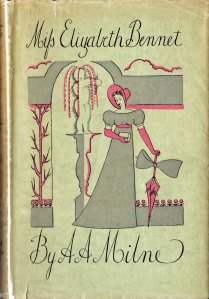
The novels of Jane Austen have been the basis of many dramatic performances from the first home theatrical extracts arranged by Rosina Filippi and published by J M Dent in 1895, to the modern adaptations of the novels for the movie and television industries. The first full play to appear as a dramatic adaptation was a version of Pride and Prejudice published in 1906, and several more adaptations of this novel have continued to appear over the subsequent 100 years, including, in 1936, Miss Elizabeth Bennet by A.A. Milne, the author of Winnie-the-pooh.

Dramatic versions of Emma

The first full dramatic version of Emma to be published was Romances by Emma by DeWitt Bodeen in 1938, which was first performed in Pasadena, California. This was followed by Emma by Marion Morse MacKaye; the play was written in 1937 but the author died before its first publication by Macmillan and first performance at the North Dakota Agricultural College, both occurring in 1941. The first English dramatisation of Emma was a three act play called Emma, written by John Lindsey and Ronald Russell, which was published by the theatrical script publisher Samuel French in 1943 and first produced at The Little Theatre in Bristol in March of the same year.

The first London production of Emma

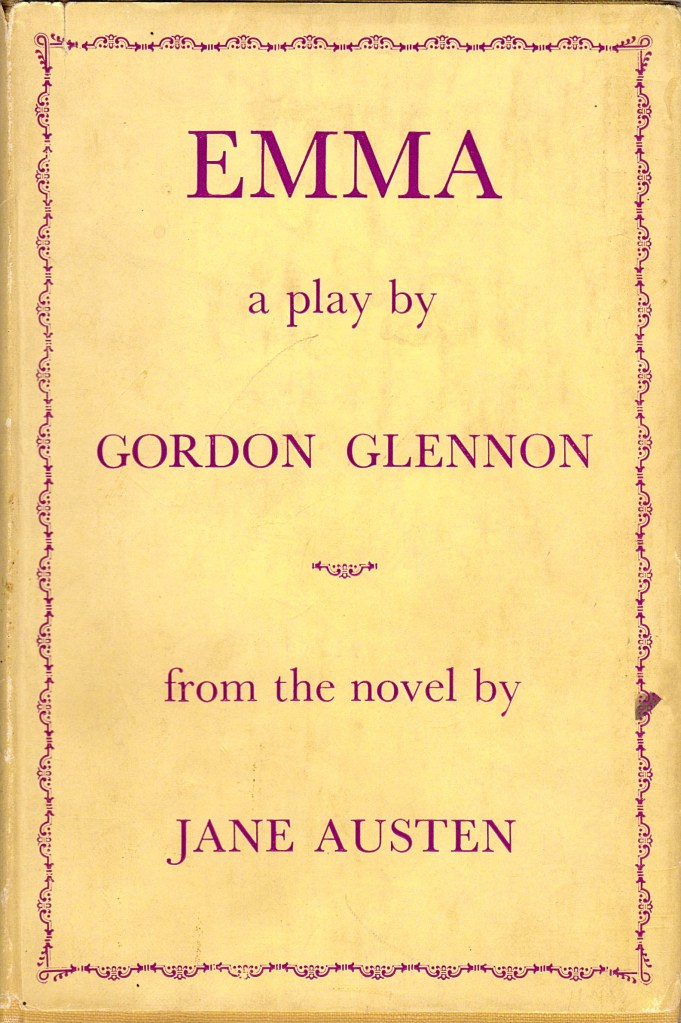
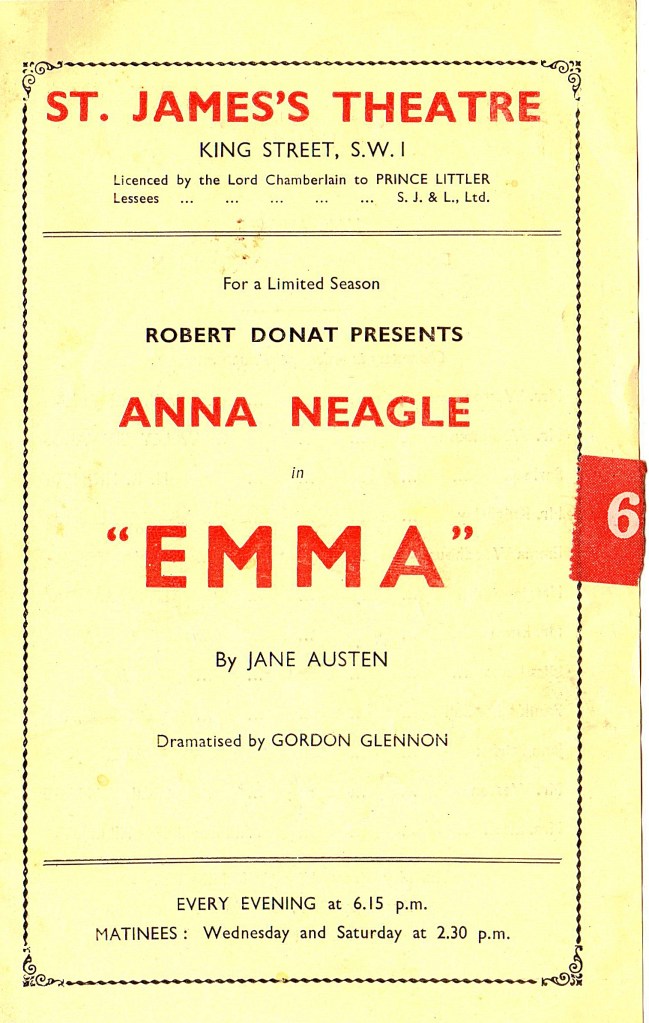
The first production of Emma to appear in a theatre in London was a three act play, Emma, written by Gordon Glennon and published by Macmillan in 1945. Before coming to St James’s Theatre in London, the play had a successful regional tour, opening with performances in Rugby in August 1943 and including a popular and critically acclaimed season in Manchester before the first London performance on 7th February 1945. The play was produced by the popular film star Robert Donat, who worked as a theatrical promotor during the Second World War. The play had a cast of 12 actors, led by Anna Neagle, (1904-1986), a popular starlet who had started as a stage dancer but who had achieved recent film successes in the title roles of films about Nell Gwyn (1935), Queen Victoria (1937 and 1938) and Edith Cavell (1939). As well as a very good copy of the first Macmillan edition of Emma (1945) in dust jacket, I also have a copy of the program for the London season of the play, which was only moderately successful at around 60 performances.

The play, which ran in London from February to April 1945 was in competition with air raids from Hitler’s Vengeance weapons, the V1 “Doodlebug” and the V2 rocket designed by Wernher von Braun. A V2 exploded very close to the theatre during one evening performance. There is interesting advice in the program to the theatre patrons on how to react to an air raid, which I have reproduced below.

Emma the play

The play is structured into three acts, with Act 1 consisting of a single scene and Acts 2 and 3 both arranged as two scenes each. The program tells us that the events take place in 1815. All of the action of the play occurs on the same set, which represents the Woodhouse’s drawing room at Hartfield. This means that we hear about events that occur elsewhere, such as Harriet’s encounter with the gypsies, and the Weston’s ball, all during conversations in the drawing room, and that Mr. Elton’s attempted proposal to Emma, Frank Churchill’s misapprehended conversation to Emma about Jane Fairfax and Emma’s insulting remark to Miss Bates all are arranged to occur within the Woodhouse’s drawing room.

The dialogue of the play is sometimes close to the original words of the novel and at other times diverges quite considerably. For instance, here from Act 2 Scene 2 of the play is Glennon’s version of the remark by Miss Bates which provokes Emma’s insult, followed by Emma’s unfortunate response:

Miss Bates: Oh, that will not be difficult. I shall be sure to say three dull things as soon as I open my mouth.

Emma: (unable to resist) Ah, madam, but you will be limited as to the number – only three at once.

Emma Act 2 Scene 2.

This is a considerable contraction of the original dialogue from Chapter 43 of Emma, which takes place during the outing to Box Hill. It diminishes the prolix nature of Miss Bates’ conversation. Here is the original as written by Jane Austen:

“Oh! very well,” exclaimed Miss Bates; “then I need not be uneasy. ‘Three things very dull indeed.’ That will just do for me, you know. I shall be sure to say three dull things as soon as ever I open my mouth, shan’t I?” looking round with the most good-humoured dependence on everyone’s assent. “Do you not all think I shall ?”

Emma could not resist.

Ah, ma’am, but there may be a difficulty. Pardon me, but you will be limited as to the number – only three at once.

Emma, Chapter XLIII

I leave the reader to judge how well or otherwise Mr. Glennon has done with this famous passage.

Images from the play

Both the program and the book of the play give the original cast list. I have reproduced the version from the program below. I am not aware of any changes to the cast during the play’s short London run. I assume that this program, which cost 6d, was held by a woman, as the red smudge, seen alongside Harriet Smith and Mr. Elton, appears to be lipstick!

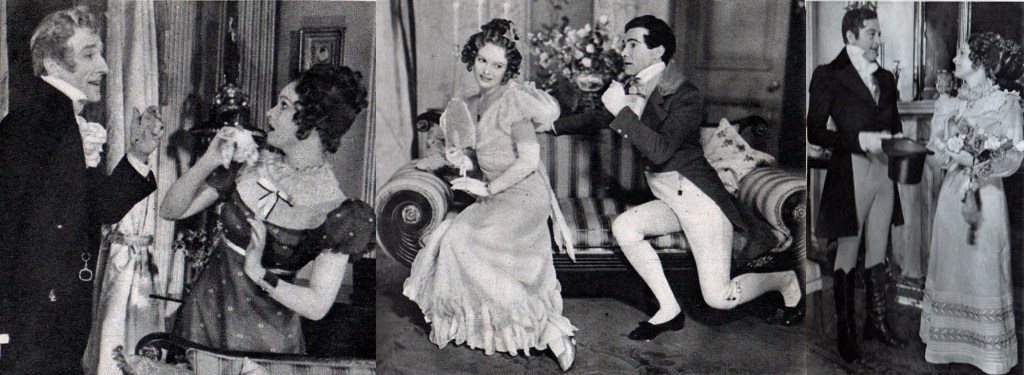
I had wondered what the set and actors looked like and how authentic the costumes were. I have recently been fortunate enough to gain some insight into this. I have just received a copy of an edition of Emma published in 1890 by George Routledge and Sons Ltd. The Irish dealer who I bought it from had described the book as having “some newspaper cuttings stuck to the front prelims”. Imagine my delight to discover that these cuttings were pictures taken from a magazine of the London production of Gordon Glennon’s Emma, with Anna Neagle and the rest of the cast as listed above. Photos of Mr. Elton’s proposal to Emma, Frank Churchill’s non-proposal to Emma and Mr. Knightley’s proposal to Emma are shown below.

Left: Mr Elton and Emma. Centre: Frank Churchill and Emma. Right: Mr. Knightley and Emma

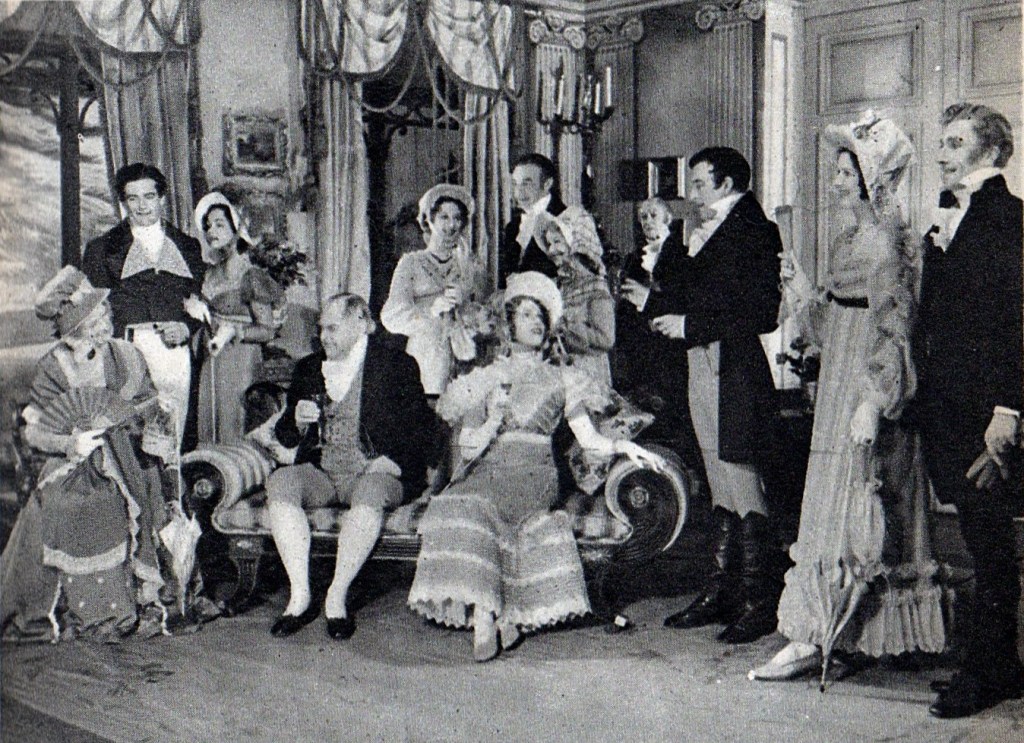
The play ends with the whole ensemble on stage, with everyone asked to toast the three future brides, Jane Fairfax, Harriet Smith and Emma Woodhouse in turn. Note that Glennon has decreed that Frank Churchill and Jane Fairfax will marry. Also note that Robert Martin does not get an appearance in this version of Emma. Below is the picture of that final final toasting scene.

From the left we can see:

Miss Bates; Frank and Jane; Mr. Woodhouse; Mrs. Weston; Emma; Mr. Weston; Harriet; Serle; Mr. Knightley; Mrs. and Mr. Elton

For more information on the representations of Emma on stage, I suggest that you view the entertaining video presentation by Professor Devoney Looser at the 2020 Virtual JaneCom which can be viewed on You Tube.

More about interesting books relating to Jane Austen will be posted shortly.

Robinson Crusoe for Younger readers

Note: In this and linked posts, I have recrafted some material from earlier posts to improve navigation.

Robinson Crusoe as a book for Juveniles

Defoe intended his book to be a moral tale that showed how a rather reckless youth can become a thoughtful, religious and worthy man, by application to work and devotion to the scriptures. The original text by Defoe contains many sections of religious or philosophical ruminations, that can make the book quite heavy going for the younger or indeed the modern reader. It was first recognised by a German writer that Robinson Crusoe contained the kernel of an exciting story for younger people. Accordingly, in 1779, Joachim Heinrich Campe translated and edited Defoe’s work to produce Robinson der Jüngere (Robinson the Younger). Campe followed this with a similar treatment of The Farther Adventures published as a second volume in 1780.

These two books came to the attention of the London publisher John Stockdale, who translated them back into English, and then published them in two volumes as The New Robinson Crusoe An Instructive and Entertainment History for the Use of Children of Both Sexes (1788). Stockdale claimed to have translated the book from a French text, but it was clearly a translation of Campe’s German texts. In the following year, Stockdale published a simplified single volume version of this treatment of Robinson Crusoe as a book for children as An Abridgement of The New Robinson Crusoe An Instructive and Entertainment History for the Use of Children of Both Sexes (1789). This was the real start in English of Robinson Crusoe as an adventure book for the younger reader. It is interesting that these two publications by Stockdale predate by one and two years his famous two volume illustrated edition of Robinson Crusoe for adult readers.

Here follows a link to a posting about my copy of An Abridgement of The New Robinson Crusoe An Instructive and Entertainment History for the Use of Children of Both Sexes (1789) and here is a link to a post about my copy of a related reprint published by George Routledge called Robinson the Younger or the New Crusoe (1856).

Since then, there have been many versions of Robinson Crusoe that have been specifically published for the juvenile market. There are editions in simplified language, indeed a couple written in words of one syllable, excluding the personal names. There also continues to be many illustrated editions published for the younger reader, and some more deluxe illustrated editions that were probably intended for the children and adults of wealthy families. The story has also been translated into many different languages over the years.

All of these juvenile editions are based on the first volume of Robinson Crusoe as written by Defoe, which culminates with Crusoe’s escape from the island and his return to England. Some editions may also contain material taken from “The Farther Adventures” that made up the original second volume written by Defoe, particularly the sections describing the return of Crusoe to the island. None of the juvenile editions that I have seen contain material from the more rarefied and philosophical volume 3 of Defoe.

Robinson the Younger 1856

Robinson the Younger or the New Crusoe published in 1856

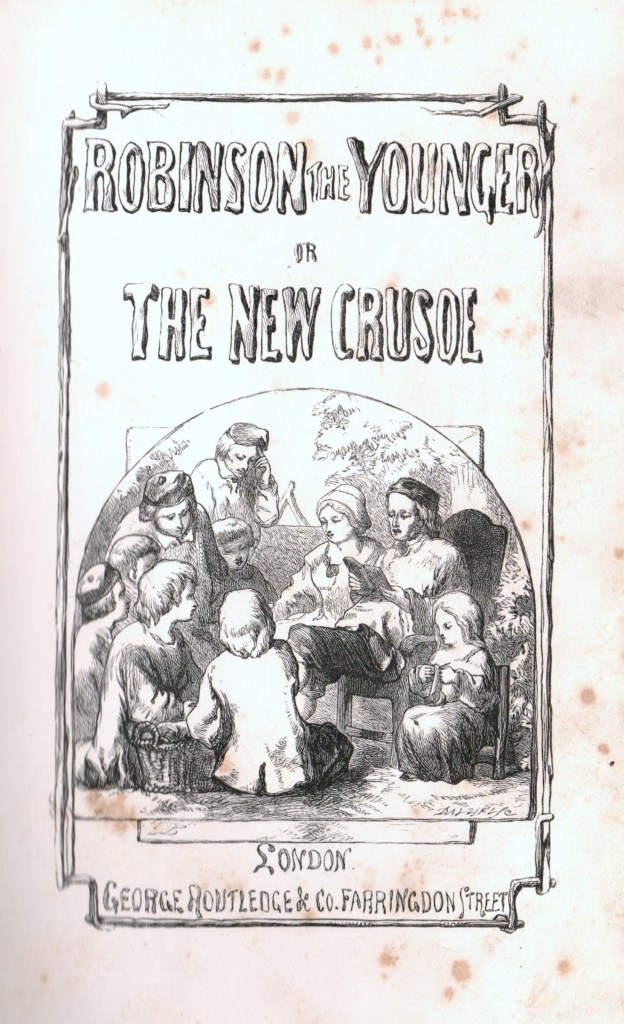
This version of Robinson Crusoe from my collection was specifically produced for the juvenile reader as Robinson the Younger, and was published by George Routledge & Co. in London in 1856. The upper board, which is the original gilt-decorated cloth binding, and both the engraved and the printed title pages are shown below.

The printed title page reveals that this is an English translation of Robinson der Jüngere (1779) by Joachim Heinrich Campe, the first juvenile version of the story of Robinson Crusoe ever published, which was discussed in a previous Robinson Crusoe blog. My copy is the second Routledge edition of 1856, the first edition having appeared in 1855. There seems also to have been a third edition published in 1859. All three editions are scarce, but the text is available in electronic form in several libraries.

The book has two prefaces; a translator’s preface and some extracts from an unattributed author’s preface, which is presumably a translation of part of a preface written in German by Campe in 1779. The translator R. Hick explained how he came to translate Campe’s book as follows:

The original work of which the following is a translation, fell accidentally into my hands when looking for an entertaining German reading book. I was presently struck with its admirable adaptation for the use of children, and once resolved to translate it for my own little boys; during the progress of my agreeable task I now and then read what I had written, sometimes to my wife, sometimes to friends, who one and all strongly recommended my offering it for publication.

Translator’s Preface, Robinson the Younger, George Routledge & Co. London 1856

He finished by writing:

I have endeavoured as much as possible to render it simply what it professes to be, a faithful image of the admirable original, the worth of which has been emphatically stamped by the German public having demanded upwards of forty large editions of it.

R.Hick Woodhouse Hill, Near Leeds, 1855.

The image on the engraved title page in the central panel above shows a man reading from a book to his family grouped around him. This is how Robinson der Jüngere  and Robinson the Younger are both structured, with the story being read out to the children by the father as a narrative interrupted by frequent questions from the children. I give an example of this below, with the famous incident of the discovery by Robinson of the footprint. This is from the chapter headed “Fourteenth Evening.”

“He had not gone far when he reached the most southerly part of the island. Here the ground in some parts was sandy, and just as he reached the most prominent point, he was struck almost as with a thunderbolt, became as white as a sheet, and trembled all over.

John.- Why?

Papa.- He saw what he never dreamed of seeing here, the footprints of one or more men in the sand.

Nicholas.- And did that frighten him so? Why, it should have delighted him!

Papa.- The cause of his terror was this : he concluded at once that the man of whose foot this was the print, was not a brother or a friend, who would be ready to help and serve him; but a cruel creature, who would fall upon him in a fury, and would kill and eat him. In a word, he saw in this, not the trace of a polished European, but of a savage cannibal, like those of whom you have heard in the Caribbee Islands.

George.- Ah! That I believe, and so he must have been frightened.”

from Robinson the Younger, George Routledge & Co. London, 1856, pp 117-118.

My copy of the book has no illustrations other than its frontispiece, shown below. The Robinson Crusoe depicted seems decidedly older than the young man described in the text.

Frontispiece from Robinson the Younger, George Routledge and Co. London, second edition 1856

In the next blog postings, I will discuss some other 19th century editions of Robinson Crusoe that I have in my collection.