1891 The Picture of Dorian Gray: Oscar Wilde

1891 The Picture of Dorian Gray: Oscar Wilde


The Picture of Dorian Gray, Oscar Wilde’s famous story of a portrait which ages while its human subject stays young, was first published in the July 1890 issue of Lippincott’s Magazine. The story was regarded as quite immoral by many at the time; indeed, the editor of Lippincott’s Magazine, J. M. Stoddart, removed about 500 words from Wilde’s original manuscript, without the author’s permission, because he held it to be indecent due to its homoerotic content. 

The first edition in book form followed in 1891, and because of the widely-voiced criticism of the initial version, Wilde wrote a preface to the book defending his point of view, although he did also agree to edit out a few of the more contentious passages. A complete uncensored version, in which all Stoddart’s excisions and Wilde’s enforced additional amendments have been reversed, was not published until 2011 by the Belknap Press.

The 1890 magazine form of the novella is famously scarce and the book form is much more likely to be accessible to the keen collector. Lippincott’s Magazine cover for July 1890 is shown below.

Return to the Gothic Novel list

1886 The Strange Case of Dr Jekyll and Mr Hyde: Robert Louis Stevenson

1886 The Strange Case of Dr Jekyll and Mr Hyde: Robert Louis Stevenson


Robert Louis Stevenson (1850-1894) had already made his name with the adventure story Treasure Island, published in 1883. While asked about the inspiration for this, his famous macabre story of good and evil, he claimed to have conceived The Strange Case of Dr Jekyll and Mr Hyde in a dream. According to his family, he wrote the first draft in a frenzy in 3 to 4 days. He then spent about a week revising his manuscript for the publisher.

The story was a sensation from its first publication in the first week of January 1886 in both Britain and the USA. It sold more than 40,000 copies in the first six months of that year and has never been out of print. For many readers, it represents a fundamental duality in the make up of all people; an internal struggle between good and evil. The phrase “Jekyll and Hyde” quickly entered the language to express differences in the moral behaviour of individuals from one situation to the next. More than 100 film and dramatic versions of the story have been produced.

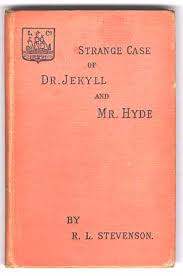
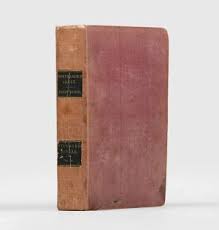
For any collector, the first issues of the English or American editions, in their paper wrappers are the most desirable forms, but these are exceedingly rare. The hardback book form which first appeared later in January 1886 is also highly desirable. A picture of my copy of that first edition of the hardback version of the book on the right is shown below alongside the very rare paperback edition on the left. Both were published by Longmans Green and Co. in January 1886.


Return to the Gothic Novel list


1872 Carmilla (from In A Glass Darkly): Sheridan Le Fanu

1872 Carmilla (from In A Glass Darkly): Sheridan Le Fanu

Joseph Thomas Sheridan le Fanu (1814-1873) was an Irish journalist who worked steadily in his craft until the sudden death of his wife in 1858. He then turned his hand to writing Gothic and supernatural stories and produced several important works. The most important one is Carmilla, a short story published in a magazine, The Dark Blue, in 1871 and then, in the following year, in a collection of five short stories called In a Glass Darkly.

 The story is about a female vampire, Carmilla, the alias of Mircalla, Countess Karstein, who befriends and then preys on a young woman called Laura. The relationship between Laura and Carmilla is one of lesbian eroticism as well as vampiric, and some of the writing is very explicit for its time.

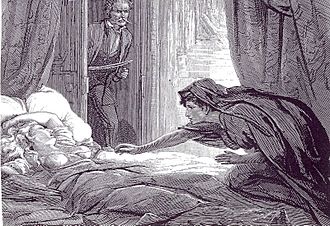
The story had been reprinted many times and has been the basis of several other books and several films. The iconic image below of Carmilla approaching a sleeping Laura, with Laura’s father watching in the background, was drawn by David Henry Friston, and first appeared in the magazine The Dark Blue in 1871. This image has been reprinted many times. 

It is this first appearance of Carmilla that is the collector’s most desirable version, but the first edition of In a Glass Darkly in 1872 is also very collectableAn interesting more recent edition of In a Glass Darkly is that published in 1929 by Peter Davies, with illustrations by Edward Ardizzone. 

Return to the Gothic Novel list

1853 Bleak House: Charles Dickens

1853 Bleak House: Charles Dickens


Charles Dickens was clearly influenced by the earlier Gothic novels, and several of Dickens’ stories have elements of the Gothic, such as the Christmas Stories, with their supernatural themes, the highly gothic situations in Oliver Twist and Great Expectations, and the gothic setting and situation of Dickens’ unfinished masterpiece The Mystery of Edwin Drood

Not withstanding all these, I regard Bleak House as Dickens’ Gothic high point. The whole setting of the book is a bleak vision of London as a threatening Gothic city, mired in mud and swathed in fog. The main plot line concerns the interminable legal case of Jarndyce vs Jarndyce, perhaps showing Gothic excesses of the system operating in the Courts of Chancery. The book is also highly collected by detective fiction collectors, as it features one of fiction’s earliest detectives, Inspector Bucket.

The Gothic narrative is reinforced by the some very fine illustrations by Hablot K Browne (Phiz) that are found in the second half of the first edition. These have been specially created by a novel effect of cross hatching on the plates with some fine diagonal lines, which create a feeling of extra gloom. These are called the so called ‘Dark Plates’ of Bleak House, and made very strong visual statements, which enhanced the narrative and were an innovation in 19th century book illustration.

The desirable edition is the first edition, published by Bradbury and Evans in 1853 with the ten dark plates, which can be found for around $2000. A more expensive alternative is to find a complete set of Bleak House in the original issue in 19 parts, which will cost more than $10,000. 

Two examples of the Dark Plate illustrations are shown below.


Return to the Gothic Novel list

1847 Wuthering Heights: Emily Bronte

1847 Wuthering Heights: Emily Bronte

As well as the bicentenary of the publication of Frankenstein, 2018 is the 200thanniversary of the birth of Emily Bronte (1818-1848), the author of Wuthering Heights. The novel caused great controversy on its publication, and the energy and passion of the writing, together with bleak, threatening setting of the story on the Yorkshire moors left many commentators confused. Critics were quite divided about the book. Many asserted that only a man could have written such a raw and powerful story about lust, passion and selfishness!

The first edition of Wuthering Heights was published by Thomas Cautley Newby in 1847 as the first two volumes of a three-volume publication, with Anne Bronte’s short novel Agnes Grey as the third volume. The author’s names were given as Ellis Bell and Acton Bell, respectively.

The true name of the author did not appear on the title page of the second English edition of Wuthering Heights, which was published in 1850, but this edition did include a biographical note by Charlotte Bronte, as Currer Bell, in which the origin of the sisters’ pseudonyms was explained. This may have been prompted by the publication of the first American edition of Wuthering Heights by Harper & Brothers in 1848 as “by the author of Jane Eyre”, which was incorrect of course, as Jane Eyre had been written by Charlotte Bronte, not Emily Bronte.

Book collectors are very happy to own any of the editions mentioned above, but all are rare and expensive. Another possibility for collectors is the first edition published in English in Europe by Bernard Tauchnitz in 1851, as this tends to be less expensive.

As a rough guide to prices, the English first edition (1847) sells for more than $20,000, the American first edition (1848) for around $10,000, the English second edition (1850) for around $5000 and the Tauchnitz edition (1851) for around $2000.

The title page of the first English edition is shown here.


Return to the Gothic Novel list

1847 Jane Eyre: Charlotte Bronte

1847 Jane Eyre: Charlotte Bronte

Jane Eyrewas the first novel to be published by one of the Bronte sisters, appearing on October 16th 1847, a few weeks before the combined publication of Wuthering Heights and Agnes Grey by Charlotte’s sisters Emily and Anne respectively.

The three Bronte sisters had published their combined book of poetry, Poems, in 1846 under the names Acton (Anne), Currer (Charlotte) and Ellis (Emily) Bell. The three pseudonyms had been deliberately chosen to sound masculine, without being definitive about gender. Only two or three copies of the 1846 edition of Poems were said to have been sold. 

The first English edition of Jane Eyre in 1847 was followed by the first American edition of Jane Eyre, published by Harper & Brothers in 1848. On both the English and American first editions, the author’s name is given as Currer Bell.

Jane Eyre is a romance, but with Gothic elements, such as the Byronic Mr. Rochester, the mysterious Thornfield Hall and the strange ‘mad woman’ who disrupts life at Thornfield. Jane Eyre inspired the creation of the later novels Rebecca, by Daphne du Maurier and Wide Sargasso Sea by Jean Rhys.

The first English edition of Jane Eyre is one of the most desirable books in English Literature. It is the first book published by a Bronte sister and only 500 copies were printed. The second edition is also of interest as it is dedicated by the author to William Makepeace Thackeray, and contains a preface written by Charlotte Bronte, in which she robustly challenges and refutes some of the views of her critics.

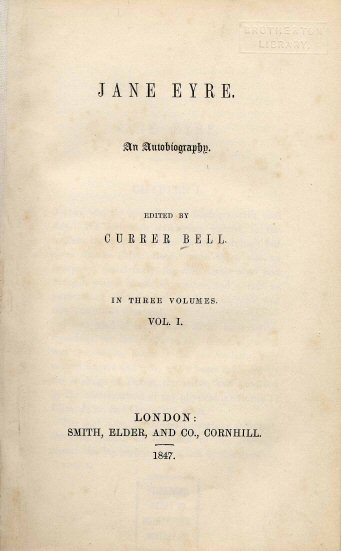
I show here the title page of the very scarce English first edition of Jane Eyre, published in three volumes by Smith Elder, and Co. in 1847.


Return to the Gothic Novel list

1833 The Hunchback of Notre Dame: Victor Hugo

1833 The Hunchback of Notre Dame: Victor Hugo


Although we know this book as The Hunchback of Notre Dame, it was first published in France as Notre Dame de Paris in 1831. The more familiar version of the title was coined by the translator, Frederic Shoberl, who provided the text for the first English edition of 1833.

In conceiving the novel, Victor Hugo was mainly concerned with the conservation of important Gothic architecture in France, using the example of the cathedral of Notre Dame de Paris, which was in a rather poor state of repair by 1830. However, the drama and pathos of the infatuation of the disfigured dwarf, Quasimodo, with the beautiful and seductive gypsy, Esmeralda captured the imagination of readers in both French and English.

Many other English translations have followed, and several film and stage adaptations have also been devised. The famous film version of 1939, with Charles Laughton’s immortal performance as Quasimodo to Maureen O’Hara’s Esmeralda is the image of the hunchback that most people recognise.

The first French edition published by Gosselin in 2 volumes in Paris or the first English edition published as a single volume by Bentley in London in 1833 are both highly desirable.

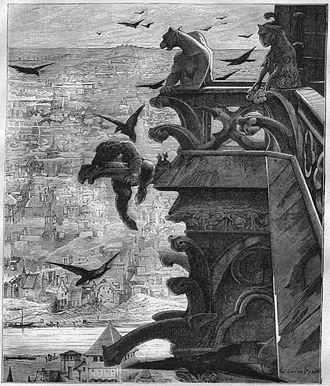
The most memorable image of the hunchback from a book is probably the one below, which is neither from The Hunchback of Notre Dame nor from Notre Dame de Paris, but is from Victor Hugo et son temps, by Alfred Barbou,  published by G. Charpentier in Paris in 1881.


Return to the Gothic Novel list

1817 Northanger Abbey: Jane Austen

1817 Northanger Abbey: Jane Austen


Northanger Abbey and Persuasionwere both published posthumously in four volumes in December 1817, following the death of Jane Austen in July 1817. Whereas Persuasion was the last manuscript that Jane Austen completed before she died, Northanger Abbey was a result of her reworking of an earlier manuscript called initially Susan and then Catherine. 

The copyright of Susan was sold to a bookseller and publisher, Crosby, in 1803 for £10.  Susan was never published, and the family eventually repurchased the copyright from Crosby in 1816, after the successful publication of Sense and Sensibility, Pride and Prejudice,Mansfield Park and Emma, for the same sum of £10. Crosby was unaware of the identity of the author! 

The story was revised and renamed Catherine by the author, as a successful novel called Susan had recently been published. The title Northanger Abbeyis thought to have been chosen by Jane Austen’s brother Henry after the author’s death.

Northanger Abbey is a wonderful satire of Gothic novels, which allows Austen to poke gentle fun at the genre, through the words, thoughts and actions of the naïve heroine, Catherine Morland. Although Pride and Prejudice and Emma are generally the most popular of the novels of Jane Austen, Northanger Abbey is my favourite because of all the discussion of literature, especially Gothic fiction, that it contains. 

The second edition, published by Bentley in 1833 is the first illustrated edition, first single volume edition and the first English edition to acknowledge Jane Austen as the author on the title page. There was a gap of 15 years between the publication of the first edition in 1817 and the second edition. Northanger Abbey has not been out of print since.

  The original publisher’s binding and the frontispiece are shown below. The frontispiece shows Henry Tilney finding Catherine Morland, as she is snooping around Northanger Abbey, looking for evidence of a ghastly, imagined, (Gothic) fate for Henry’s mother.


Return to the Gothic Novel list


1818 Frankenstein: Mary Shelley

1818 Frankenstein: Mary Shelley


2018 was the 200th anniversary of the publication of Mary Shelley’s landmark novel Frankenstein; or, The Modern Prometheus, to give it the full title, which had been conceived and started at the famous Villa Diodati in June 1816, when Mary Shelley was 18 years old.

Frankenstein was the result of a competitive game involving Mary and Percy Shelley, Lord Byron and John Polidori, Bryon’s friend and doctor, after they had been reading German Gothic stories during a few days of rain by Lake Geneva.
The first edition was published anonymously in three volumes on 1st January 1818 with a preface written by Percy Shelley. A second edition appeared in two volumes in August 1822, which named Mary Shelley as the author on the title page. The first single volume edition appeared in October 1831, this time with a new preface written by Mary Shelley, and with the text significantly revised by the author. Most subsequent editions used the text from this revised edition of 1831.

In many ways all three of these editions are highly desirable, although the first edition is now very scarce (only 500 copies were printed) and very expensive. The 1831 single volume edition, published by Colburn and Bentley, is very attractive to collectors as it has Mary Shelley’s preface together with an iconic frontispiece designed by Theodor von Holst. This is the picture shown below.

Frankenstein has been reprinted many times over the last 200 years and has been the inspiration for many film, television and stage portrayals of the monster, most famously by Boris Karloff in the film which was released in 1931, 100 years after the publication of the Colburn and Bentley edition.

Return to the Gothic Novel list

1796 The Monk: M G Lewis

1796 The Monk: M G Lewis


The Monkby Matthew Gregory Lewis, for ever after known as ‘Monk’ Lewis, was a notorious book from the time of its first publication. The story revolves around the relationship between the monk of the title, Ambrosio, and the woman, Matilda who both loves him and tricks him into a sexual relationship with her, in what was described at the time as “a lewd and blasphemous book.”

The first edition is dated 1796 but is thought by some commentators to be published, in three volumes, in late 1795, when Lewis was only 19 years old. In that edition, the author is only identified by the initials M.G.L. In late 1796, after initially favourable reviews, second and third editions were published which identified the author as M.G. Lewis Esq. M.P., for Lewis had been elected to parliament at the age of 20 in 1796.

In 1797, Samuel Taylor Coleridge published a highly critical review, which condemned the book as one likely to corrupt the reader. In response to this, Lewis edited the book, removing the equivalent of 17 pages of his most extreme writing for the fourth edition published in 1798. Most 19thcentury editions were further expurgated by other hands.

Any one of the first three editions of 1796 are desirable to the collector. The title page of the first volume of my second edition of October 1796 is shown below.

Return to the Gothic Novel list