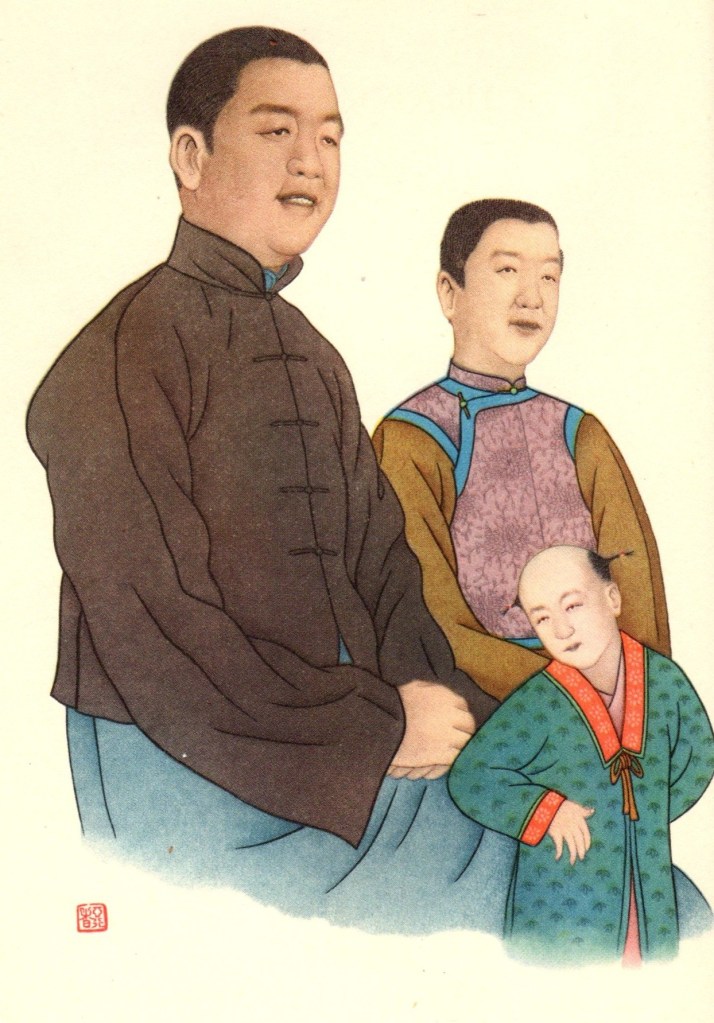
A triple self-portrait of Chiang Yee at 6, 15 and 37 years old.
Family origins
Ancestors of the Chiang clan have lived in northern China since the 12th century B.C., with the first named ancestor of Chiang Yee known to have lived there in the 1st century B.C. (Han dynasty). Many Chiang family members had migrated from northern China to establish themselves in central China in the 13th century of the modern era (Southern Sung dynasty) following the Mongol invasion of the north. In the 18th century (Ch’ing dynasty), some members of the Chiang family crossed the Yangtse river from Hubei province to live in Jiangxi province, settling in the region of Jiujiang, which became an important port on the Yangtse river in the 19th century.
Childhood in Jiangxi

Jiangxi province is situated south-west of Shanghai. Jiujiang, which is shown by the red dot on the map, directly north of the provincial capital Nanchang, is situated on the southern bank of the Yangtse river, between the Lu mountain (Lu-Shen), a famous Chinese landmark and World Heritage site and Poyang lake, China’s largest freshwater lake.
Chiang Yee was born on May 19, 1903, in Jiujiang as Chiang Chun-Ya, the third child of Chiang Ho-an and his wife Tsai Hsiang-Lin. He had an older brother, Chiang Ta-Chuan and an older sister, Chiang Tsui-Chen. Chiang Yee’s family lived in the Chiang family compound as part of an extended family group, with ten uncles and more than 25 cousins. The head of the clan during Chiang Yee’s early childhood was his grandfather, Chiang Chi-Kao, but the most important elder in Chiang Yee’s childhood was his grandmother, as his mother died when he was five years old. His two older siblings, particularly his sister, also paid important roles in his upbringing.
In his book, A Chinese Childhood, he presents a picture of himself with his grandparents (below left), as well as pictures of his father (centre) and his brother (right).


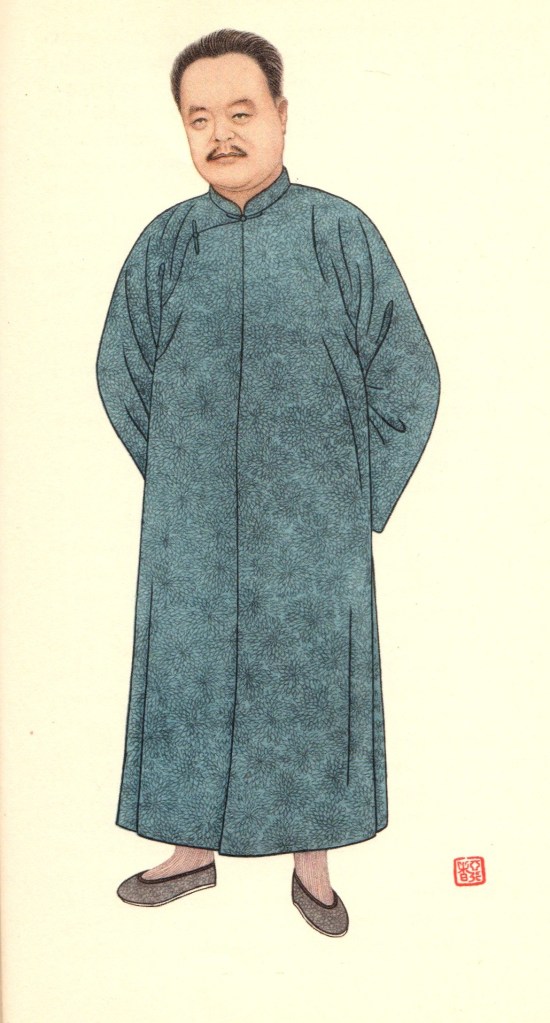
Grandfather Chiang Chi-Kao (left). Father Chiang Ko-an (centre). Brother Chiang Ta-Chuan (right)
Chiang Yee’s father was an artist, which traditionally in China meant that he was skilled in painting, drawing, calligraphy and poetry. The young Chiang Yee started his life-long engagement in the study and practice of Chinese art by observing and copying his father, who he idolised. One of his most important childhood memories was a trip to climb Mount Lu (Lu-Shan) with his father when he was around 13 years of age. Mount Lu became the focus of his early memories of China and the nostalgia he felt for his homeland. He mentions Mount Lu in most of his books and invariably compares hills and mountains that he see outside China with his beloved Mount Lu. He created a lovely painting of Mount Lu which he published in his book of nostalgic recollections of his homeland, A Chinese Childhood, in 1940. Chiang Yee’s father, Chiang Ho-an, died in 1921 in Jiujiang.

Painting “Up the Lu Mountain” from A Chinese Childhood
Early adult life
Chiang Yee left Jiujiang in 1922 to study chemistry at National Southeastern University (now Nanjing University) in Nanjing in Jiangsu province. After four years study, he graduated with a BSc. in 1925. On June 3rd 1924, Chiang Yee married his first cousin Tseng Yun in Jiujiang, in a marriage that had been arranged by the families before the two of them had been born. Over the next nine years, the couple had four children: two daughters, Hsiao-Yen and Chien-Lan and two sons, Chien-Kou and Chien-Fei.
After completing his degree, Chiang Yee taught chemistry in schools, firstly for six months at the Eleventh Middle School in Haichow in Jiangsu province and then in a middle school in his home city of Jiujiang.
Political and military life
During this time in the mid 1920s, the relatively newly formed Chinese Nationalist Republic was in turmoil following the untimely death of Dr Sun Yat-Sen in 1925. He had been appointed the first president of Nationalist China in January 1912, following the fall of the Manchu regime in 1911. The country was riven by fighting between regional warlords and other military leaders, including General Chiang Kai-Shek, who had established himself as the successor to Sun Yat-Sen in Nanchang, the provincial capital of Jiangxi Province . Chiang Yee got caught up in this fervour, and, in mid-1926, joined the Northern Expeditionary Force of the National Revolutionary Army led by General Pai Tsung-Hsi, which marched from Jiangxi north to Shanghai and beyond to defeat the local warlords and expand the regime of Chiang Kai-Shek. The expeditionary force met little resistance and soon occupied Shanghai, Suzhou and Nanjing, allowing Chiang Kai-Shek to establish a provisional Nationalist Kuomintang government in Nanjing in 1927 that was soon recognised around the world as the official government of China.
Chiang Yee left the army in Suzhou after becoming disenchanted by the factional struggles between the Kuomintang nationalists and the emerging communists. He joined his older brother Chiang Ta-Chuan in Shanghai, where his brother had become the Chief Secretary to the local military governor. A chance encounter in Shanghai with an old university friend who had become Dean of Science at Chinan University in Shanghai led to Chiang Yee gaining a position to teach inorganic chemistry at Chengchi Unversity where he taught for six months in 1927-1928.
In late 1928, Chiang Yee was appointed to the position of chief civil servant in Wuhu hsien (county) in Anhwei Province, a position that made him responsible for the law, taxation, education and housing in the county. This was followed by his appointment to the position of county governor in neighbouring Tan-Tou county in June 1929 to replace the incumbent governor who was corrupt and incompetent. In May 1930, Chiang Yee was appointed to be governor of his home Jiujiang county in Jiangxi Province. He tried to reform the ancient and corrupt land tax system and to prevent American oil companies from taking over large areas of land bordering the Yangtse river, through their corrupt dealings with local warlords. He found himself in continual disputes with powerful local political and military factions, including the provincial governor and the military governor, and so late in 1932 he resigned his position as county governor, and rejoined his brother in Shanghai.
Leaving China
After much discussion with his brother, Chiang Yee decided that his best option was to leave China to pursue further studies in the West with a view to returning to China with more insight into political systems and methods of governance. In May 1933, he bade farewell to his friends and family and travelled to Shanghai, where he boarded a French ship that was bound for Marseilles, where he duly arrived in June 1933 after 33 days at sea. He had little money and almost no knowledge of European languages. He took a train from Marseilles to Paris and after one night in Paris, took a boat across the channel to arrive in London on June 12th 1933.
England was to be his home for the next 22 years. He was never to see his brother and sister again, and did not see his eldest son Chiang Chien-Kou again for 15 years, his youngest son Chiang Chien-Fei for 25 years, and his wife Tseng Yun, and two daughters, Chiang Hsiao-Yen and Chiang Chien-Lan for more than 40 years.
Return to Chiang Yee The Silent Traveller Main Page.
 Book Collecting World