1832 Sense and Sensibility: Gilson D1

Richard Bentley, London: New Burlington Street

For more background information of the Bentley editions of Jane Austen, please read the first few paragraphs of the article on Bentley edition of Emma, Gilson D2.

Sense and Sensibility, along with the other five novels of Jane Austen that had been published between 1811 and 1817, did not appear in a new English edition until Richard Bentley decided to reprint all of the Austen novels as “Standard Novels” in 1832. The first edition of Sense and Sensibility had been published in 1811 followed by the second edition in 1813, both published by Thomas Egerton in 3 volumes. Sense and Sensibility was published by Richard Bentley on 28th December 1932, for 6 shillings. Sense and Sensibility was numbered “XXIII” (23 ) in the Standard Novel series. It was the third edition of Sense and Sensibility to be published in the UK, the first single volume edition, the first edition to have any illustrations and the first to have Jane Austen’s name as author on the title page(s). Standard Novel XXIV (24) was a translation of Madame de Stael’s Corinne, which appeared on February 1st 1833. An announcement of the intended publication of Corrine by Bentley on this date appears on the verso of the series title page of Sense and Sensibility (Figure 1). Although the publication date of Sense and Sensibility was on 28th December 1832, Bentley printed 1833 on all of the dated pages, a common practice by publishers, who used this practice to extend the apparent currency or newness of their books.

Figure 1: (left) Series title page for Gilson D1 Bentley’s Sense and Sensibility 1832

Figure 1: (right) Verso of Series Title page showing announcement of Corinne.

In Figure 2, the two illustrations for the Bentley edition of Sense and Sensibility are presented as the frontispiece on the left and the engraved title page vignette on the right. They are both drawn by Ferdinand Pickering and engraved by William Greatbatch, as is the case for all of the illustrated Bentley editions of Jane Austen’s novels. The images show figures in costumes appropriate to 1832, rather than to the earlier period when the book was written. The frontispiece shows the incident from Chapter 22 of Volume 1, where Lucy Steele is showing the miniature of Edward Ferrars to Elinor Dashwood. The text under the image reads as follows: Then taking a small miniature from her pocket, she added “To prevent the possibility of a mistake, be so good as to look at this face.” This is a slight misquotation of the original text on page 133 which reads “possibility of mistake”.

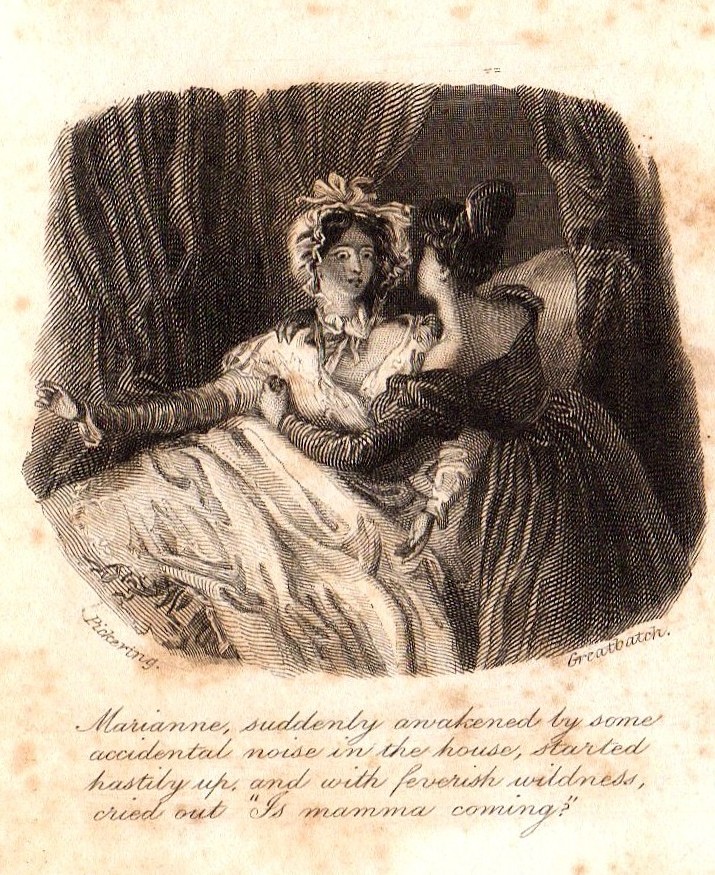
Figure 2. Frontispiece (left) and vignette (right) illustrations from Gilson D1

The vignette on the right of Figure 2 shows Marianne Dashwood suddenly awakening, startled and arising from her sickbed, held by her sister Elinor (from Volume 3, Chapter 7). The text reads: Marianne suddenly awakened by some accidental noise in the house, started hastily up, and with feverish wildness, cried out “Is mamma coming?”

The full engraved title page and the letterpress title page are shown in Figure 3 below. Note that there are some small differences in the way that the publishers details are presented on these two pages. The dates on these pages shown in figures 1, 2 and 3 are all presented as 1833, rather than 1832. There is an inscription of a previous owner of the book, “Hugh Block”, on the top of the engraved title page.
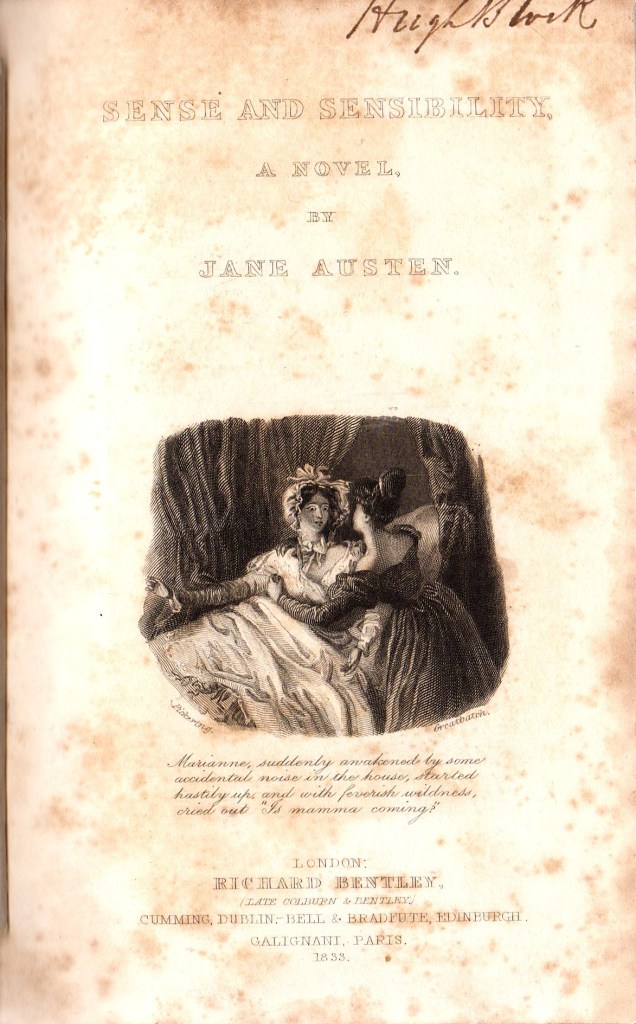
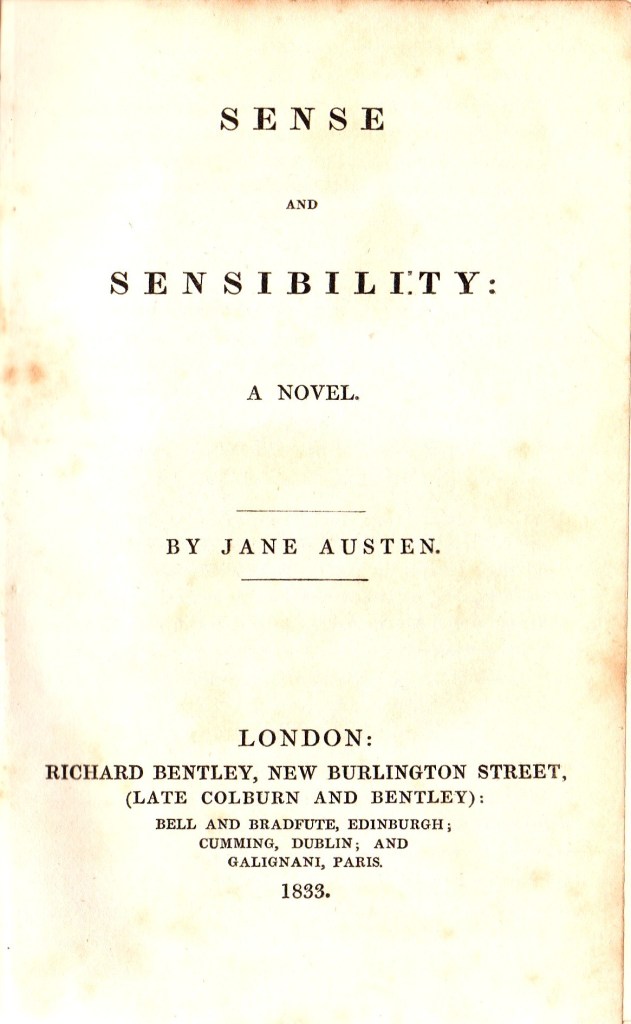
Figure 3. The engraved (left) and printed title pages for Sense and Sensibility Gilson D1

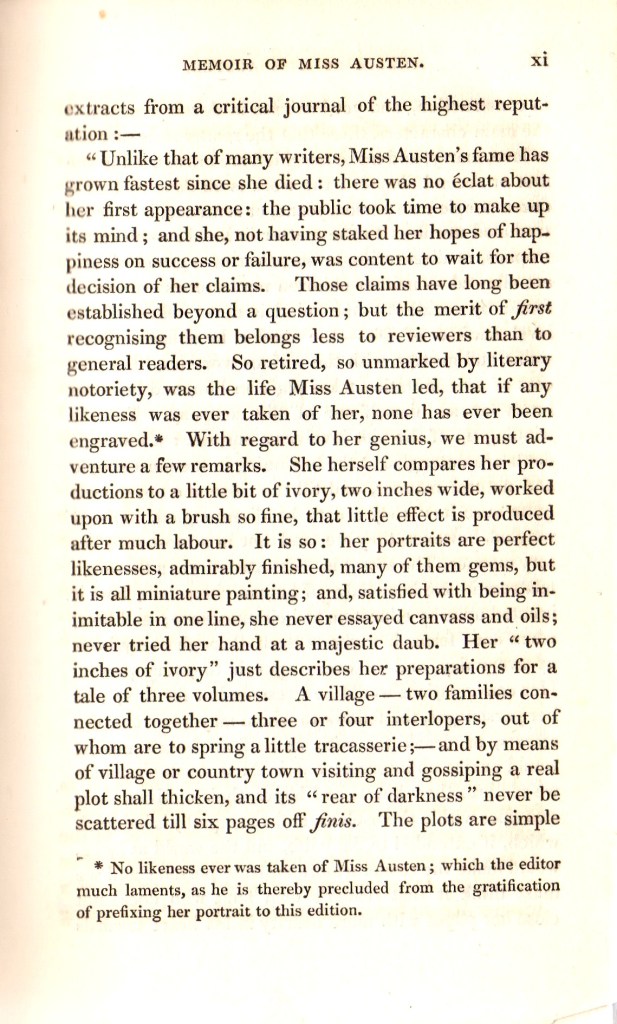
Immediately following the printed title page, Bentley presents a “Memoir of Miss Austen” which is on the preliminary pages (v) to (xiv), that is p5 to p14 in roman numerals. The memoir is unsigned and dated October 5th 1832. It has been described elsewhere as by “the Rev. Mr. Austen”, which would have been the author’s brother Henry Austen. The first part of the Memoir is an edited and revised version of the “Biographical Notice” published by Murray as a preface to the posthumous edition of Northanger Abbey/Persuasion in 1817, which is itself dated December 13th 1817. This was also generally agreed to have been written by Rev. Henry Austen. The second part of the Memoir, running from the bottom of page (x) to page (xiv), pages 10-14), are taken from a review of Northanger Abbey/Persuasion published in the Quarterly Review of January 24th 1821.

The final page of the “Memoir” is a note from the editor of Gilson D1, presumably Richard Bentley himself, which announces that the other novels of Jane Austen will follow in the Standard Novels series. The editor also comments on the importance of Jane Austen, cites the related novels of Madam D’Arblay (Fanny Burney), Miss (Maria) Edgeworth, Mrs. Opie and Miss Porter, and praises Jane Austen for “the truth, spirit, ease and refined humour of her conversations” , and her ability “to make the veriest every-day person a character of great interest.”

Figure 4 show three pages from the “Memoir” section of Gilson D1.
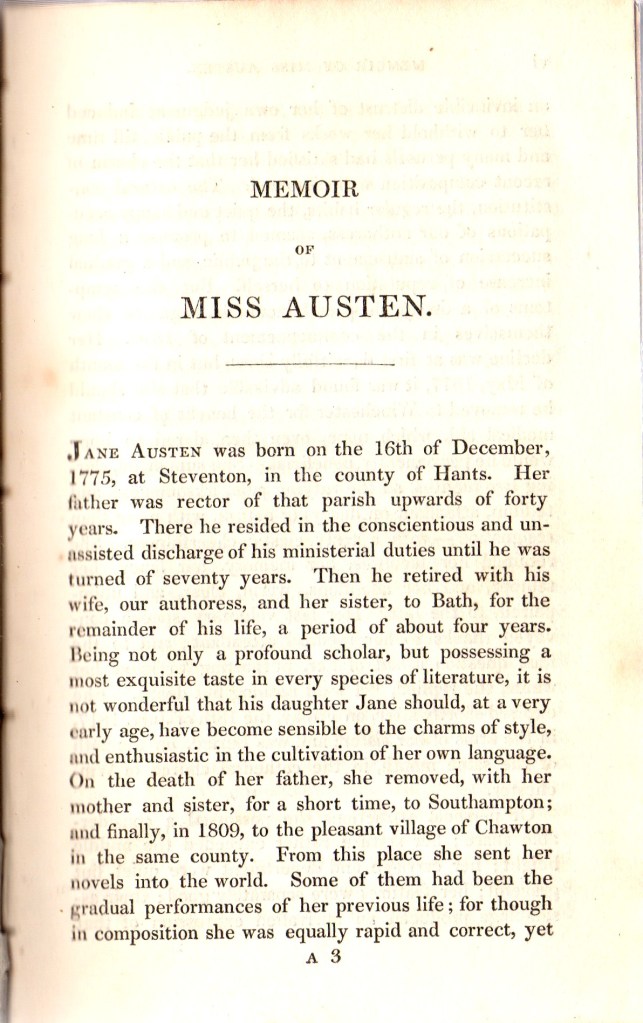
Figure 4. Pages v, x and xi from the Memoir of Miss Austen

Richard Bentley arranged the text of Sense and Sensibility to correspond to the same chapter and volume arrangement as in the first and second editions. Accordingly, the book remains divided into 3 volumes, with Volume The First consisting of 22 chapters occupying pages 1-116; Volume the Second has 14 chapters running through pages 117-219 and Volume the Third also has 14 chapters running from page 220 to the final page 331. Throughout the book, most of the chapters do not start on a new page, and are separated by a simple centrally placed ruled line about half the width of the page. The chapters are numbered in large Roman numerals, whereas the page numbers are printed as Arabic numbers at the outer top corners of the pages. The first and last pages are shown in Figure 5 below.

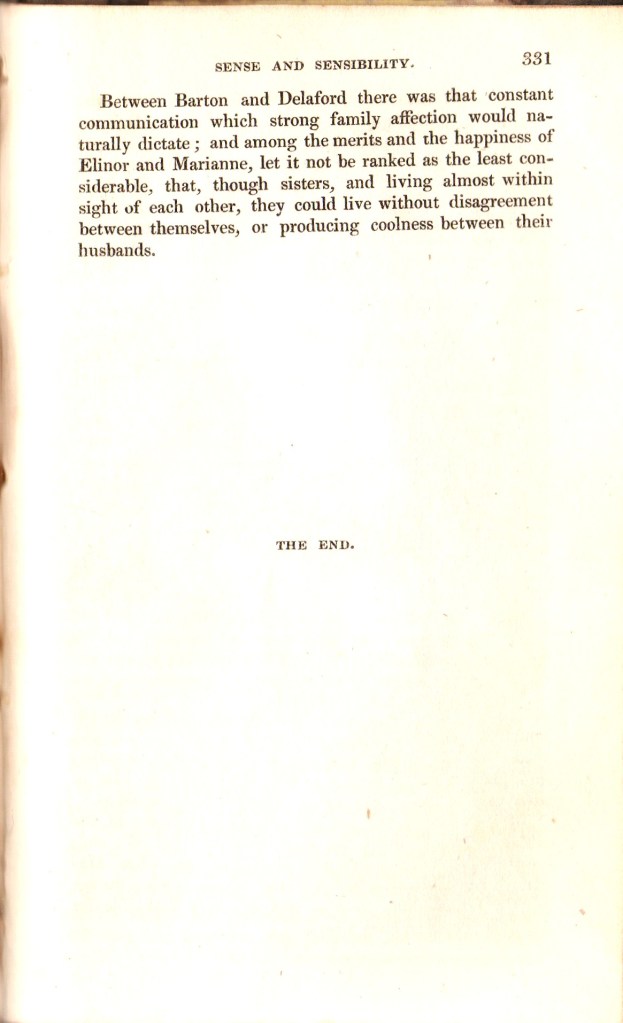
Figure 5. Pages 1 and 331 of 1832 Bentley edition of Sense and Sensibility

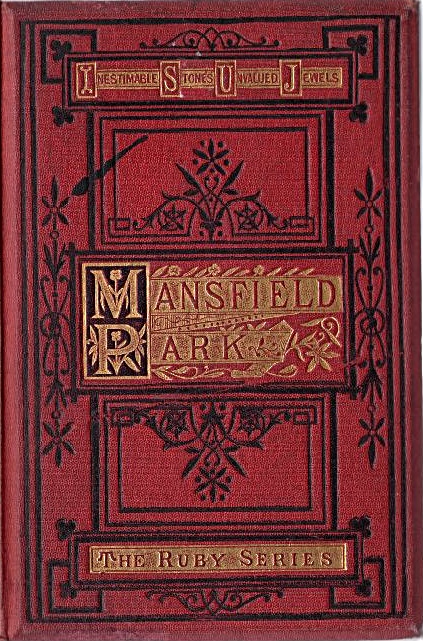
Gilson D1, Sense and Sensibility, would have been originally bound in plum-coloured, glazed linen boards, with black labels on the spine which were printed in gold. This binding was used by Bentley for the Standard novels issued between 1831 and 1838, and is generally called Sadlier style 1. Examples of this can be seen in my copies of Mansfield Park (Gilson D3) and Northanger Abbey/Persuasion (Gilson D4). However, my copy of Sense and Sensibility has been rebound in marbled paper-covered boards, half-bound in green morocco with gilt labelling on the spine in two gold lined compartments (Figure 6) . The spine has faded from green to light brown. The binding looks mid-19th century, but has recently been rebound, with the addition of new yellow endpapers.
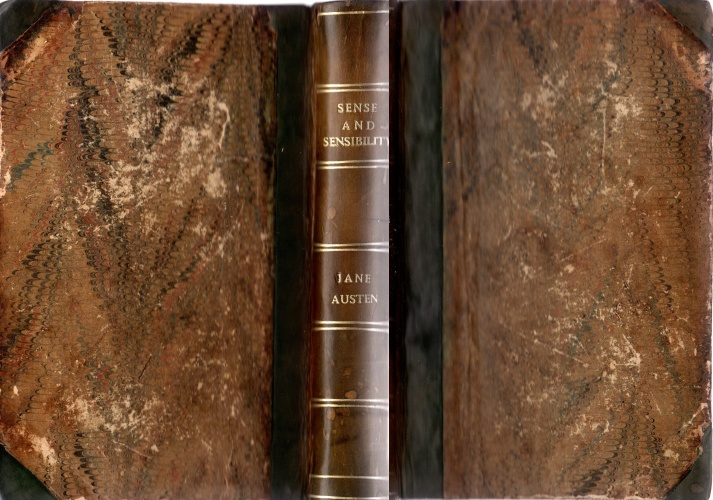
Figure 6. Binding of my copy of the Bentley edition of Sense and Sensibility.

Later reprints of Bentley’s Sense and Sensibility Gilson D1

The 1832 issue of Bentley’s first edition of Sense and Sensibility shown in this article is the only issue that I currently have of this Standard Novels edition, I do also have a copy of the 1856 issue, which is as a part of a set of The Novels of Miss Austen (Gilson D6). There are other known reprinted issues of Bentley’s Sense and Sensibility that appeared in 1837, 1846, 1853, and 1854 in the Standard Novels series, all designated Gilson D7, and a further reprinted set of Gilson D6 in 1866. A “New Edition” of Sense and Sensibility is published by Bentley in 1970 as Gilson D8. That is the subject of a separate article in this series.

Return to the Index page for Illustrated Editions of Jane Austen.
1833 Emma; 2nd UK edition

Richard Bentley, London, Gilson D2

The first edition of Emma, the fourth novel to be published by Jane Austen, was published in 3 volumes in December 1815 by John Murray. Like all of the first editions of Austen it was not illustrated. It was the first Austen title published by John Murray, following some dissatisfaction with Thomas Egerton, who had published the first three Austen novels. The first edition of Emma was issued as 2000 copies, which all sold within one year of publication. Following Jane Austen’s death on 18th July 1817, John Murray resisted efforts by the Austen family, notably the author’s brother Henry and sister Cassandra, to publish a second edition of Emma.

Richard Bentley (1794-1871) had been born into a distinguished family of three generations of printers and publishers. After initially working in partnership with his brother Samuel as “S. and R. Bentley” for ten years, Richard formed a new partnership with Henry Colburn in 1829. Colburn and Bentley had started to publish a series of cheap, illustrated reprints of English novels as “Colburn and Bentley’s Standard Novels” in 1831. They offered reprints of novels in a single volume for six shillings. Each volume had two illustrations, an engraved frontispiece illustration and an engraved title page which had a smaller “vignette” illustration. The first novel in the series was The Pilot by James Fennimore Cooper, published in February 1831 and the highlight of the early titles was Frankenstein by Mary Shelley published on 31st October 1831. After an acrimonious dissolution of the partnership in mid-1832, by which point 19 Standard Novels had been printed and published, Richard Bentley continued with his own series of “Standard Novels”.

Emma, along with the other five novels of Jane Austen that had been published between 1811 and 1817, did not appear in a new English edition until Richard Bentley decided to reprint all of the Austen novels as “Standard Novels” in 1832. Emma was published by Richard Bentley on 27th February 1833, following his purchase of the Austen copyrights from Cassandra Austen via Henry Austen. Emma was numbered “XXV” (25 ) in the Standard Novel series. It was the second edition of Emma to be published in the UK, the first single volume edition, the first edition to have any illustrations and the first to have Jane Austen’s name as author on the title page(s). It was the second of Austen’s novels to be published by Bentley, following Sense and Sensibility (Gilson D1), which was published as Standard Novel number XXIII (23) on 28th December 1932, although it was dated 1833. Standard Novel XXIV (24) was a translation of Madame de Stael’s Corinne, which appeared on February 1st 1833.

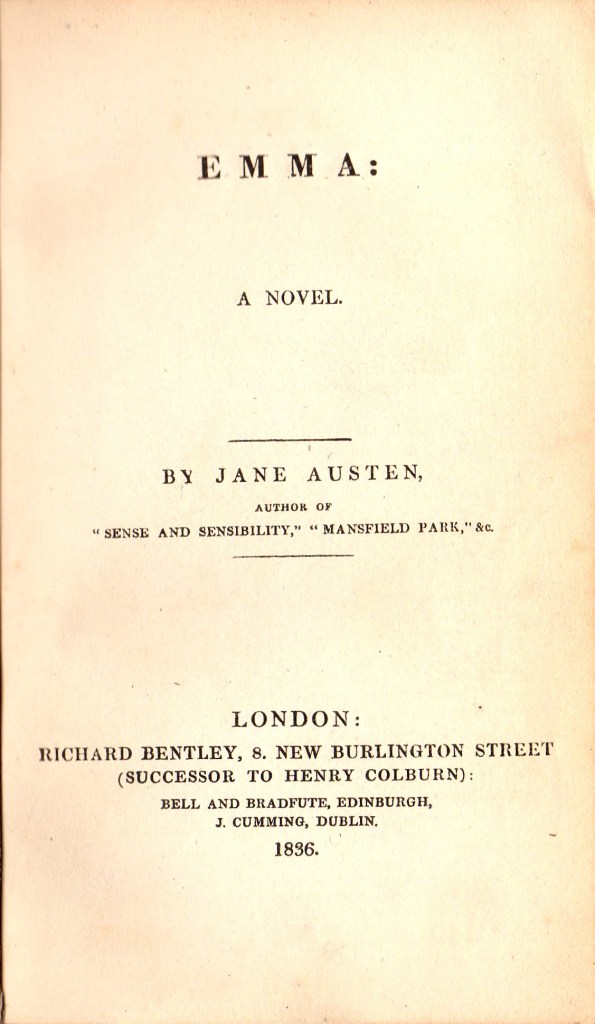
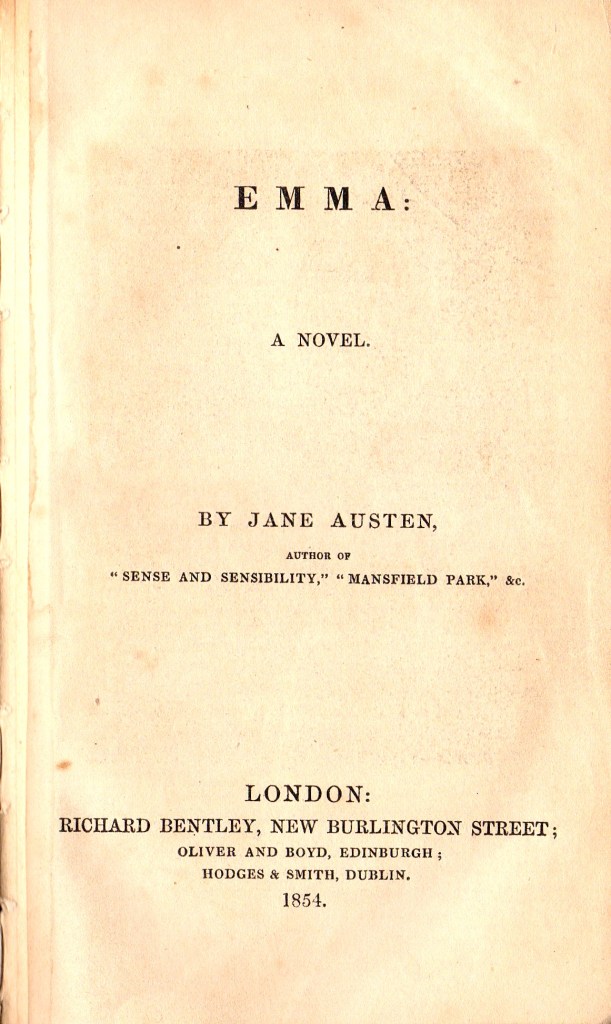
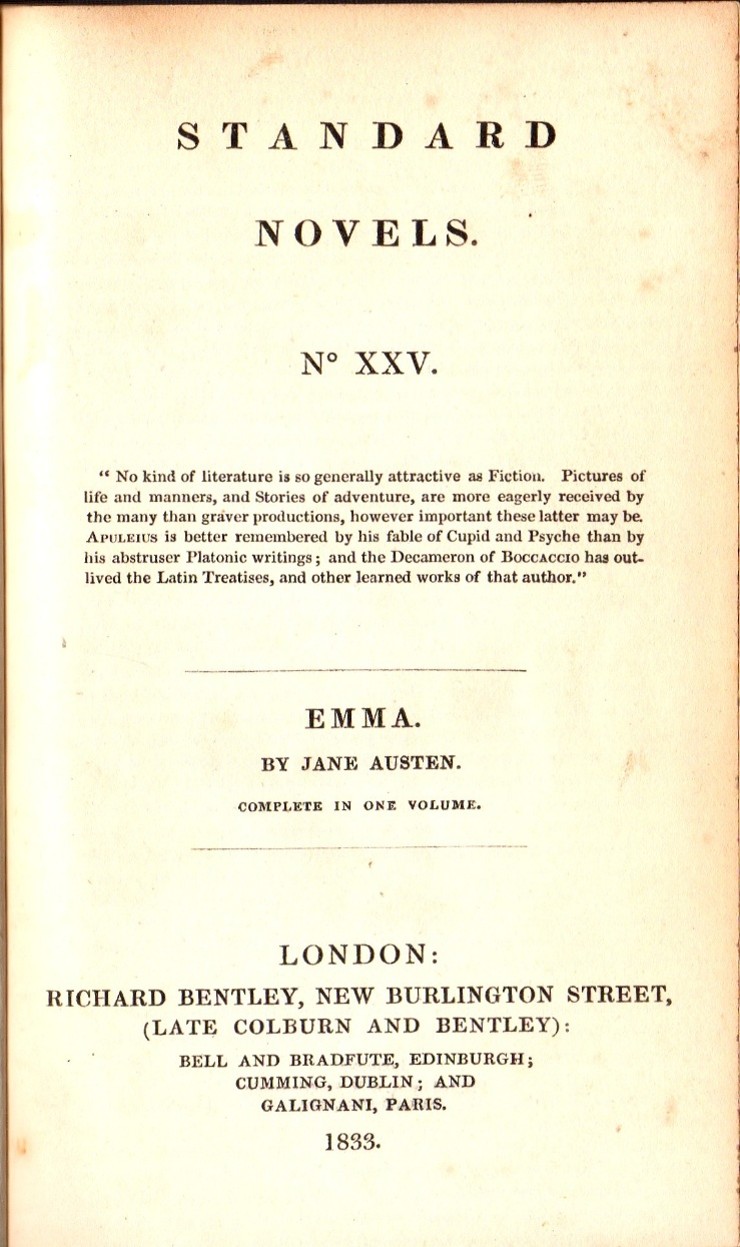
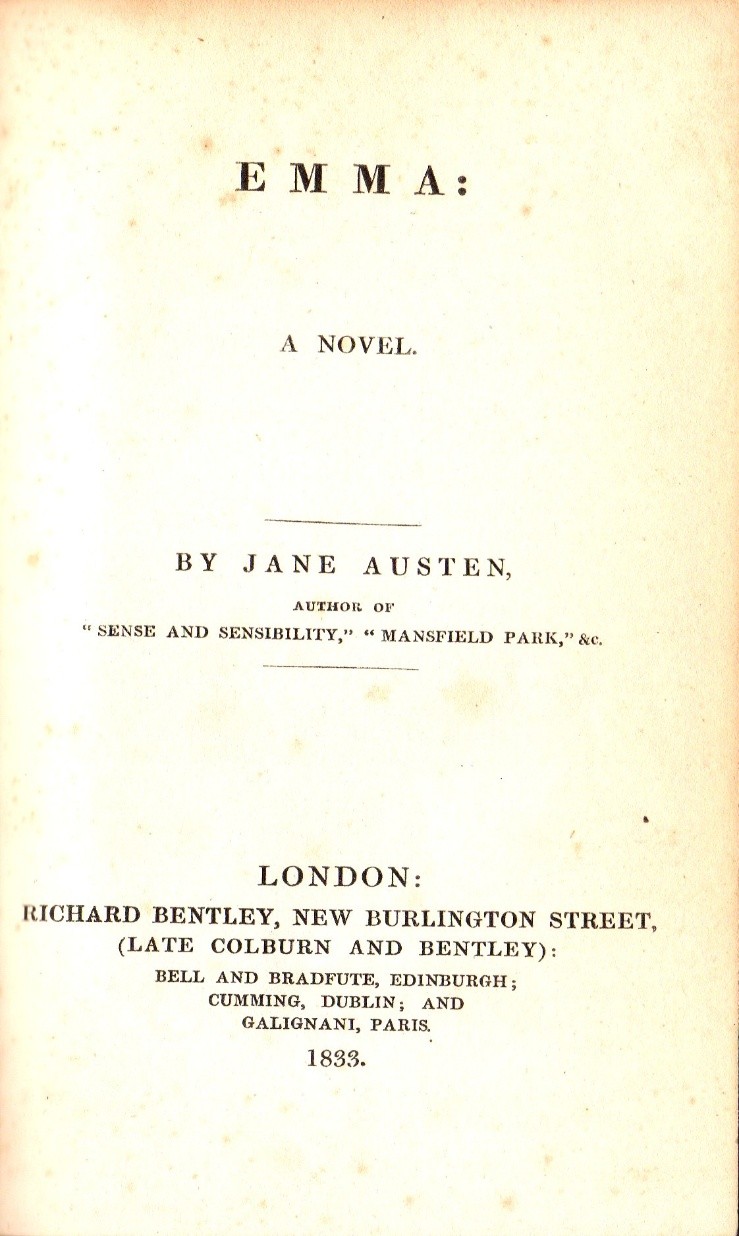
The format of Bentley’s Standard Novels was indeed standardised, so that each volume had a “series title page”, which identified it as a part of the Bentley’s Standard Novels series with a date of publication and a series number, a full page engraved frontispiece, an engraved title page, normally with an engraved date, and a letterpress or printed title page which had the title, authors name, Bentley’s name and address and a publication date. These four pages for first Bentley edition of Emma are shown in figure 1.

Figure 1. Series Title, Frontispiece, Engraved Title and Letterpress Title pages

Bentley published Emma in the same volume and chapter format as the original three volume first edition published by John Murray in December 1815. The novel starts with Emma | Volume the First | Chapter I. on page 1, and finishes Volume the First with the end of Chapter XVIII (18) on page 134 with the line “End of the First Volume”. Volume the Second begins with Chapter I of the second volume on page 135 and ends on page 279 at the end of Chapter XVIII (19) of the second volume, with the line “End of the Second Volume”. Volume the Third then begins on page 280 and the novel ends on page 435 with the last page of Chapter XIX (19) of Volume three with the simple words “The End”. By maintaining the volume and chapter structure of the first edition, Bentley has ensured that any sentence from any chapter of any book will be found in the same chapter and book in the Bentley edition as it was in the Murray first edition.

The book ends with the printer’s colophon on the verso of page 435. It reads “London: Printed by A. & R, Spottiswoode, New-street-Square.” on three lines. The only page missing from the Bentley edition of Emma is the dedication page that was included in the first edition of 1815, where Jane Austen dedicated Emma to the Prince Regent with these words: “To His Royal Highness, The Prince Regent, this work is, by His Royal Highness’s permission, most respectfully dedicated, by His Royal Highness’s dutiful and obedient humble servant, The Author.” It is not clear why Bentley chose not to include the dedication. It may be due to the fact that the Bentley edition of Emma was first published in 1833, in the reign of King William IV, younger brother and successor to the late, former Prince Regent, who had eventually reigned in his own right from 1820 to 1830 as King George IV. Perhaps respect to the present king outweighed respect to his predecessor.

Illustrations in Bentley’s 1833 edition of Emma

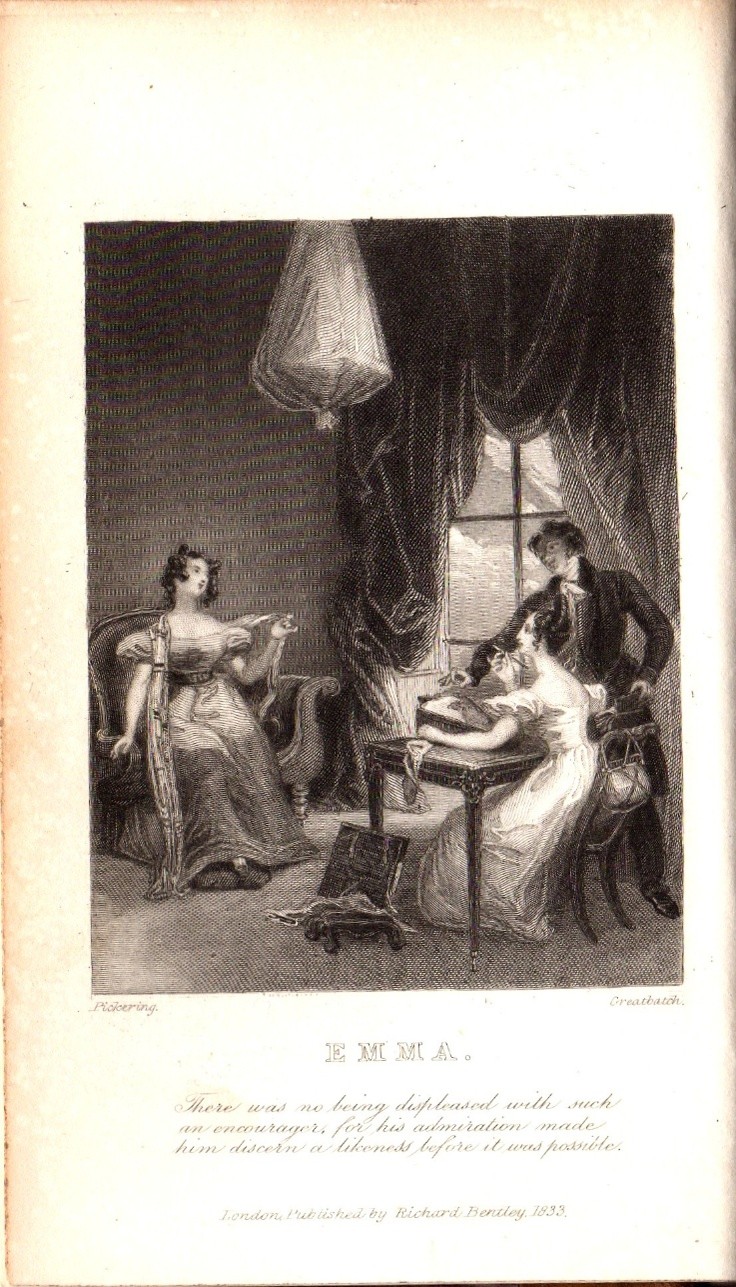
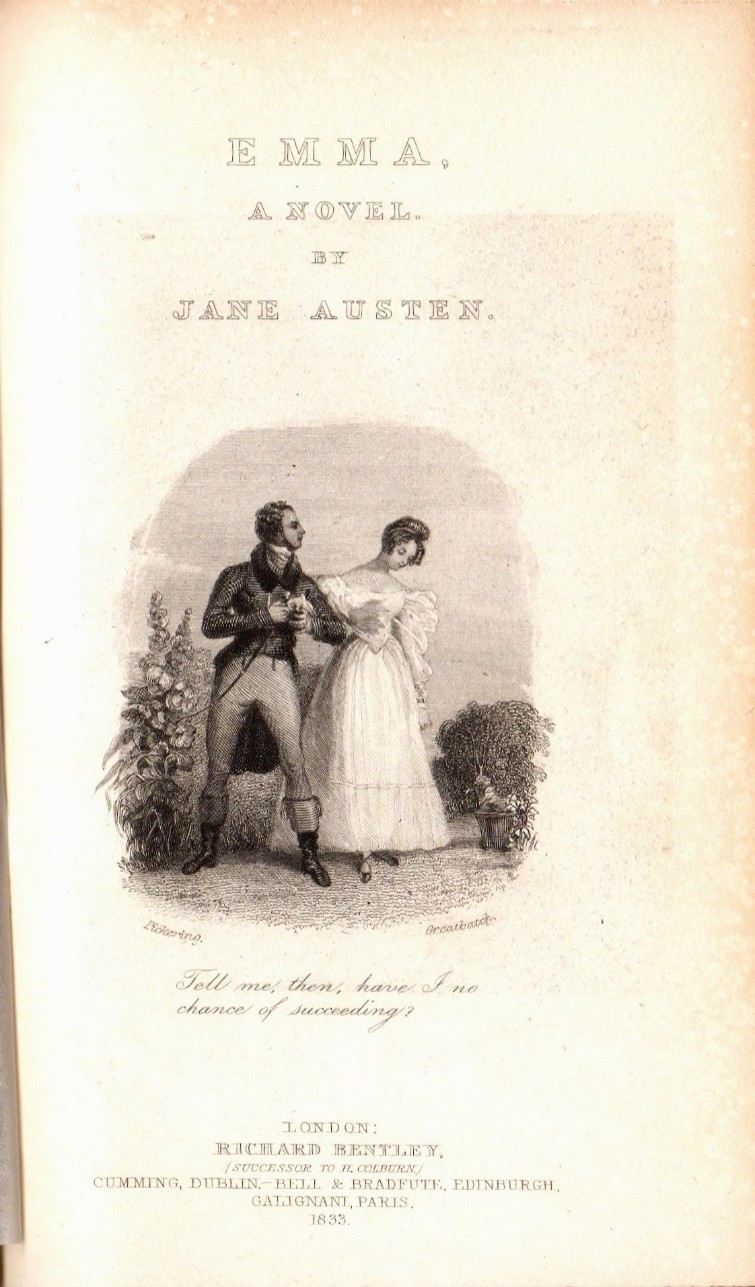
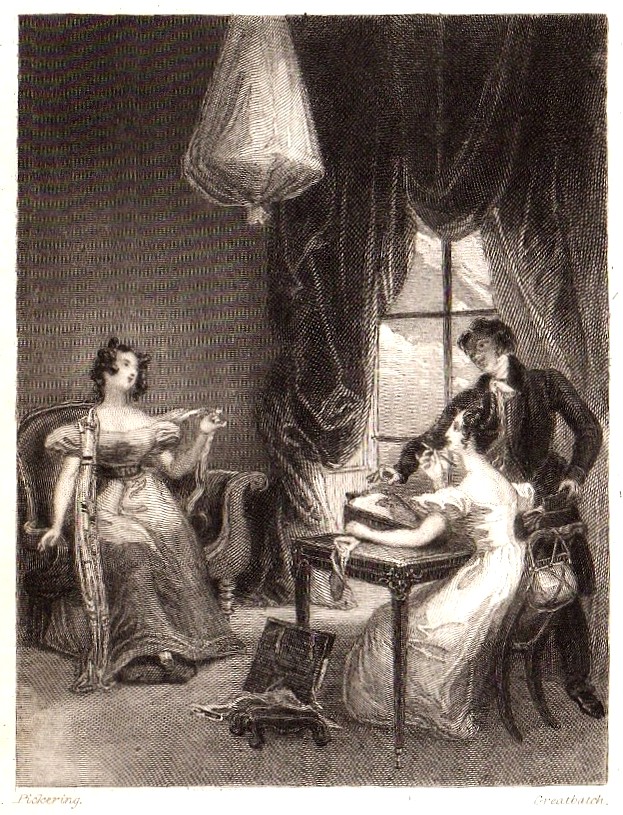
The two illustrations in this edition of Emma were drawn by Ferdinand Pickering (1810-1889) and engraved on wood by William Greatbatch (1802-1872). The identity of the artist had been uncertain for many years. The illustrations in Emma are clearly signed “Pickering”, which led David Gilson to suggest that they were by George Pickering (ca 1794-1857). However, other illustrations in the Standard Novel series that have many similarities of style to those in Emma are clearly signed “F. Pickering”, which has led to the corrected identification of Ferdinand Pickering as the artist. An enlarged version of the frontispiece is shown in Figure 2.

Figure 2. Frontispiece of Emma from Gilson D2.

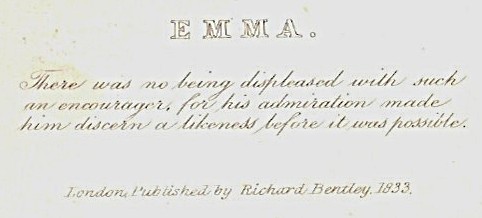
The name “Pickering” can be clearly seen at the bottom left of the image and “Greatbatch” at the bottom right. The picture depicts Emma Woodhouse drawing a portrait of her friend Harriet Smith, while Mr. Elton is playing very close attention to Emma. The style of the costumes is from the 1830s rather than being correct for the late 18th century to Regency period. The legend of the frontispiece is shown below as Figure 3.

Figure 3. Text below the frontispiece of Emma

The text reads “There was no being displeased with such an encourager, for his admiration made him discern a likeness before it was possible.” It is a direct quotation from Chapter 6 of Emma. Mr. Elton is lavishing praise on Emma, who he greatly admires, despite Emma’s attempts to deflect his attentions to Harriet. The final line in a smaller font reads “London, Published by Richard Bentley. 1833.” This is the publisher asserting his ownership of the copyright of the image, which he commissioned from Pickering and Greatbatch.

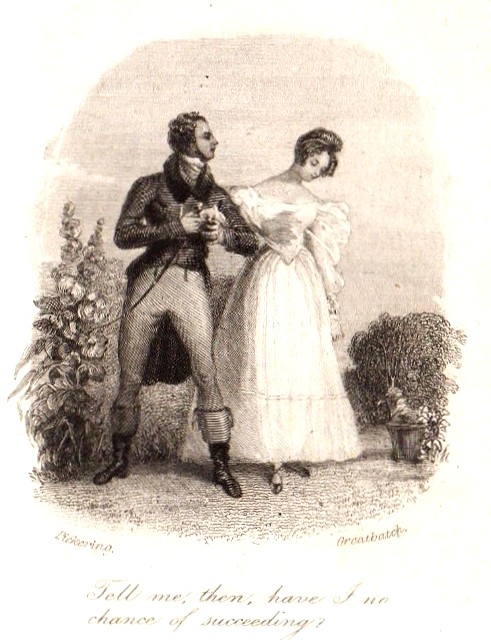
The engraved title page, together with an enlarged picture of the illustration, are shown below in Figure 4.

Figure 4. Engraved title page and vignette image from Emma

The engraved title page announces at the top that this is “EMMA. | A NOVEL. | BY | JANE AUSTEN.”. At the bottom of the page the publishers details are given thus: LONDON | RICHARD BENTLEY | (SUCESSOR TO H. COLBURN) | CUMMING, DUBLIN BELL & BRADFUTE, EDINBURGH | GALIGNANI, PARIS | 1833 . In the vignette, in the right hand panel, we see Emma out walking with Mr. Knightley, who has just declared his love for her. He then asks her “Tell me, then, have I no chance of succeeding?” which is the text below the image. This is taken directly from Chapter 49 of Emma. You can also see the names of Pickering and Greatbatch on the left and right lower corners of the image.

Reprints of the Bentley 1833 edition of Emma (Gilson D7)

Bentley’s edition of Emma was reprinted several times in the subsequent 35 years. Stereotype plates were created and used for reprints of Emma (Gilson D2) for the Standard Novels series that were published in 1836, 1841, 1851, and 1854. Emma was also reprinted as a part of five volume sets of “The Novels of Miss Austen” that were published in 1833, 1853, 1856 and 1866. All of the reprinted Bentley editions of the Austen novels were designated D7 by David Gilson. I have copies of the 1833, 1836 and 1854 issues of Emma and of the 1856 five volume set of the six novels. In Figure 5 below, I show the printed title pages for my Emma editions of 1836, 1854 and 1856. As well as having a different date from the 1833 edition, these are differences in the page layout, Bentley’s address and the Edinburgh and Dublin publisher’s details.

Figure 5. Emma Title pages from Gilson D7 editions of 1836, 1854 and 1856

All these three reprinted editions also contain the original engraved frontispiece from 1833. The 1836 and 1856 editions also contain the engraved title page that was first published in the 1833 edition, shown in Figure 1 above. The engraved pages all still show the date 1833.

The two Standard Novel reprints of 1836 and 1854 do not have a series title page, whereas the 1856 reprint from The Novels of Miss Austen set has a half title which just bears the single word “EMMA”. The page and chapter layout for the three reprinted editions are all identical to that of the 1833 first Bentley edition. However, the printers colophons on the verso of page 435 are all different from the 1833 edition. All editions have “London:” on the first line and “New-street-Square” on the third line but are all different in the second line. These are shown below.

  • 1833 edition: Printed by A.& R. Spottiswoode,
  • 1836 edition: Printed by A. Spotiswoode,
  • 1854 edition: A. & G. A. Spottiswoode,
  • 1856 edition: Printed by Spottiswoode and Co.,

Provenance of my Bentley Emma edition of 1854

In Figure 6 below, the front endpapers of my 1854 Bentley edition of Emma are shown. They show the provenance of this book in more recent years.

Figure 6. Front endpapers of my 1854 copy of Emma (Gilson D7)

The most obvious and prominent feature in Figure 6 is the bookplate of David John Gilson on the front pastedown. This is the Gilson who compiled the standard bibliography of Jane Austen and its is an absolute privilege for me to have this copy in my Austen collection. Gilson actually mentions this copy on page 229 of the Oak Knoll Press second edition of A Bibliography of Jane Austen. Above the Gilson bookplate there is an inscription in pencil which reads: ” D7: 1854 | Given to me by | David G | 3/8/85″. This was written by Gilson’s friend John Jordan, whose bookplate is on the lower right of the free front endpaper. The two other inscriptions are: “T. Lindsay, 1914″, doubtless a previous owner of the book, and the lower line which reads ” Rebound: Ferney-Voltaire; 1953″. The book is bound in an obviously 20th century ivory textured cloth binding.

Ferney-Voltaire is a small commune of around 10,000 in south-eastern France, close to the Swiss border. It was the residence of Voltaire from 1758-1778 and his Chateau can still be visited there. As well as the Voltaire museum in the Chateau Voltaire, there is a small workshop and museum of printing and bookbinding in Ferney-Voltaire called Atelier du Livre. It is currently run by an Englishman, Andrew Brown. This may be where the 1854 Emma was rebound in 1953, by a previous owner.

Return to the Index page for Illustrated Editions of Jane Austen.
1828 Raison et Sensibilité.

Published by Arthus Bertrand Paris. 2nd ed. 3 vols. Gilson C8

Illustrated by Charles-Abraham Chasselat

The first French edition of a Jane Austen novel to appear was Raison et Sensibilité, translated from Sense and Sensibility by Mme Isabelle de Montelieu and published in Paris by Arthus Bertrand in 1815 in four volumes. It did not have any illustrations. There is no mention of this translation in any of Jane Austen’s letters, so one might conclude that she was not aware of it.

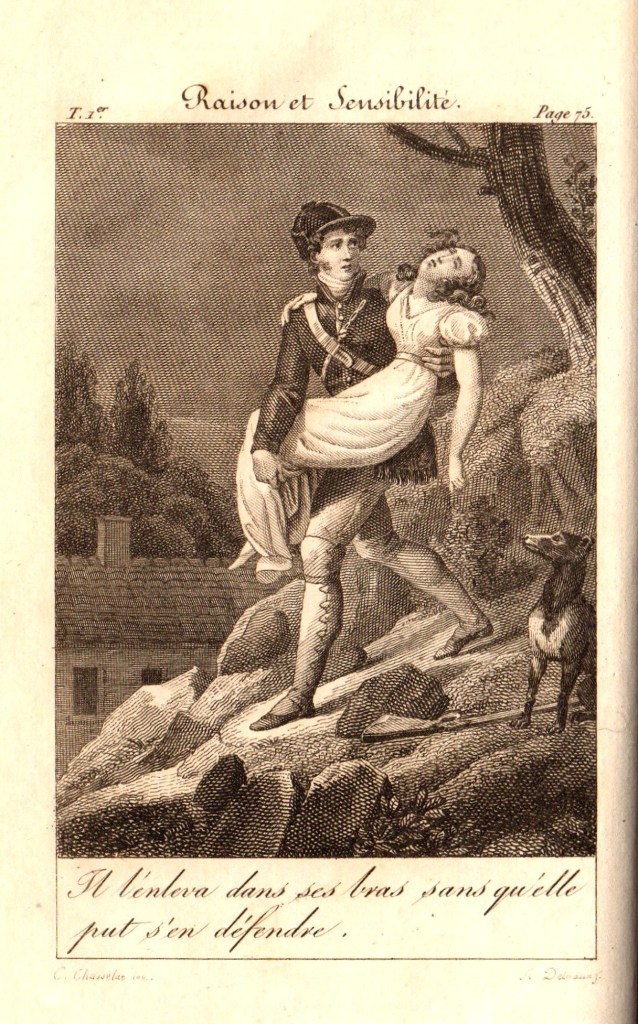
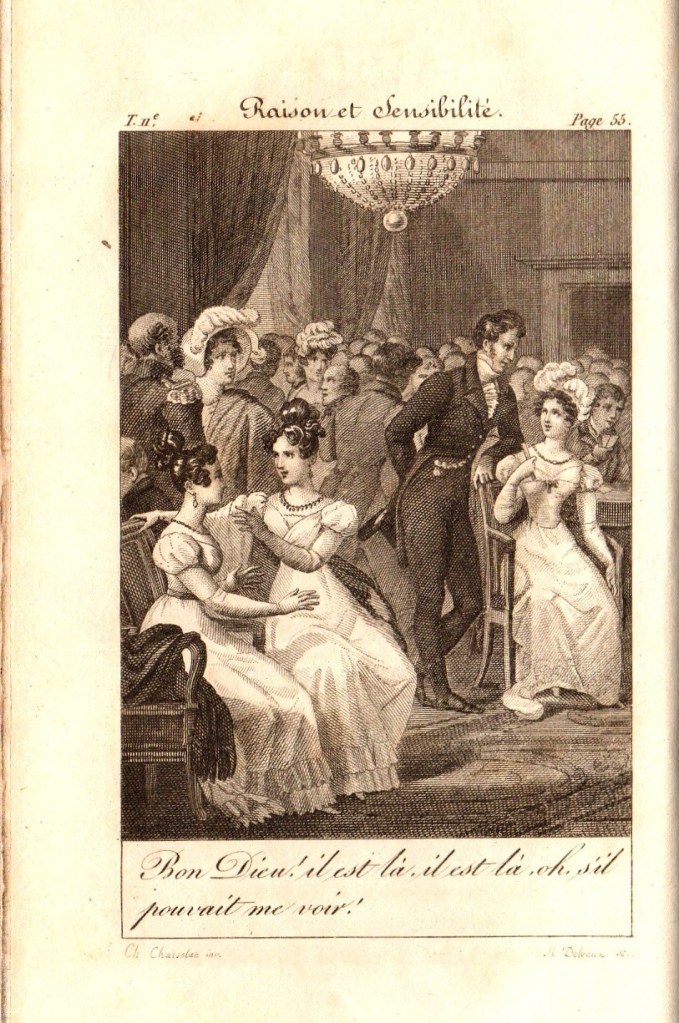
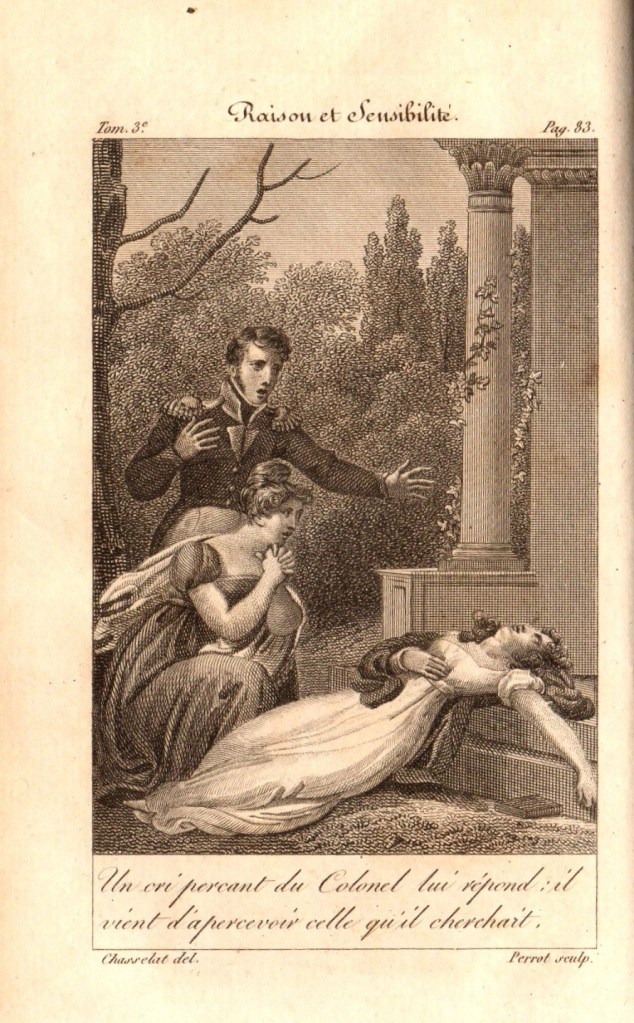
A second French edition of Raison et Sensibilité was published by Bertrand in Paris dated 1828. It is possible that this second edition was published in December 1827. This time, the Raison et Sensibilité, now published in three volumes, had a frontispiece in each of the three volumes. This is the first illustrated edition of Sense and Sensibility to be published anywhere. The illustrator for all three images was Charles-Abraham Chasselat, just as in the 1821 edition of La Famille Elliot described in a related article. The engraver was Auguste Delvaux for volumes 1 and 2, and then Jean-Simon-Narcisse Perrot (born 1796) for volume 3. The three frontispiece illustrations for Raison et Sensibilité are shown below in Figure 1.

Figure 1. Frontispieces for volumes 1,2 and 3 of Raison et Sensibilité

In volume 1 (Fig. 1 left), the picture shows Willoughby carrying Marianne back down the hill to safety, after she had twisted her ankle. The text below the image reads “Il l’enleva dans ses bras sans qu’elle put s’en défendre“, which can be translated as “He took her into his arms without her being able to defend herself” , which seems somewhat at odds with Austen’s description of the event. She also appears to have fainted in this picture.

In volume 2 (Fig. 1 centre), the scene is at a party in London, some while after Willoughby has “dumped” Marianne. She sees him across the room and exclaims, according to the figure legend. “Bien Dieu! il est là, ll est là, oh! s’il pouvait me voir!” This is not too far removed from Austen’s original text which read “‘Good heavens!’ she exclaimed, ‘he is there-he is there-Oh! why does he not look at me?” Elinor, who is seated next to Marianne tries to calm her down and prevent an embarrassing scene.

In volume 3 (Fig. 1 right), the picture shows Elinor and Colonel Brandon, who have found Marianne, who has rather melodramatically fainted by a small classical temple. The text reads “Un en’ percant du Colonel lui répend: il vient d’apercevoir celle qu’il cherchait”. This translates to something like “A piercing message from the Colonel answers him: he has just seen the one he was looking for.”

Readers, you will search in vain for this incident in Jane Austen’s Sense and Sensibility, as it simply does not occur. My view is that Mme. de Montolieu has added in this scene as a counterbalance to the rescue of Marianne by Willoughby shown in the left hand panel. In a way, it can be seen as validating Colonel Brandon as a suitor for Marianne, who is thus seen to be at least as gallant as Willoughby.

There are many other changes in the text, and the whole plot is rather distilled down to an account of the romantic tribulations of Marianne and her infatuation with Willoughby; Elinor and Edward Ferrars hardly get a look in, and Margaret, the third and youngest Dashwood sister, is virtually ignored and renamed “Emma”. Mme. de Montolieu gave her Raison et Sensibilité the subtitle “ou les deux manières d’aimer“, translated perhaps as “or the two ways of loving”. Those familiar with Sense and Sensibility might expect that this refers to the difference in approaches to romance of Marianne and Elinor, but for Mme. de Montolieu, I fear it represents the differences between Willoughby and Colonel Brandon.

Return to the Index page for Illustrated Editions of Jane Austen.
1821 La Famille Elliot.

First Illustrated Austen Novel

Published by Arthus Bertrand, Paris. 2 vols. Gilson C12

Illustrated by Charles-Abraham Chasselat

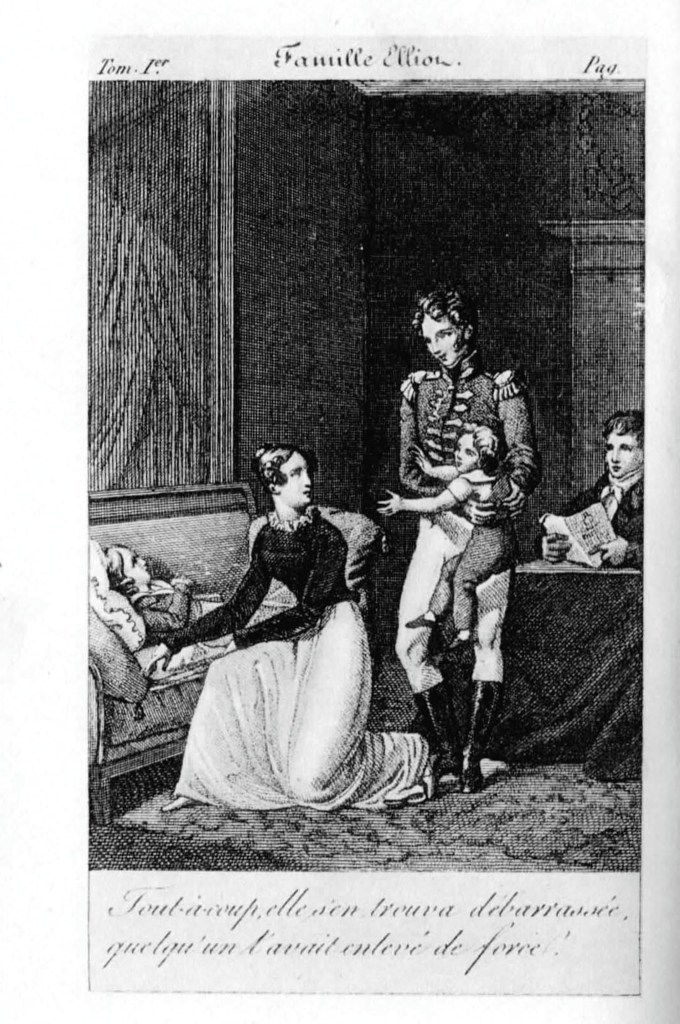
It seems ironic that the first illustrated edition of any novel by Jane Austen, that most English of authors, was published in France, but here it is. The first editions of the canonic six great novels of Jane Austen were published in London between 1811 and 1817 without any illustrations. Following Austen’s death in July 1817 and the posthumous publication of Northanger Abbey and Persuasion by John Murray in December 1817, there were no further editions of Austen’s novels published in Britain for 15 years. However in 1821, four years after the author’s death, a French translation of Persuasion was published by Arthus Bertrand in Paris in two volumes, under the title “La Famille Elliot” which translates to “The Elliot Family” in English. Each volume has a frontispiece illustration by Charles-Abraham Chasselat (1782-1843), a well-known painter of historical subjects, who also illustrated books by Voltaire, Racine and Moliere. The engraver of these frontispieces is given as “Delvaux”, which was Auguste Delvaux, (1786-1836), who was one of a pair of brothers, both of whom were fine engravers. Figure 1 shows the title page from volume 1 and the two frontispieces from La Famille Elliot.

Figure 1. Title page of Vol. 1 (left), frontispieces of Vol. 1 (centre) and Vol. 2 (right).

The title page headings read as follows (in French followed by English):

La Famille Elliot ou L’Ancienne Inclination. —– The Elliot Family or The Old Inclination

Traduction Libre de L’Anglais ———- Free Translation from English

D’Un Roman Posthume de Miss Jane Austen ——-From a posthumous novel by Jane Austen

Par Mme de Montolieu —— By Madame (Isabelle) de Montolieu.

This 1821 edition of a translation of Jane Austen’s Persuasion is not only the first Austen novel to have any illustrations; it is also the first time that the name “Jane Austen” is printed on the title page of any of her novels.

The translator, Madame de Montolieu had been born Jeanne-Isabelle-Pauline Polier de Botten in Lausanne in the French speaking part of Switzerland in 1751. After her first husband, Benjamin de Crousaz, has died in 1775, the year of Jane Austen’s birth, she remarried Baron Louis de Montolieu in 1786. After the baron died in 1800, she lived on for more than 30 years as a widow, publishing under the names Madame de Montolieu, Isabelle de Montolieu or La Baronne Isabelle de Montolieu, until her death in 1832. Her other translation of an Austen novel was Raison et Sensibilité, which was also published by Arthus Bertrand in Paris in 1815. This four volume edition was not illustrated, but a second edition in three volumes was published in 1828 with three frontispieces by the same illustrator as La Famille Elliot.

Legends for the two Frontispieces

The frontispiece to Volume One of La Famille Elliot has a text caption below the image which identifies the incident depicted. It reads: “Tout à coup elle s’en trouva debarrasseé, quelqu’ un l’avait enlevé de force.” This can be translated as: “Suddenly she found herself free of him; someone had taken him by force.” This refers to an incident where Anne Elliot is consoling her nephew Charles Musgrove, who is ill, but while she is trying to do this, Charles’ younger brother Walter Musgrove is climbing all over Anne’s back to get some attention, and is making a nuisance of himself. Captain Wentworth removes Walter Musgrove from Anne Elliot’s back. (Persuasion, Vol 1, Chapter IX p80.) This incident demonstrates the protective care that Wentworth feels that he should offer the young woman who he admires.

The frontispiece to Volume Two of La Famille Elliot also has a text caption below the image which identifies the incident depicted. It reads: “Il s’approcha de la table, montre la lettre à Alice, et sortit sans dire un mot!” This is easily translated to “He walked over to the table, showed Alice the letter, and left without saying a word!” This is the incident towards the end of the story, where Captain Wentworth presents a letter to Anne Elliot to explain his feelings (Persuasion, Vol 2, Chapter XI, p. 236).

You will note that the text refers to Anne Elliot as “Alice”. For some reason, the only name that Mme. de Montolieu alters in the book is Anne Elliot, who she renames Alice Elliot. Ironically, the translator has chanced upon the correct title for the book, as we learn from Jane Austen’s letters, published more than 50 years after the death of Mme. de Montolieu, that her working name for Persuasion was “The Elliot Family.” The name Persuasion was almost certainly coined by Jane Austen’s brother Henry Austen, who arranged the posthumous publication of the text by John Murray in 1817.

La Famille Elliot was reissued by Arthus Bertrand in 1828 in a complete edition of the works of Mme. de Montolieu. The text and illustrations were retained from the 1821 edition.

Return to the Index page for Illustrated Editions of Jane Austen.
Illustrated editions of Jane Austen

A summary and list

The following articles will be an detailed account of the most important and most attractive illustrated editions of the novels of Jane Austen. In this first part, I will simply list the editions that will be covered and give a brief summary of the illustrator and the edition. These editions will be listed in the order of first publication. This page will therefore be an index page for the following pages as they are developed. I will mostly focus on English editions, but there will be some notable exceptions. For every book that I cover, a reference will be given from the second revised 1997 edition of the magisterial bibliography of Jane Austen published by the late David Gilson, in the form of a “Gilson number” (eg. “Gilson D1”, which refers to the first Bentley edition of Sense and Sensibility published in December 1832). Each of the individual articles will present many examples of the illustrations, scanned from my own copies where possible. Where there are illustrated dust wrappers, I will show these as well.

In the Beginning…

None of the first English or American editions of the Austen novels were illustrated, so the story of illustrated editions of Austen begins surprisingly in France. The first French edition of a Jane Austen novel to appear was Raison et Sensibilité, translated from Sense and Sensibility by Mme Isabelle de Montelieu and published in Paris by Arthus Bertrand in 1815 in four volumes. It did not have any illustrations. The second French edition to appear was La Famille Elliot, translated by Mme de Montelieu from Persuasion and published by Arthus Bertrand in two volumes in 1821. It had two illustrations, a frontispiece to each volume. This is the first edition of any Austen novel to have any illustrations. Second editions of both of these books were published by Bertrand in Paris in 1828. This time, the Raison et Sensibilité (in three volumes) had a frontispiece in each of the three volumes. The two illustrations from the 1821 edition of La Famille Elliot were reissued in the 1828 second edition.

My listing of the illustrated editions of the Jane Austen Novels therefore begins with these two entries:

The next Austen novels to be published with illustrations were the individual volumes and the five volume set offered by Richard Bentley with frontispieces and title page vignettes:

These were the first English illustrated editions of Jane Austen’s novels. The novels were reprinted many times before being reissued in a new edition by Bentley starting in 1870. The details of the reprints and the second Bentley edition of 1870 will be given in the individual articles.

The first Austen novel to have illustrations throughout the text block was the edition of Mansfield Park published by Richard Groombridge and Sons in 1875. It had 7 full page illustrations engraved from pictures by A.F. Lydon.

More books will be added to the list as new articles are developed.

Keep watching.

1875 Mansfield Park.

Published by Groombridge and Sons, London. Gilson E43

Illustrated by Andrew Francis Lydon.

The First Illustrated edition of Mansfield Park

Mansfield Park by Jane Austen was first published in 1814 by T. Egerton as a three volume novel. A second edition, also in three volumes, was published in 1816 by John Murray. Neither of these two editions had any illustrations. The next edition to be published was a single volume edition published in 1833 by Richard Bentley (Gilson D3). It had an engraved frontispiece and an engraved title page with a vignette illustration. Technically, the Bentley edition is the first edition of Mansfield Park to have any illustrations, but in most collector’s opinions this would not count as an illustrated edition, as there are no illustrations either embedded or interleaved in the text.

Several other editions of Mansfield Park were published following the Bentley edition, particularly editions by Simms and M’Intyre (1846), Routledge (1857), Derby and Jackson (1857), Ticknor and Fields (1863) and Tauchnitz (1867). None of these were illustrated, even with a frontispiece.

The first illustrated edition of Mansfield Park was an undated edition published by Groombridge and Sons, 5 Paternoster Row, London. It is generally accepted that this edition was published in October 1875. The book contains 7 full-page engraved illustrations of drawings by Andrew Francis Lydon. Not only is this the first edition of Mansfield Park with a set of illustrations, it is the first edition of any Jane Austen novel to be published in English with a set of illustrations. The top board, engraved title page and letterpress title page of my copy of the Groombridge Mansfield Park are shown in Figure 1 below. Note the unusual rendering of “a” in the engraved page.

A F Lydon, the illustrator and B Fawcett, the printer

The seven illustrations were all engraved by the firm of Benjamin Fawcett (1808-1893), a fine printer and engraver, from original drawings by Alexander Francis Lydon (1836-1917), an Anglo-Irish watercolourist and engraver. The pictures are all signed “A F Lydon” as the artist, but they also have small and indistinct second signatures or marks by the individual engravers. This is underlined by the statement on the printed title page “Illustrated from Drawings by A.F.Lydon”. Indeed, much of the firm’s work was engraved by Benjamin Fawcett himself. Lydon was in fact an employee of Benjamin Fawcett (1808-1893), and had served his appenticeship as an engraver with Fawcett. This was mutually convenient as Driffield, a town in East Yorkshire, was both Lydon’s family home and the site of Fawcett’s business. There is a modern pub in Driffield today called “The Benjamin Fawcett”.

Lydon and Fawcett worked together over many years to produce mainly illustrations of wildlife, landscapes or architectural subjects. Lydon excelled in fine watercolour paintings of birds and plants, and also of grand houses in landscaped parks.

The binding is a standard one used by Groombridge and Sons for some of their published fiction. The last page of the text block of my Groombridge edition of Mansfield Park is numbered 440, and bears the name of the printer, “B Fawcett, Engraver and Printer, Driffield.” The page height is 18.7 cm. These three characteristics all support the idea that this edition was printed de novo, rather than being a reprint of an earlier known edition, as no other known edition of Mansfield Park fits this description. David Gilson gives this book the designation E43 in his A Bibliography of Jane Austen, where he reports a publication date of October 1875, derived from the English Catalogue of Books. WorldCat also gives the date 1975, which comes from the deposit copy held by the British Library, the only copy listed on WorldCat. This is a very rare book, which means that few people have seen the illustrations. I will show all seven on them in the following section.

The Lydon illustrations for Mansfield Park

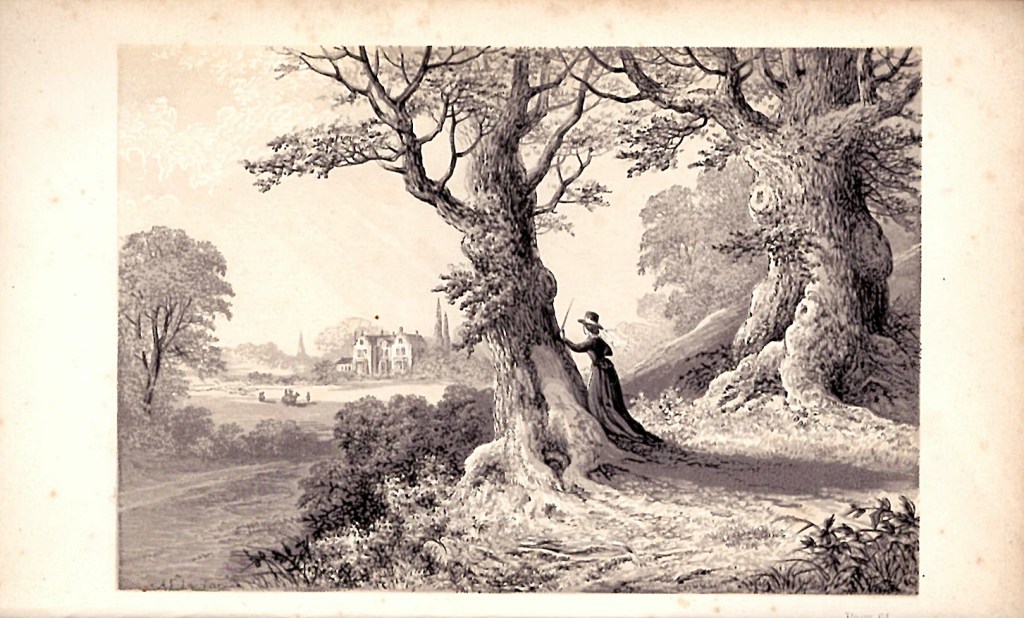
The illustrations for the Groombridge edition of Mansfield Park are all black and white printings of finely executed engravings on woodblocks of line drawings by Lydon. Several of them show off the artist’s skill in landscapes. This starts with the frontispiece, shown below in Figure 2.

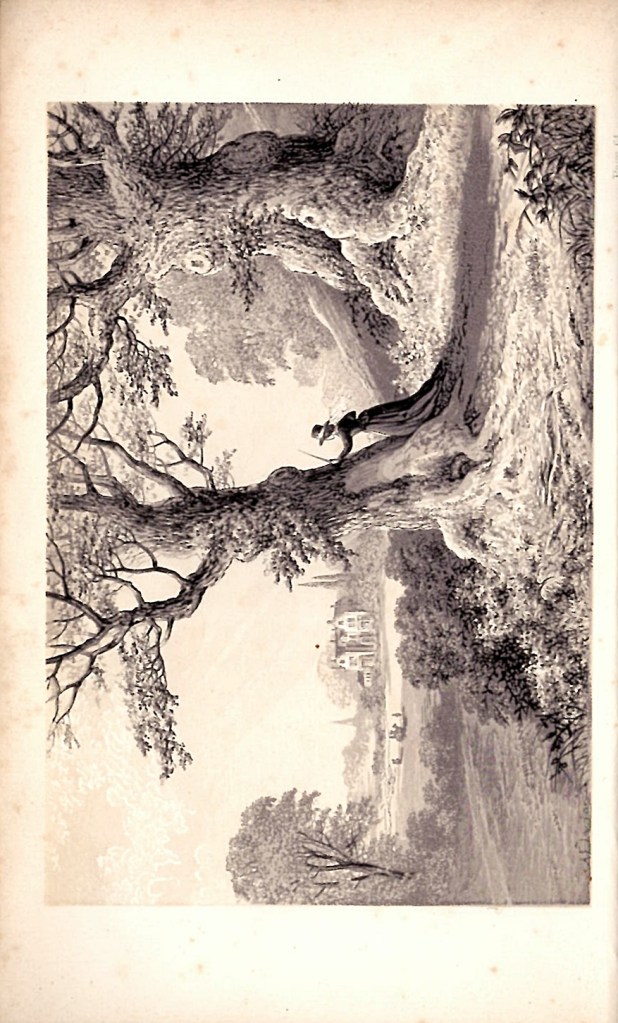
Black and white picture of woman in woods viewing a distant house.
Figure 2. Frontispiece to Mansfield Park

This shows the heroine, Fanny Price, looking back towards the riding party of Edmund Bertram and Miss Crawford in front of the house at Mansfield Park. The incident is from chapter 7. Lydon’s expertise in the depiction of landscape is very much to the fore in this design.

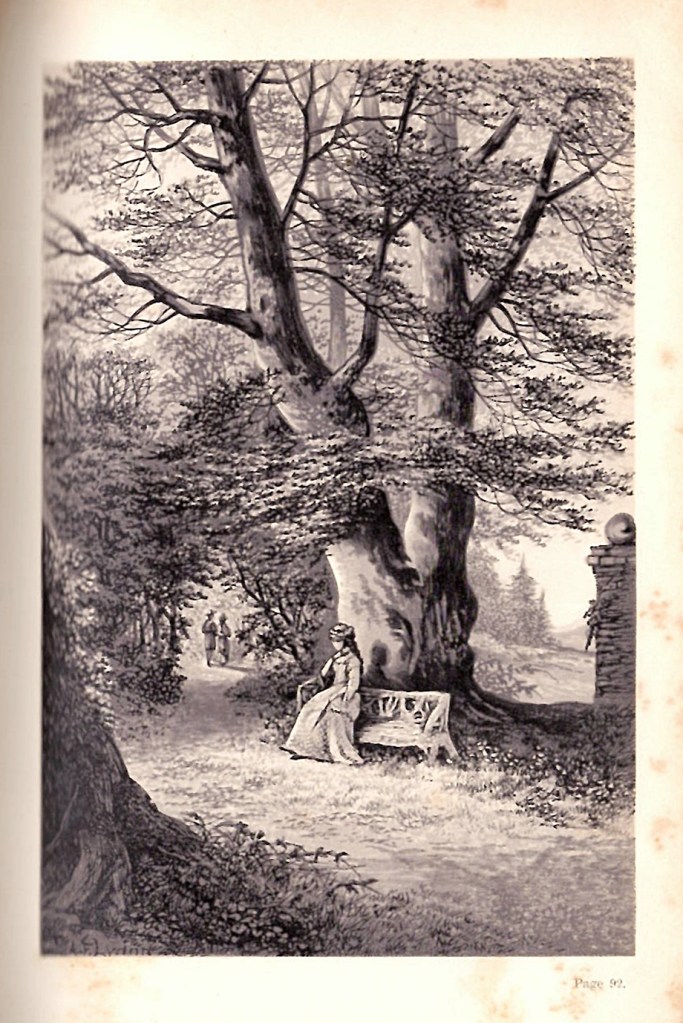
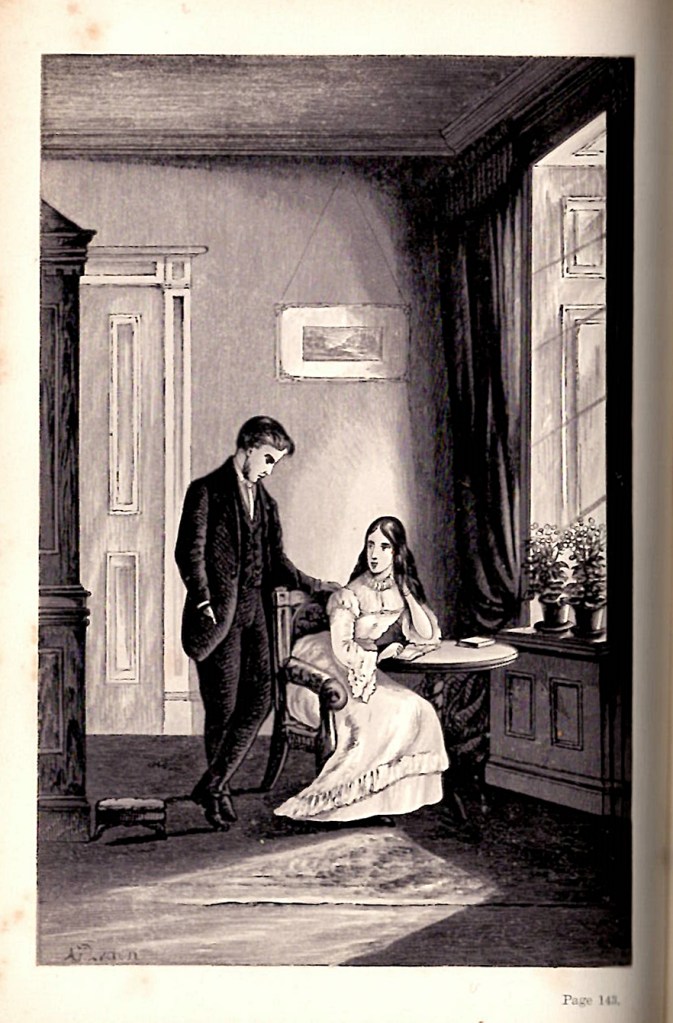
The second illustration (Figure 3, left) shows an incident from chapter 9, where Fanny, Edmund and Miss Crawford have rested on a seat during a walk in the woods. Edmund and Miss Crawford then walk on together to the end of the wood, leaving Fanny still on the seat to watch them disappear together down the path.

The illustration shown on the right of Figure 3 depicts Edmund explaining to Fanny his concerns about the propriety of the amateur dramatics that the house party is engaged in.

In the next illustration (Figure 4), which is from chapter 25, we return to Lydon’s love of landscape as he depicts Henry Crawford’s story of stumbling across the village of Thornton Lacey, his promised living, while walking his lame horse back to Mansfield Park.

Figure 4 Henry Crawford views Thornton Lacey.

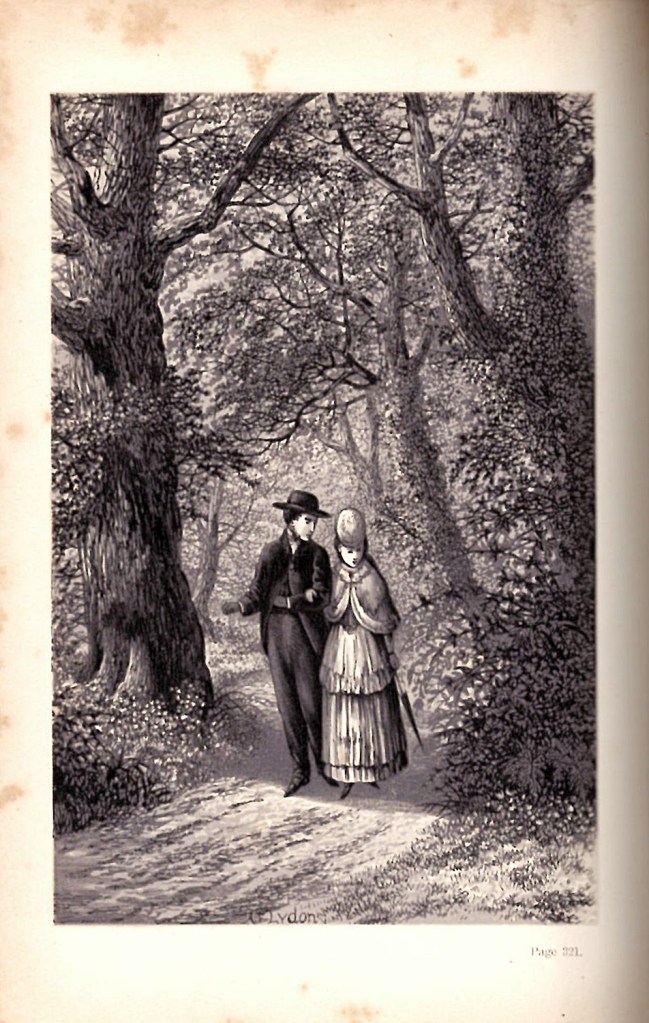
In the next illustration (Figure 5 left), taken from chapter 35, we see Edmund and Fanny walking together arm in arm as Edmund tries to find out what feelings she might have for Henry Crawford. In Figure 5 (right), we have moved on to chapter 41, where Henry Crawford is talking about his future prospects to Fanny Price at Portsmouth docks, rather wishing that Fanny’s younger sister, Susan, was not present.

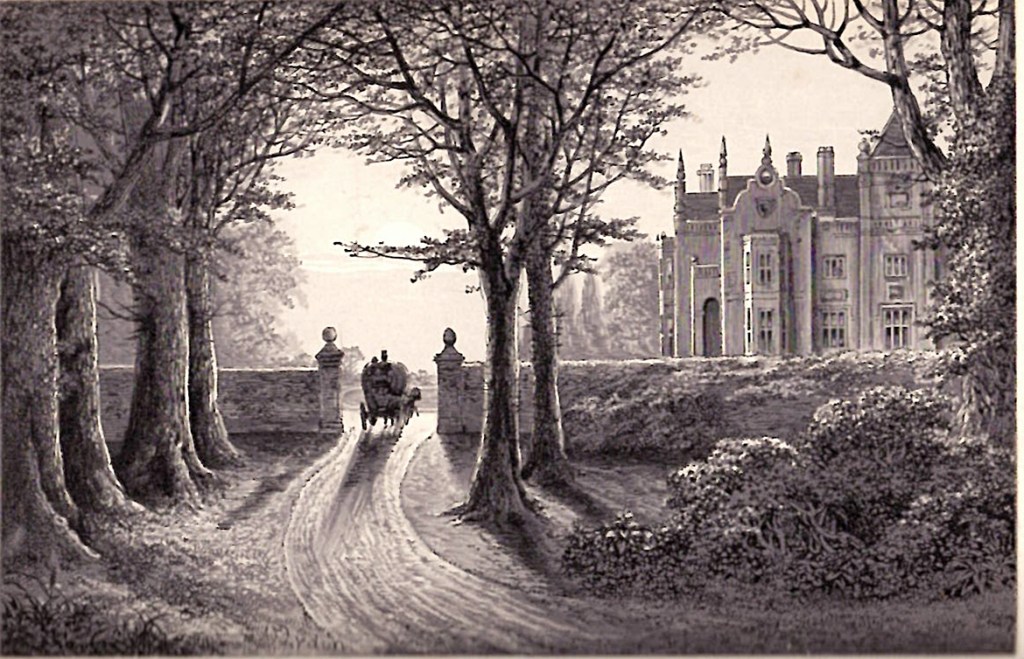
The final illustration, shown in Figure 6 below, comes from an event in chapter 46, when Fanny, accompanied by her excited sister Susan and a nervous Edmund Bertram, returns to Mansfield Park by carriage from Portsmouth. This picture shows off Lydon’s facility in drawing country houses and landscaped grounds.

Figure 6 Fanny’s return to Mansfield Park

These seven drawings give an interesting view of an Austen novel through the eyes of a landscape and wildlife artist. Although the clothes depicted are decidedly from the 1860s and 1870s rather than Regency period, the drawings offer an interesting contrast to the classic illustrations of Austen by some other illustrators, whom tended to concentrate on fine drawings of interiors, with accurate depictions of costume, manners and decor of paramount importance.

This is the only novel of Jane Austen known to be illustrated by A. F. Lydon.

A few comments on the publisher, Groombridge and Sons

Richard Groombridge started as a publisher in 1833, when he operated out of his home, 6 Panyer Alley, using the imprint of Richard Groombridge or R. Groombridge. Four of his sons served as his apprentices and joined the firm to work as publishers and booksellers. In 1845, when his two eldest sons were 28 and 25 years old respectively, the imprint of the firm was changed to “Groombridge and Sons”, usually followed by “5, Paternoster Row” on the title page. Following Richard Groombridge’s death in 1855 the firm was run jointly by the two oldest sons. Sadly, the three oldest sons all died between 1860 and 1868, leaving the youngest, Charles Groombridge, as the last surviving son of the founder. He seems to have lost interest in publishing sometime during the 1860s, and by the 1870s, the firm was run by three grandsons of Richard Groombridge until it ceased to trade sometime around 1900.

R. Groombridge and Groombridge and Sons were best known as publishers of books on religion, agriculture and natural history, although they did also reprint several of the novels of Grace Aguilar (1816-1847), a popular writer on themes of Jewish history and religion. The Groombridges worked closely with Benjamin Fawcett, publishing many of his finely illustrated books between 1844 and 1890.

It is not known why Groombridge and Sons decided to publish an illustrated edition of Mansfield Park in 1875. It is even possible that the genesis of the book came from the printer, Benjamin Fawcett or the illustrator A F Lydon. We shall probably never know. For more details about the Groombridge family of publishers, read my Groombridge, Publishers page.

Return to the Index page for Illustrated Editions of Jane Austen.
Emma takes to the West End stage

An exploration of the first London stage production of Jane Austen’s Emma

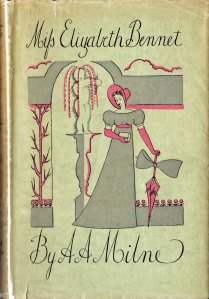
The novels of Jane Austen have been the basis of many dramatic performances from the first home theatrical extracts arranged by Rosina Filippi and published by J M Dent in 1895, to the modern adaptations of the novels for the movie and television industries. The first full play to appear as a dramatic adaptation was a version of Pride and Prejudice published in 1906, and several more adaptations of this novel have continued to appear over the subsequent 100 years, including, in 1936, Miss Elizabeth Bennet by A.A. Milne, the author of Winnie-the-pooh.

Dramatic versions of Emma

The first full dramatic version of Emma to be published was Romances by Emma by DeWitt Bodeen in 1938, which was first performed in Pasadena, California. This was followed by Emma by Marion Morse MacKaye; the play was written in 1937 but the author died before its first publication by Macmillan and first performance at the North Dakota Agricultural College, both occurring in 1941. The first English dramatisation of Emma was a three act play called Emma, written by John Lindsey and Ronald Russell, which was published by the theatrical script publisher Samuel French in 1943 and first produced at The Little Theatre in Bristol in March of the same year.

The first London production of Emma

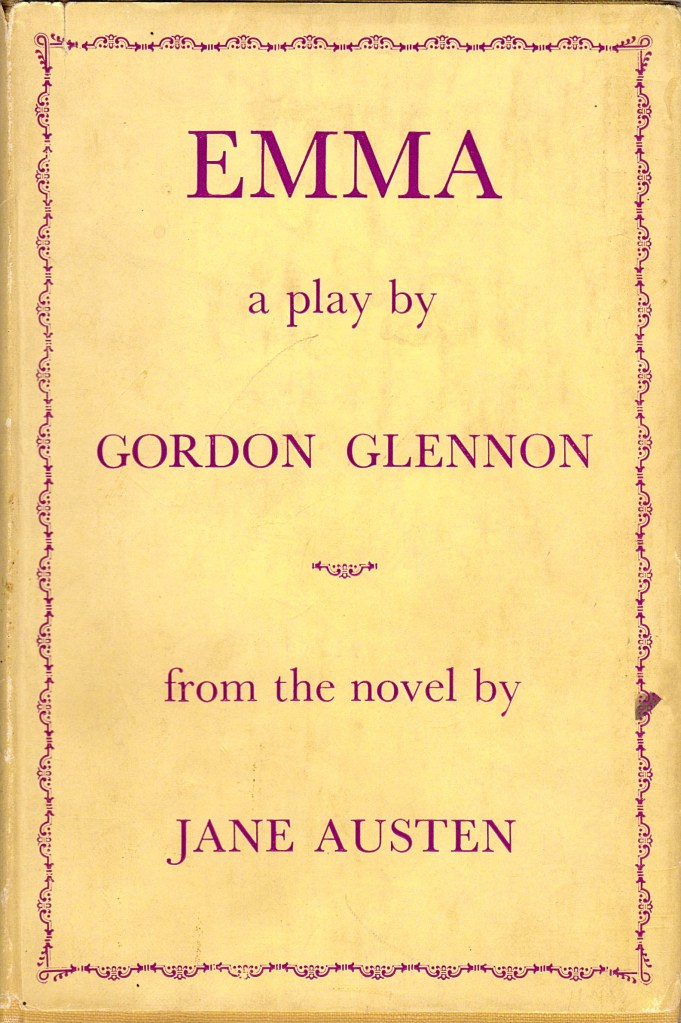
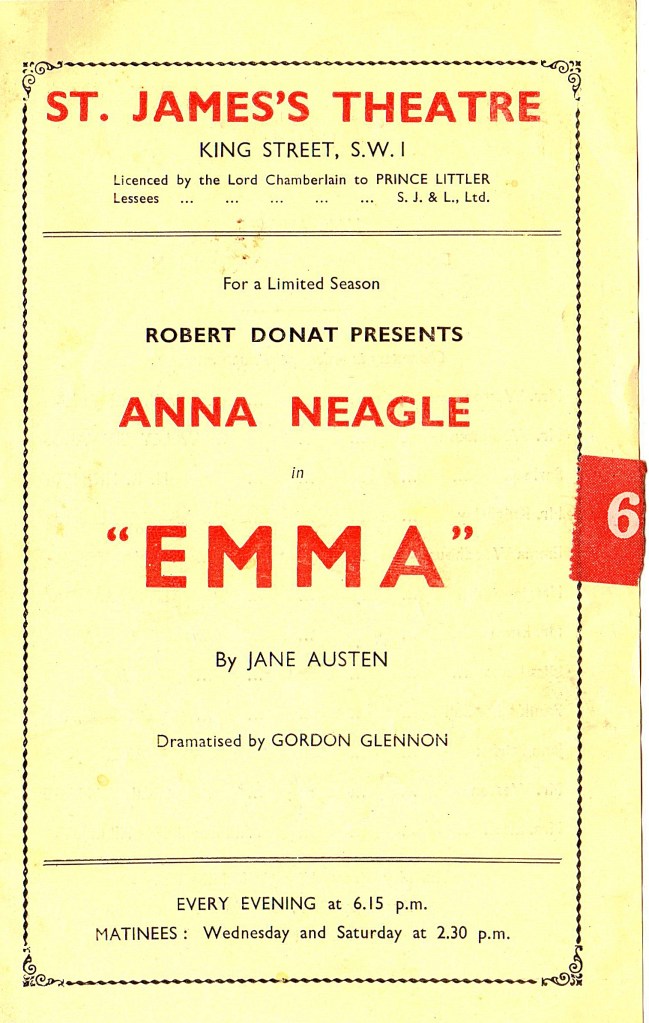
The first production of Emma to appear in a theatre in London was a three act play, Emma, written by Gordon Glennon and published by Macmillan in 1945. Before coming to St James’s Theatre in London, the play had a successful regional tour, opening with performances in Rugby in August 1943 and including a popular and critically acclaimed season in Manchester before the first London performance on 7th February 1945. The play was produced by the popular film star Robert Donat, who worked as a theatrical promotor during the Second World War. The play had a cast of 12 actors, led by Anna Neagle, (1904-1986), a popular starlet who had started as a stage dancer but who had achieved recent film successes in the title roles of films about Nell Gwyn (1935), Queen Victoria (1937 and 1938) and Edith Cavell (1939). As well as a very good copy of the first Macmillan edition of Emma (1945) in dust jacket, I also have a copy of the program for the London season of the play, which was only moderately successful at around 60 performances.

The play, which ran in London from February to April 1945 was in competition with air raids from Hitler’s Vengeance weapons, the V1 “Doodlebug” and the V2 rocket designed by Wernher von Braun. A V2 exploded very close to the theatre during one evening performance. There is interesting advice in the program to the theatre patrons on how to react to an air raid, which I have reproduced below.

Emma the play

The play is structured into three acts, with Act 1 consisting of a single scene and Acts 2 and 3 both arranged as two scenes each. The program tells us that the events take place in 1815. All of the action of the play occurs on the same set, which represents the Woodhouse’s drawing room at Hartfield. This means that we hear about events that occur elsewhere, such as Harriet’s encounter with the gypsies, and the Weston’s ball, all during conversations in the drawing room, and that Mr. Elton’s attempted proposal to Emma, Frank Churchill’s misapprehended conversation to Emma about Jane Fairfax and Emma’s insulting remark to Miss Bates all are arranged to occur within the Woodhouse’s drawing room.

The dialogue of the play is sometimes close to the original words of the novel and at other times diverges quite considerably. For instance, here from Act 2 Scene 2 of the play is Glennon’s version of the remark by Miss Bates which provokes Emma’s insult, followed by Emma’s unfortunate response:

Miss Bates: Oh, that will not be difficult. I shall be sure to say three dull things as soon as I open my mouth.

Emma: (unable to resist) Ah, madam, but you will be limited as to the number – only three at once.

Emma Act 2 Scene 2.

This is a considerable contraction of the original dialogue from Chapter 43 of Emma, which takes place during the outing to Box Hill. It diminishes the prolix nature of Miss Bates’ conversation. Here is the original as written by Jane Austen:

“Oh! very well,” exclaimed Miss Bates; “then I need not be uneasy. ‘Three things very dull indeed.’ That will just do for me, you know. I shall be sure to say three dull things as soon as ever I open my mouth, shan’t I?” looking round with the most good-humoured dependence on everyone’s assent. “Do you not all think I shall ?”

Emma could not resist.

Ah, ma’am, but there may be a difficulty. Pardon me, but you will be limited as to the number – only three at once.

Emma, Chapter XLIII

I leave the reader to judge how well or otherwise Mr. Glennon has done with this famous passage.

Images from the play

Both the program and the book of the play give the original cast list. I have reproduced the version from the program below. I am not aware of any changes to the cast during the play’s short London run. I assume that this program, which cost 6d, was held by a woman, as the red smudge, seen alongside Harriet Smith and Mr. Elton, appears to be lipstick!

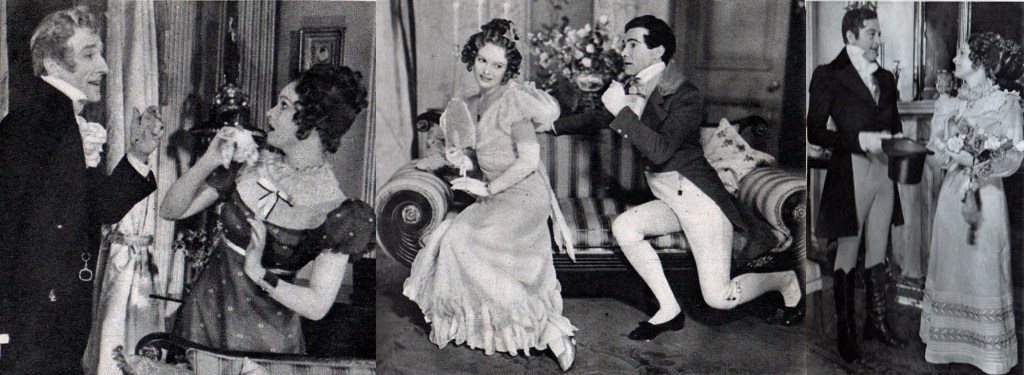
I had wondered what the set and actors looked like and how authentic the costumes were. I have recently been fortunate enough to gain some insight into this. I have just received a copy of an edition of Emma published in 1890 by George Routledge and Sons Ltd. The Irish dealer who I bought it from had described the book as having “some newspaper cuttings stuck to the front prelims”. Imagine my delight to discover that these cuttings were pictures taken from a magazine of the London production of Gordon Glennon’s Emma, with Anna Neagle and the rest of the cast as listed above. Photos of Mr. Elton’s proposal to Emma, Frank Churchill’s non-proposal to Emma and Mr. Knightley’s proposal to Emma are shown below.

Left: Mr Elton and Emma. Centre: Frank Churchill and Emma. Right: Mr. Knightley and Emma

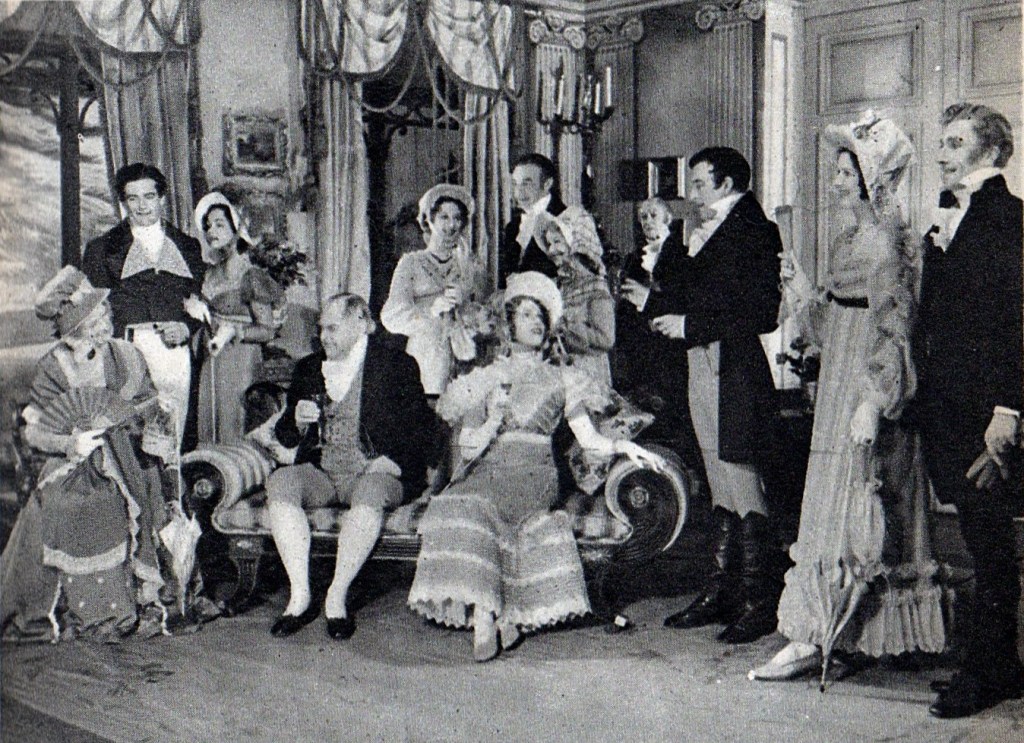
The play ends with the whole ensemble on stage, with everyone asked to toast the three future brides, Jane Fairfax, Harriet Smith and Emma Woodhouse in turn. Note that Glennon has decreed that Frank Churchill and Jane Fairfax will marry. Also note that Robert Martin does not get an appearance in this version of Emma. Below is the picture of that final final toasting scene.

From the left we can see:

Miss Bates; Frank and Jane; Mr. Woodhouse; Mrs. Weston; Emma; Mr. Weston; Harriet; Serle; Mr. Knightley; Mrs. and Mr. Elton

For more information on the representations of Emma on stage, I suggest that you view the entertaining video presentation by Professor Devoney Looser at the 2020 Virtual JaneCom which can be viewed on You Tube.

More about interesting books relating to Jane Austen will be posted shortly.

Price and Provenance 12

Pride and Prejudice 3rd edition and the Crimean War

This posting is about my copy of the third edition of Pride and Prejudice and a link between its first owner and me, through the unlikely route of the Crimean War.

The First and Second Editions of Pride and Prejudice

The first three editions of Pride and Prejudice were all published by T. Egerton of Whitehall in London, who had also previously published Jane Austen’s first novel, Sense and Sensibility. Although Pride and Prejudice was published after Sense and Sensibility, it is generally agreed that the first draft of the novel, known to have been called First Impressions, was written before Sense and Sensibility. Jane’s sister, Cassandra Austen, reported that First Impressions was written between October 1796 and August 1797 at Steventon. Jane’s father, the Rev. George Austen, is known to have written to the London publisher Cadell about the manuscript on 1st November 1797, only to receive a rapid rejection of it sight unseen. We also know from letters that the family enjoyed readings of First Impressions in 1799. Before the publication of Sense and Sensibility, we know that Jane Austen returned to her “rejected” manuscript for major revisions around 1809-1810, changing the title as another author, Margaret Holford, had already published a novel called First Impressions in 1800. We know that the title Pride and Prejudice comes from the repeated use of the phrase on page 303 of Volume V of Fanny Burney’s Cecilia, a book that we know that Jane Austen possessed. After the successful publication of Sense and Sensibility in 1811, Jane Austen famously “lopt and cropt” the manuscript of Pride and Prejudice in 1812, before selling the copyright to Egerton for 110 pounds.

The first edition of Pride and Prejudice was published in late January 1813 in three volumes in an edition of 1000 copies. Where the first edition of Sense and Sensibility was famously written “By a Lady”, Pride and Prejudice carried the by-line “By the Author of Sense and Sensibility.” Pride and Prejudice is first recorded in a newspaper advertisement published on 28th January 1813, where the novel was advertised as on sale for 18 shillings. Although positive reviews were published in February, March and April of that same year, its reputation was largely spread by word of mouth and there was much conjecture about the identity, and even the gender, of the author.

The first edition of Pride and Prejudice sold out in a few months, and the second editions of both Pride and Prejudice and Sense and Sensibility were published by Egerton in late 1813. They were both in the original three volume format of the first editions, and although Jane Austen had made some slight changes to the second edition of Sense and Sensibility, it is believed that she had no opportunity to make any alterations to the second edition of Pride and Prejudice, and was not shown a proof. There are a few minor textural differences between the first and second editions of Pride and Prejudice that are generally explained as the correction of printer’s errors from the first edition, as well as the introduction of some new printer’s errors into the second. There is no definitive information on how many copies of the second edition were printed and sold, but the number is believed to be 1000 copies. David Gilson recorded in his bibliography that about 50 copies of the first edition and 25 copies of the second edition were known to have survived into the late 20th century.

The Third Edition of Pride and Prejudice

The third edition of Pride and Prejudice was the final edition of Jane Austen that was published by Egerton, following the first two editions of Sense and Sensibility and Pride and Prejudice and the first edition of Mansfield Park in 1814. Indeed, it was in part the refusal of Egerton to publish a second edition of Mansfield Park that led to Henry Austen, Jane’s brother and de facto literary agent, to approach John Murray about the publication of the first edition of Emma and a second edition of Mansfield Park in 1816.

The third edition of Pride and Prejudice was published in 1817 as a two volume edition for 12 shillings. The precise date of publication is not known, and is of particular interest as Jane Austen died on July 18th 1817. Gilson reported knowledge of a copy with an inscription dated September 6th 1817, but more recently, a dealer has reported seeing a copy with an inscription from July 1817. There is no evidence that Jane Austen or any other member of the family had any input into the making of the third edition. The number of copies printed is not known, but is unlikely to be more than 1000. Gilson reported the existence of around 25 copies, including two in their original light blue binding.

To construct a two-volume version of Pride and Prejudice from the earlier three-volume versions required a renumbering of the chapters, as the chapter numbering was restarted for each volume. The first and second editions of Pride and Prejudice were made up as follows: Volume 1: Chapters 1-23; Volume 2: Chapters 1-19; Volume 3: Chapters 1-19, making 61 chapters in total. The third edition was constructed by making Volume 1 contain 33 chapters, that is all of Volume 1 from the first edition together with chapters 1-10 from Volume 2 of the first edition. Volume 2 of the third edition was made up of chapters 11-19 from Volume 2 of the first edition together with all 19 chapters from the original Volume 3. Unfortunately, Egerton misnumbered the chapters in Volume 2 of the third edition, numbering them 1-11 and 13-29, so that there appear to be 62 chapters rather than 61.

The structure of the third edition is important, as almost all of the reprints of Pride and Prejudice for the following 100 years use the text of the Egerton third edition as their source. There was no major review of the text until the Oxford edition edited by Robert Chapman was published in 1923. Fortunately, no other publishers repeated the chapter numbering mistake made by Egerton.

My copy of the third edition of Pride and Prejudice.

Figure 1 below shows my copy of the third edition of Pride and Prejudice. The books are in a rather worn half binding of brown marbled boards and brown soft leather on the spine and corners. The binding looks as if it could be contemporary, since the style is consistent with a binding of the first quarter of the 19th century. It is certainly not the original binding, which should be in light blue paper-covered boards.

The title pages of the two volumes are shown in Figure 2 below. They are typical of the style of title pages of their time, giving the standard information of title, author, volume number, publisher details and date with no decoration other than the small horizontal lines.

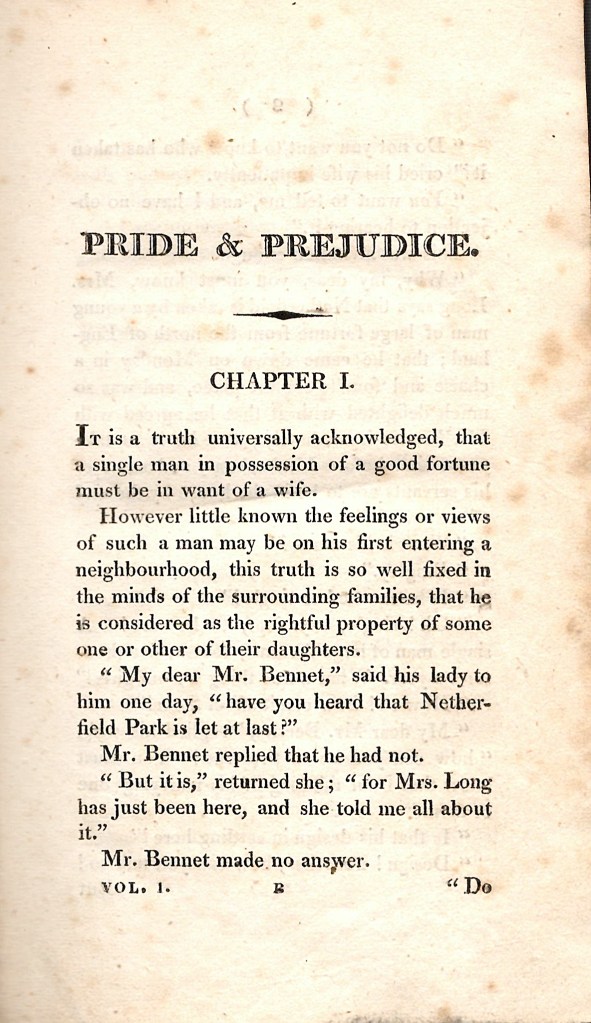
The “byline” is “by the author of Sense and Sensibility &c”, with the “&c” relating to Mansfield Park and Emma, which had been published in 1814 and 1816. Like the first and second editions of Pride and Prejudice, the publisher’s details are given as London: Printed for T. Egerton| Military Library, Whitehall. This is slightly misleading, as Egerton’s offices were actually in St. Martin’s Lane, but I think that the combination of “Military” and “Whitehall” is deliberately used in an attempt to make the publisher sound more prestigious. You can see from the images that the pages show some foxing, the brown discolouration caused by the interaction of mould with acidic paper. Indeed the paper quality is not particularly good, which is one of the issues that Henry Austen had with Egerton’s editions of his sister’s works. Both volumes were printed by C. Roworth of Bell-Yard, Temple-Bar. Roworth had printed Volume 1 of both the first and second editions of Pride and Prejudice, but not volumes two or three of those editions. The Roworth printing is generally regarded as superior to the printing of the other two volumes by G. Sidney. The next figure is of the first page of chapter 1 of volume 1, with the famous opening sentence. You can see from this scan that the thinness of the paper is allowing a faint image of the printing on the verso to be visible.

Figure 3 First page of Pride and Prejudice

The word edition means that the type was reset anew for each edition, and this is clear by comparing the third edition with the two earlier ones, as the font size, line length and text block size are different from the first two editions. There are no illustrations in any of the Egerton editions of Jane Austen’s novels.

Provenance of my third edition of Pride and Prejudice

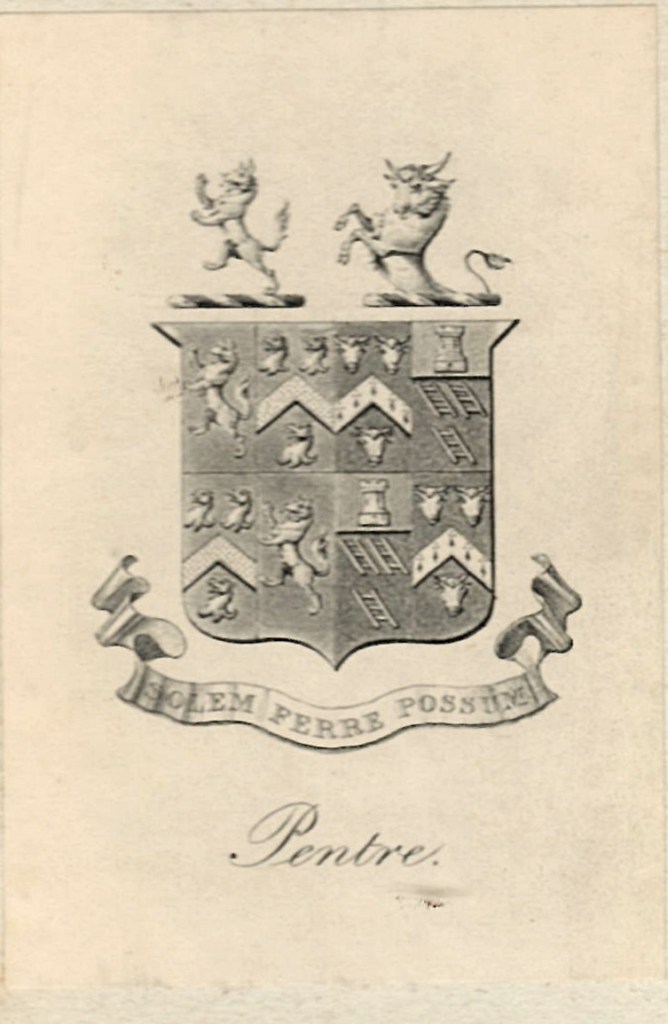
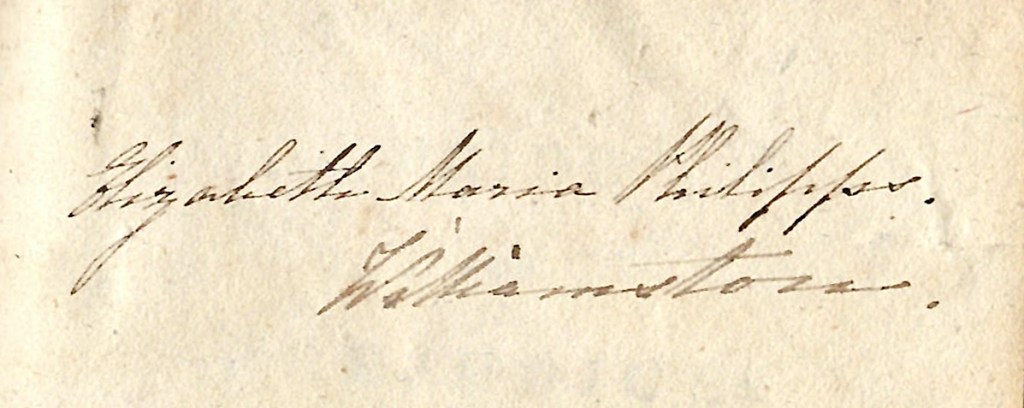
There are two very helpful items of evidence to identify the original owner of the book. There is a hand written inscription on the ffep of volume 2, and an armorial bookplate on the front paste-downs. Images of these are shown in Figure 4.

The inscription is ” Elizabeth Maria Philipps, Williamston” and the armorial bookplate is labelled “Pentre” with the motto “Solem Ferre Possum.” A little research soon revealed that Pentre was a place not a family name, and the coat of arms was of the Saunders-Davies family of Pentre in South Wales. On 31st July 1826, Elizabeth Maria Philipps, only daughter of Captain Owen Philipps of Williamstown, Pembrokeshire married David Arthur Saunders-Davies, of Pentre, Manordeifi near Boncath in Pembrokeshire, Wales.

The signature is clearly of Elizabeth Maria Philipps prior to her marriage, as she is using her maiden name and the name of the residence of her father. The 3rd edition was published in a single issue by Egerton in the middle of 1817, to our best knowledge. Miss Philipps, as she was before her marriage, must have obtained her copy some time between mid-1817 and mid-1826. Her birth date is unknown, nor is there any baptismal record for her, but from her age on her death certificate, she must have been born in 1805 or 1806, making her 19 or 20 years old at her marriage. It seems to me to be most likely that she obtained the book in her early teenage years, shortly after the book was published. The signature certainly looks quite firmly written and mature. The Pentre bookplate would have been applied following her marriage, when she took up residence as the lady of the house, her mother-in-law, Susannah Saunders, having died in 1823. The house passed into the ownership of her husband three years later, when his father Dr. David Davies died in 1829.

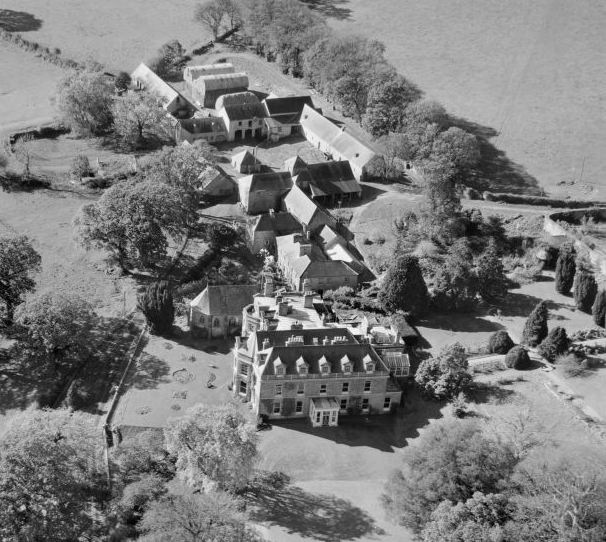
The mansion Pentre is shown below in a modern photograph. This is essentially the house as it was rebuilt and restored in the early 19th century. There had been several houses on the site for many centuries, and the estate had belonged to the Saunders family since the late 17th century. Dr David Davies had married the heiress of the Saunders estates, Susannah Saunders (1755-1823), who was the last survivor of the three daughters of Erasmus Saunders, on the understanding that their children would adopt the name Saunders-Davies. The house stayed in the Saunders-Davies family for five more generations of inheritance through the eldest son, until the 1950s.

Figure 5. Pentre from the air in the late 20th century

I have no information on how my Pride and Prejudice left Pentre. Group Captain D A P Saunders-Davies, the last Saunders-Davies owner of Pentre, gave up the house around the early 1950s, and one imagines that there might have been a sale of the contents around that time, which would have included books. I bought the book in 2015 from a dealer in the East Midlands of England, who had acquired it from an English collector.

The Crimean War connection

Elizabeth Maria Philipps and David Arthur Saunders-Davies had five children, two daughters and three sons, born between 1829 and 1837. Elizabeth died on 19th July 1851 at Pentre. Her youngest daughter seems to have died during infancy, but her four eldest children survived her. The middle child was Owen Gwyn Saunders-Davies, who had been born early in 1834. After attending Eton, he joined the army and was commissioned as a 2nd Lieutenant in the 38th Regiment of Foot. The Crimean War between Britain, the Ottoman Empire and France on the one side and Russia on the other started in October 1853. One of the bloodiest battles was the assault on the Great Redan stronghold, during the siege of Sevastopol, on 18th June 1855. 2nd Lieutenant Owen Gwyn Saunders-Davies died during that assault. He was only 21 years old. His mother Elizabeth had not lived long enough to have to cope with that loss to the family.

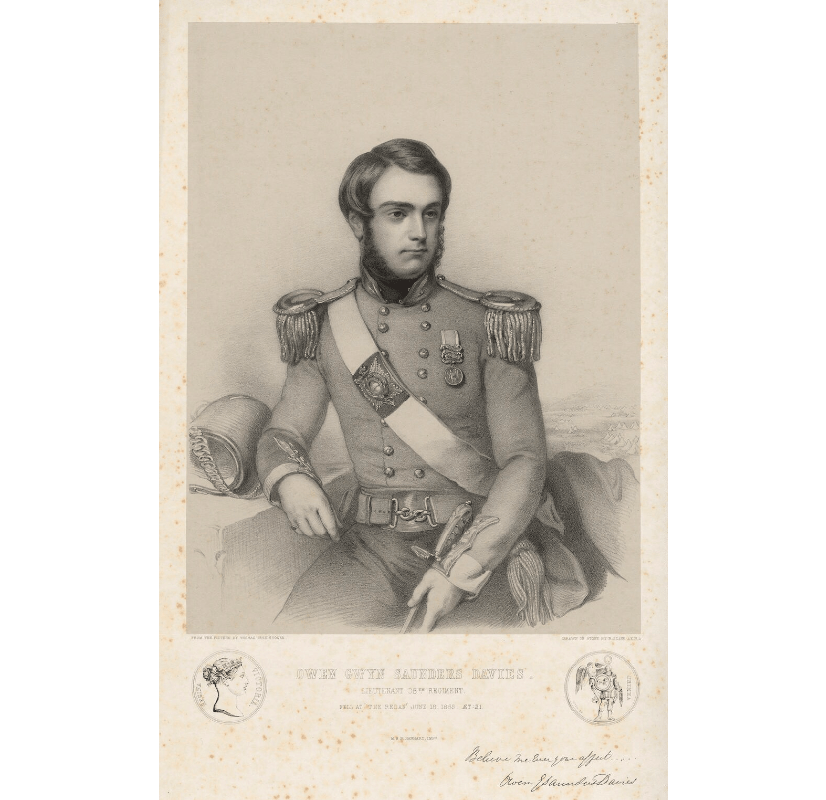
There is an engraved portrait of 2nd Lieutenant Owen Gwyn Saunders-Davies in the National Portrait Gallery in London, which is taken from a drawing by Thomas Brigstocke, a Welsh artist and a relative of the Saunders-Davies family. The portrait shows the young officer in uniform.

Lt. Owen Gwyn Saunders-Davies

This early death has always resonated with me, as my great grandfather, William Butcher (1825-1877), had been a Sergeant in the 68th Regiment of Foot and had served in the Crimean War. He had fought at the first two great battles of the war, Alma and Balaclava, and was shot in the abdomen during the battle of Inkerman on 5th November 1854. He must have been tough, since he survived and continued his army career, including action in India following the mutiny in 1857, until his discharge from the army in 1865. He married and started a family shortly after leaving the army, so if he had not survived his wound at Inkerman, I would not be here! Like many of the veterans of the Battle of Alma, he named his first born daughter Alma. The picture below shows a group of men from the 68th Regiment of Foot during the Crimean campaign. I doubt that my great-grandfather is in the picture, but it is still an image that I value.

Members of the Saunders-Davies family are still alive and I have been in correspondence with Elizabeth Maria Philipps’ five-times great-grand-daughter, who has given me information on the family, for which I am very grateful. I was pleased to send her a scan of her five-time great grandmother’s signature, and share with her the thought that her ancestor may have been an early fan of Jane Austen.

Featured

Price and Provenance 0

An Index to the Price and Provenance Posts

Here is an Index with a brief description for the Price and Provenance posts.

Price and Provenance 11

Mansfield Park and the Victoria Cross

In this post I am exploring the provenance of the Groombridge Illustrated edition of Mansfield Park that I discussed in my last post, Price and Provenance 10. The book cover is shown below, with its engraved title page and frontispiece (Figure 1.)

My copy of this rare book has a hand-written dedication on the verso of the free front end paper. It is shown in Figure 2 below. It reads To | Lillie Bazley |With Emily’s love | July 1st 1876.

Figure 2. Gift inscription on ffep of Mansfield Park 1975

As a starting point, I searched on Ancestry.com for a Lillie Bazley whose birthday was 1st July, and who had been born between 1840 and 1860 in England. This search found a preexisting tree which contained an Elizabeth Mary (Lillie) Bazley born on 1st July 1857 in Eccles in Lancashire. Presumably Lillie had been a family nickname. On closer examination of that preexisting family tree, I was interested to see that Elizabeth Mary (Lillie) Bazley had married a military hero, General Sir Edward Pemberton Leach, V.C., K.C.B., K.C.V.O. Lillie Bazley was a member of a fairly distinguished family in her own right, as her father, Sir Thomas Sebastian Bazley, 2nd Baronet, was part of the minor nobility. I spent a few hours researching this family, and I have summarised my findings below. I have taken advantage of the fact that when a book is associated with a notable family, there is generally no shortage of available information about them.

The origins of the Bazley family

Elizabeth Mary (Lillie) Bazley, whom I shall call Lillie for short, was born on 1st July 1857 in Eccles, Lancashire to Thomas Sebastian Bazley (1829-1919) and Elizabeth Gardner (1828- 1890). At the time of her birth, her father had not yet inherited the baronetcy, so he was not yet Sir Thomas. His father, Sir Thomas Bazley, M.P. (1797-1885), Lillie’s grandfather, had been created the 1st Baronet Bazley of Hatherop in Gloucestershire, in 1869, on the advice of the Prime Minister William Gladstone, mainly for his services to the cotton industry. Sir Thomas had been born at Gilnow, near Bolton in Lancashire, the son of a sucessful cotton mill owner, another Thomas Bazley (1744-1845). In 1826 Sir Thomas had formed a partnership with another Lancastrian industrialist, Robert Gardner (1781-1866). Between them they took over a number of cotton mills in Lancashire, and developed the Barrow Bridge mill in Halliwell, which became famous as a model mill, and was the largest producer of fine cotton and lace in the world. On 1st November 1855, Robert Gardner’s daughter, Elizabeth, married Thomas Sebastian Bazley, the only son of Sir Thomas the 1st Baronet. Their first child was Lillie Bazley, the owner of my Mansfield Park.

Sir Thomas Bazley, who was named the 1st Baronet of Hatherop, after an estate that the family had purchased in Gloucestershire in 1867, had become sufficiently well known by 1875 that he was the subject of a Vanity Fair caricature by “Ape”, Carlo Pelligrini. The caricature is shown below in Figure 3, next to the more ordinary photograph of his erstwhile partner Robert Gardner. These two men are the grandfathers of Lillie Bazley.

Lillie Bazley was the first-born child of Thomas Sebastian Bazley and Elizabeth Gardner. She eventually had five other siblings:

  • Annie Caroline Bazley, born in 1862
  • Gardner Sebastian Bazley, born in 1863
  • Frances Annette Ellen Bazley, born in 1866
  • Jessie Marion Atkinson Bazley, born in 1868
  • Lucy Maud Mary Bazley, born in 1869

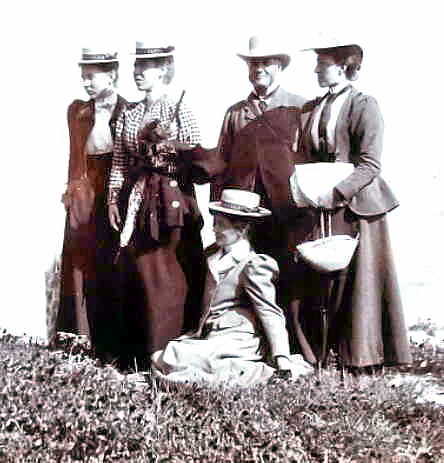
I have found this picture of the family, which is said to be from about 1900. I do not know exactly who the four ladies are. If the picture is from around 1900, my guess would be that the picture shows Sir Thomas Sebastian Bazley and his four daughters. Alternatively it could show Sir Thomas Sebastian and Lady Bazley with their three unmarried younger daughters. For this to be true, the picture must have been taken no later than 1890, when Lady Bazley died. I suspect that Lillie would not then have been in such a family picture, as she had married in 1883, the only one of the four sisters to marry before the death of Lady Bazley. The style of dress, the informality of the outdoor setting and the quality of the photograph suggest an Edwardian photograph rather than a late Victorian one. This makes me confident that one of these four ladies will be Lillie Bazley.

Figure 4 The Bazley family probably just after 1900.

The Bazley Baronetcy

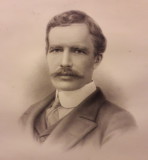
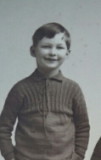
When Sir Thomas Bazley, the 1st Baronet, died in 1885, the title passed to his only son who then became Sir Thomas Sebastian Bazley, the 2nd Baronet Bazley of Hatherop. Sadly, Lillie’s brother, Gardner Sebastian Bazley, died in 1911, eight years before his father, the 2nd Baronet, so it was his son who eventually became Sir Thomas Stafford Bazley, the 3rd Baronet of Hatherop, in 1919 at the age of 12. The title is currently held by Sir Thomas Stafford Bazley’s eldest son, Sir Thomas John Sebastian Bazley, who became the 4th Baronet in 1997. Figure 5 below shows Lillie’s brother Gardner Sebastian Bazley as a young man, and his son Thomas Stafford Bazley as a boy.

The family seat, Hatherop Castle, had been purchased by the Bazley family in 1867.After the Second World War it was first leased and then sold, along with its surrounding estates, as the family wanted to see the property survive intact. It currently operates as a private school, and is shown below. Lillie Bazley is known to have lived here during several periods of her life.

Figure 6. Hatherop Castle

Edward Pemberton Leach (1847-1913)

On 31st January 1883 Lillie Bazley married the then Lieutenant-Colonel Edward Pemberton Leach, VC, at Hatherop. Edward Pemberton Leach was born in Londonderry, Northern Ireland on 2nd April 1847. After finishing his education at Highgate School in London and the Royal Military Academy at Woolwich, , he was commissioned into the Royal Engineers in 1866, the same regiment as his father, Sir George Archibald Leach (1820-1913). He was sent out to India in 1868, and in 1879, as a 31 year old captain in the Royal Engineers attached to the Bengal Sappers and Miners of the British Indian Army, he fought in the Second Afghan War, in which on 17th March 1879 he won a Victoria Cross. This event earned him a return to England to recuperate from his wounds and to receive his Victoria Cross from Queen Victoria at Windsor Castle on 9th December 1879. He returned to active service in India, and gained rapid promotion, so that less than four years later, when he returned to England to marry he was already a Lieutenant-Colonel. He later saw active service in Egypt and Sudan, before returning to senior commands in the UK. Other promotions followed and he was knighted in 1909 by King Edward VII. Lillie Bazley had now become Lady Leach.

Sir George Archibald Leach had a career in the public service after the army, and so was in the public eye, becoming the subject of a Vanity Fair caricature by FTD in 1896. Figure 6 below shows the caricature, and a photograph of his son Edward Pemberton Leach, V.C. around the time of his marriage.

Bazley-Leach marriage and beyond.

Lillie Bazley and Edward Pemberton Leach had three children. They were:
  • Lilian Vera Pemberton Leach born on 15 November 1883 at Hatherop Castle
  • Gordon Pemberton Leach, born on 2nd Aug 1885 at Hatherop Castle
  • Elsie Pemberton Leach, born in 30th June 1888 at Plymouth, Devon.
After their marriage in January 1883, Edward Leach served overseas on several occasions before his final return to the UK in 1887. The family lived in Plymouth until the mid 1890s, when Edward was promoted to Major-General and then appointed to a senior command in Northern Ireland, where the family lived in Antrim from about 1898 to 1905. Their son, Gordon Pemberton Leach, was at boarding school from around 1900 and joined the army in 1905. The rest of the family moved to Scotland later in 1905 when Edward was appointed to be the General Officer Commanding for the Scottish Command, remaining in that post until 1909. Lillie and Edward then returned to London where they lived until Edward’s retirement.

Edward Leach eventually retired from the army in 1912 as General Sir Edward Pemberton Leach, V.C., K.C.B., K.C.V.O. Sadly, he died on 27th April 1913 at Caddenabbia on Lake Como in Italy, where he and Lillie had decided to live following his retirement. He died just six weeks before his father, Sir George Archibald Leach, in June 1913. After her husband’s death, Lillie returned to England and was living at 29 Palace Gate, London W8.

Her son, Gordon Pemberton Leach, had risen to the rank of Captain in the Royal Field Artillery by the start of World War One. He was killed in action on 19th August 1915 at Hellas in Gallipoli, and is buried there at the Pink Farm military cemetery. Neither of Lillie’s daughters married, and the youngest, Elsie, lived with her mother, until Lillie Bazley, as Lady Elizabeth Leach, died in Bournemouth in Hampshire on 9th January 1940.

After her mother’s death, Elsie Leach became quite a famous ornithologist in her later years. She eventually died in Kensington in 1968. Lilian Vera Leach lived in mostly London,where she too died in Kensington in 1973. None of the three children of Elizabeth Mary (Lillie) Bazley married or had children.

Who gave Mansfield Park to Lillie Bazley?

The inscription shown in Figure 2 reads To | Lillie Bazley |With Emily’s love | July 1st 1876. We know that the Groombridge Mansfield Park was published in October 1875, so who was the Emily who gave the book to Lillie for her 19th birthday?

I will never be able to prove this, but I do have a possible theory. I think that the answer can be found on the census document for the Bazley family from April 1871, where the 13 year old Lillie Bazley is reported to be living with her family in the Alexander Hotel in Knightsbridge, London. Among their servants is a 24 year old Under-Nurse called Emily Westmacott from Leckhampton, Gloucestershire. Her job would have been to look after the children. In the April 1881 census, the Bazley family is living back at Hatherop Castle in Gloucestershire, but Emily Westmacott is no longer with the family. In fact, there are no nurses listed among the servants, as the children are all older now. There is instead a “Resident Governess” and a “Young Ladies Maid”.

On 7th October 1975, Emily Westmacott had married Charles Cornock at St. Luke’s Church, Cheltenham in Gloucestershire, and by April 1881, she and Charles were living in Leckhampton in Gloucestershire with their three young children. One can presume that in the 1870s, the Bazley family would have moved back and forth between London and Hatherop, following the social customs of the day. In July 1st 1876, Emily would probably have already have been living in Leckhampton, which is within 15 km of Hatherop. She could have bought Mansfield Park in nearby Cheltenham, where there were several bookshops in the 1870s, and sent the book from Leckhampton to Hatherop by post or by coach. We don’t know how long Emily worked for the Bazley family, but the informal tone of the inscription suggests to me the sort of close relationship that a dedicated nursemaid may well have developed with one of the children in her care.

I have no information on when or how the Groombridge Mansfield Park left the possession of the Bazley-Leach family. Lillie may have passed the book on to one of her two daughters, or to one of her surviving siblings or their families. There are no other ownership marks or inscriptions to give me any clues. I bought the book quite recently from an English book dealer who specialises in old and unusual editions of Jane Austen.