1828 Raison et Sensibilité.

Published by Arthus Bertrand Paris. 2nd ed. 3 vols. Gilson C8

Illustrated by Charles-Abraham Chasselat

The first French edition of a Jane Austen novel to appear was Raison et Sensibilité, translated from Sense and Sensibility by Mme Isabelle de Montelieu and published in Paris by Arthus Bertrand in 1815 in four volumes. It did not have any illustrations. There is no mention of this translation in any of Jane Austen’s letters, so one might conclude that she was not aware of it.

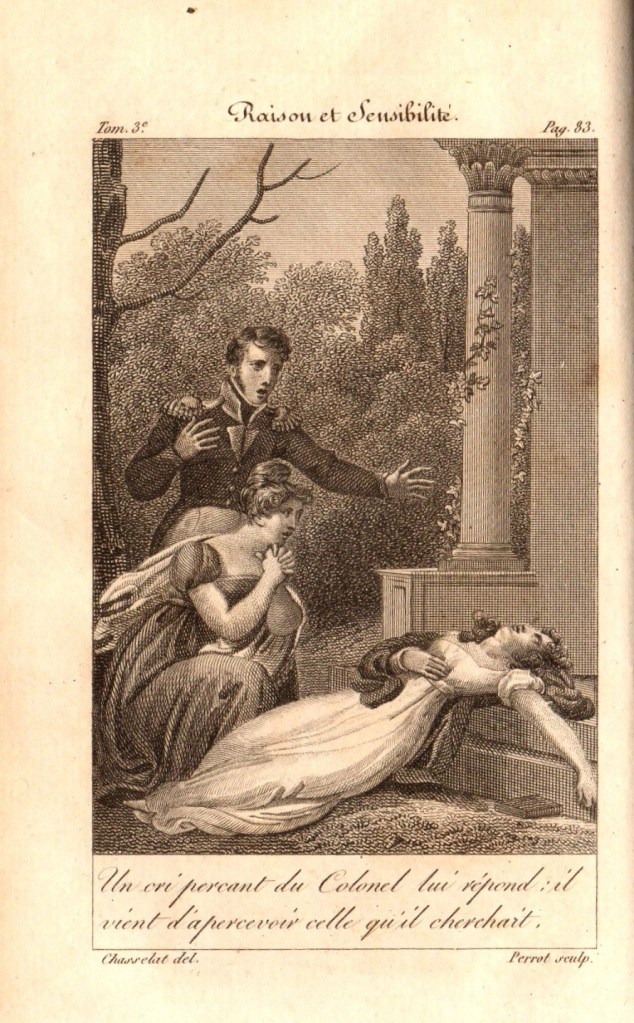
A second French edition of Raison et Sensibilité was published by Bertrand in Paris dated 1828. It is possible that this second edition was published in December 1827. This time, the Raison et Sensibilité, now published in three volumes, had a frontispiece in each of the three volumes. This is the first illustrated edition of Sense and Sensibility to be published anywhere. The illustrator for all three images was Charles-Abraham Chasselat, just as in the 1821 edition of La Famille Elliot described in a related article. The engraver was Auguste Delvaux for volumes 1 and 2, and then Jean-Simon-Narcisse Perrot (born 1796) for volume 3. The three frontispiece illustrations for Raison et Sensibilité are shown below in Figure 1.
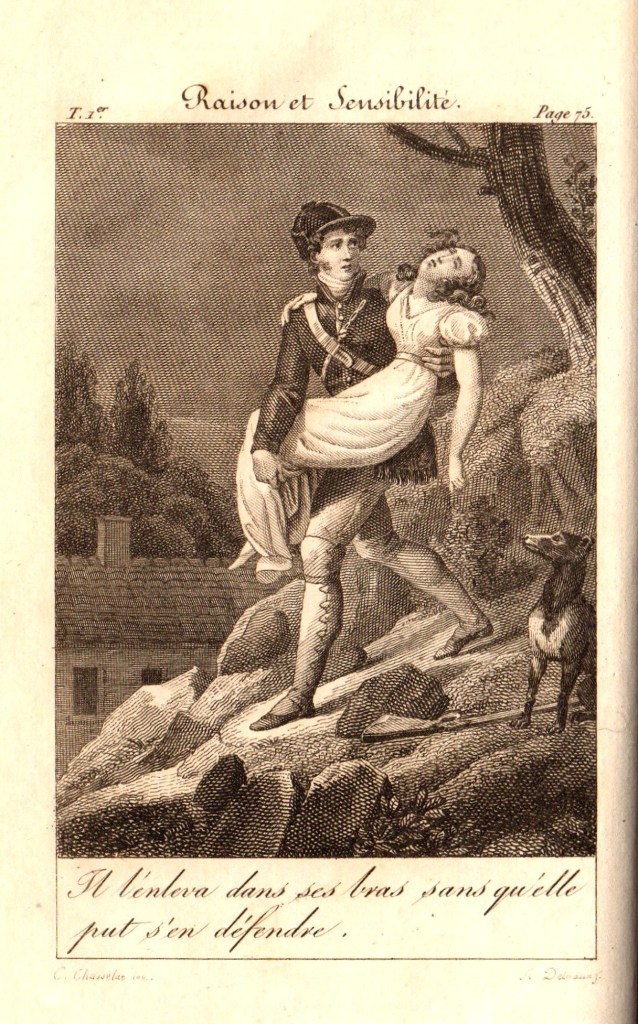
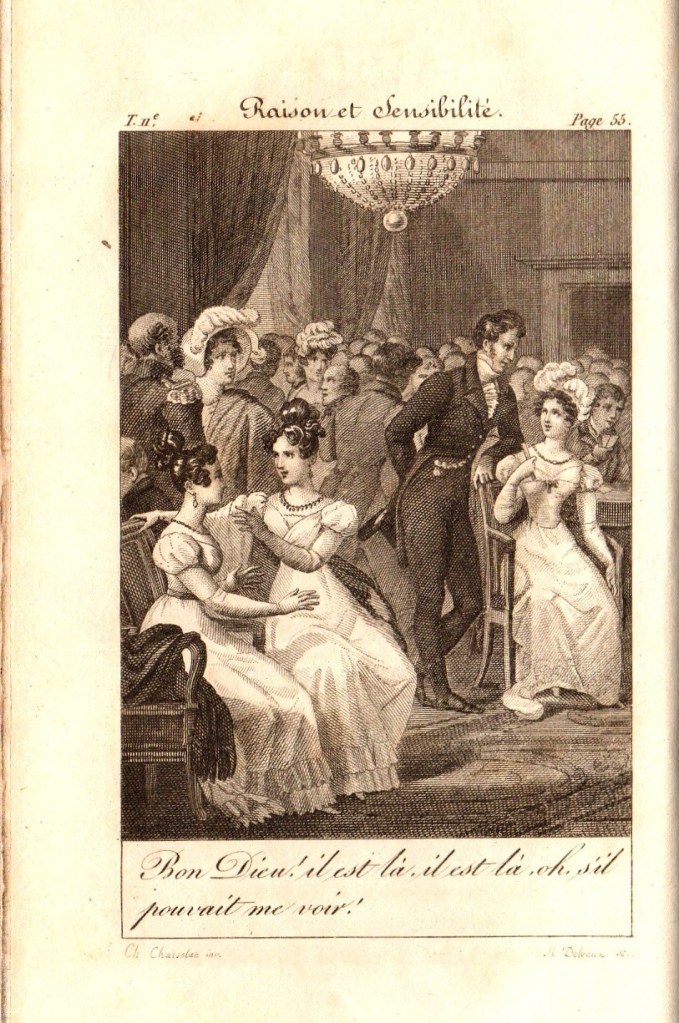
Figure 1. Frontispieces for volumes 1,2 and 3 of Raison et Sensibilité

In volume 1 (Fig. 1 left), the picture shows Willoughby carrying Marianne back down the hill to safety, after she had twisted her ankle. The text below the image reads “Il l’enleva dans ses bras sans qu’elle put s’en défendre“, which can be translated as “He took her into his arms without her being able to defend herself” , which seems somewhat at odds with Austen’s description of the event. She also appears to have fainted in this picture.

In volume 2 (Fig. 1 centre), the scene is at a party in London, some while after Willoughby has “dumped” Marianne. She sees him across the room and exclaims, according to the figure legend. “Bien Dieu! il est là, ll est là, oh! s’il pouvait me voir!” This is not too far removed from Austen’s original text which read “‘Good heavens!’ she exclaimed, ‘he is there-he is there-Oh! why does he not look at me?” Elinor, who is seated next to Marianne tries to calm her down and prevent an embarrassing scene.

In volume 3 (Fig. 1 right), the picture shows Elinor and Colonel Brandon, who have found Marianne, who has rather melodramatically fainted by a small classical temple. The text reads “Un en’ percant du Colonel lui répend: il vient d’apercevoir celle qu’il cherchait”. This translates to something like “A piercing message from the Colonel answers him: he has just seen the one he was looking for.”

Readers, you will search in vain for this incident in Jane Austen’s Sense and Sensibility, as it simply does not occur. My view is that Mme. de Montolieu has added in this scene as a counterbalance to the rescue of Marianne by Willoughby shown in the left hand panel. In a way, it can be seen as validating Colonel Brandon as a suitor for Marianne, who is thus seen to be at least as gallant as Willoughby.

There are many other changes in the text, and the whole plot is rather distilled down to an account of the romantic tribulations of Marianne and her infatuation with Willoughby; Elinor and Edward Ferrars hardly get a look in, and Margaret, the third and youngest Dashwood sister, is virtually ignored and renamed “Emma”. Mme. de Montolieu gave her Raison et Sensibilité the subtitle “ou les deux manières d’aimer“, translated perhaps as “or the two ways of loving”. Those familiar with Sense and Sensibility might expect that this refers to the difference in approaches to romance of Marianne and Elinor, but for Mme. de Montolieu, I fear it represents the differences between Willoughby and Colonel Brandon.

Return to the Index page for Illustrated Editions of Jane Austen.

1821 La Famille Elliot.

First Illustrated Austen Novel

Published by Arthus Bertrand, Paris. 2 vols. Gilson C12

Illustrated by Charles-Abraham Chasselat

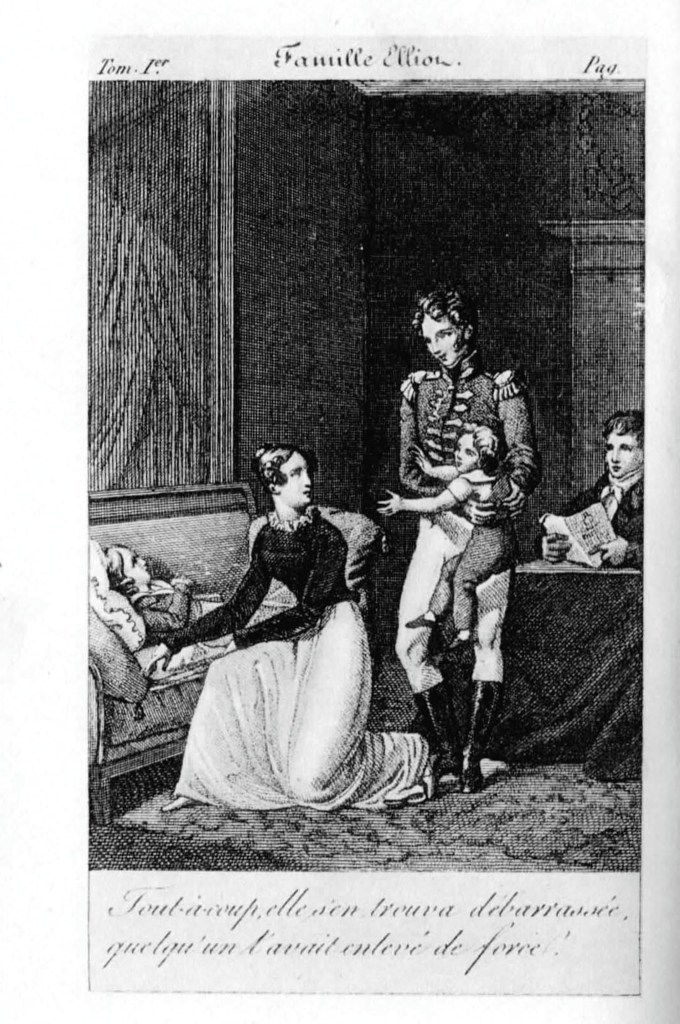
It seems ironic that the first illustrated edition of any novel by Jane Austen, that most English of authors, was published in France, but here it is. The first editions of the canonic six great novels of Jane Austen were published in London between 1811 and 1817 without any illustrations. Following Austen’s death in July 1817 and the posthumous publication of Northanger Abbey and Persuasion by John Murray in December 1817, there were no further editions of Austen’s novels published in Britain for 15 years. However in 1821, four years after the author’s death, a French translation of Persuasion was published by Arthus Bertrand in Paris in two volumes, under the title “La Famille Elliot” which translates to “The Elliot Family” in English. Each volume has a frontispiece illustration by Charles-Abraham Chasselat (1782-1843), a well-known painter of historical subjects, who also illustrated books by Voltaire, Racine and Moliere. The engraver of these frontispieces is given as “Delvaux”, which was Auguste Delvaux, (1786-1836), who was one of a pair of brothers, both of whom were fine engravers. Figure 1 shows the title page from volume 1 and the two frontispieces from La Famille Elliot.

Figure 1. Title page of Vol. 1 (left), frontispieces of Vol. 1 (centre) and Vol. 2 (right).

The title page headings read as follows (in French followed by English):

La Famille Elliot ou L’Ancienne Inclination. —– The Elliot Family or The Old Inclination

Traduction Libre de L’Anglais ———- Free Translation from English

D’Un Roman Posthume de Miss Jane Austen ——-From a posthumous novel by Jane Austen

Par Mme de Montolieu —— By Madame (Isabelle) de Montolieu.

This 1821 edition of a translation of Jane Austen’s Persuasion is not only the first Austen novel to have any illustrations; it is also the first time that the name “Jane Austen” is printed on the title page of any of her novels.

The translator, Madame de Montolieu had been born Jeanne-Isabelle-Pauline Polier de Botten in Lausanne in the French speaking part of Switzerland in 1751. After her first husband, Benjamin de Crousaz, has died in 1775, the year of Jane Austen’s birth, she remarried Baron Louis de Montolieu in 1786. After the baron died in 1800, she lived on for more than 30 years as a widow, publishing under the names Madame de Montolieu, Isabelle de Montolieu or La Baronne Isabelle de Montolieu, until her death in 1832. Her other translation of an Austen novel was Raison et Sensibilité, which was also published by Arthus Bertrand in Paris in 1815. This four volume edition was not illustrated, but a second edition in three volumes was published in 1828 with three frontispieces by the same illustrator as La Famille Elliot.

Legends for the two Frontispieces

The frontispiece to Volume One of La Famille Elliot has a text caption below the image which identifies the incident depicted. It reads: “Tout à coup elle s’en trouva debarrasseé, quelqu’ un l’avait enlevé de force.” This can be translated as: “Suddenly she found herself free of him; someone had taken him by force.” This refers to an incident where Anne Elliot is consoling her nephew Charles Musgrove, who is ill, but while she is trying to do this, Charles’ younger brother Walter Musgrove is climbing all over Anne’s back to get some attention, and is making a nuisance of himself. Captain Wentworth removes Walter Musgrove from Anne Elliot’s back. (Persuasion, Vol 1, Chapter IX p80.) This incident demonstrates the protective care that Wentworth feels that he should offer the young woman who he admires.

The frontispiece to Volume Two of La Famille Elliot also has a text caption below the image which identifies the incident depicted. It reads: “Il s’approcha de la table, montre la lettre à Alice, et sortit sans dire un mot!” This is easily translated to “He walked over to the table, showed Alice the letter, and left without saying a word!” This is the incident towards the end of the story, where Captain Wentworth presents a letter to Anne Elliot to explain his feelings (Persuasion, Vol 2, Chapter XI, p. 236).

You will note that the text refers to Anne Elliot as “Alice”. For some reason, the only name that Mme. de Montolieu alters in the book is Anne Elliot, who she renames Alice Elliot. Ironically, the translator has chanced upon the correct title for the book, as we learn from Jane Austen’s letters, published more than 50 years after the death of Mme. de Montolieu, that her working name for Persuasion was “The Elliot Family.” The name Persuasion was almost certainly coined by Jane Austen’s brother Henry Austen, who arranged the posthumous publication of the text by John Murray in 1817.

La Famille Elliot was reissued by Arthus Bertrand in 1828 in a complete edition of the works of Mme. de Montolieu. The text and illustrations were retained from the 1821 edition.

Return to the Index page for Illustrated Editions of Jane Austen.
Illustrated editions of Jane Austen

A summary and list

The following articles will be an detailed account of the most important and most attractive illustrated editions of the novels of Jane Austen. In this first part, I will simply list the editions that will be covered and give a brief summary of the illustrator and the edition. These editions will be listed in the order of first publication. This page will therefore be an index page for the following pages as they are developed. I will mostly focus on English editions, but there will be some notable exceptions. For every book that I cover, a reference will be given from the second revised 1997 edition of the magisterial bibliography of Jane Austen published by the late David Gilson, in the form of a “Gilson number” (eg. “Gilson D1”, which refers to the first Bentley edition of Sense and Sensibility published in December 1832). Each of the individual articles will present many examples of the illustrations, scanned from my own copies where possible. Where there are illustrated dust wrappers, I will show these as well.

In the Beginning…

None of the first English or American editions of the Austen novels were illustrated, so the story of illustrated editions of Austen begins surprisingly in France. The first French edition of a Jane Austen novel to appear was Raison et Sensibilité, translated from Sense and Sensibility by Mme Isabelle de Montelieu and published in Paris by Arthus Bertrand in 1815 in four volumes. It did not have any illustrations. The second French edition to appear was La Famille Elliot, translated by Mme de Montelieu from Persuasion and published by Arthus Bertrand in two volumes in 1821. It had two illustrations, a frontispiece to each volume. This is the first edition of any Austen novel to have any illustrations. Second editions of both of these books were published by Bertrand in Paris in 1828. This time, the Raison et Sensibilité (in three volumes) had a frontispiece in each of the three volumes. The two illustrations from the 1821 edition of La Famille Elliot were reissued in the 1828 second edition.

My listing of the illustrated editions of the Jane Austen Novels therefore begins with these two entries:

The next Austen novels to be published with illustrations were the individual volumes and the five volume set offered by Richard Bentley with frontispieces and title page vignettes:

These were the first English illustrated editions of Jane Austen’s novels. The novels were reprinted many times before being reissued in a new edition by Bentley starting in 1870. The details of the reprints and the second Bentley edition of 1870 will be given in the individual articles.

The first Austen novel to have illustrations throughout the text block was the edition of Mansfield Park published by Richard Groombridge and Sons in 1875. It had 7 full page illustrations engraved from pictures by A.F. Lydon.

More books will be added to the list as new articles are developed.

Keep watching.