For more background information of the Bentley editions of Jane Austen, please read the first few paragraphs of the article on Bentley edition of Emma, Gilson D2.
Sense and Sensibility, along with the other five novels of Jane Austen that had been published between 1811 and 1817, did not appear in a new English edition until Richard Bentley decided to reprint all of the Austen novels as “Standard Novels” in 1832. The first edition of Sense and Sensibility had been published in 1811 followed by the second edition in 1813, both published by Thomas Egerton in 3 volumes. Sense and Sensibility was published by Richard Bentley on 28th December 1932, for 6 shillings. Sense and Sensibility was numbered “XXIII” (23 ) in the Standard Novel series. It was the third edition of Sense and Sensibility to be published in the UK, the first single volume edition, the first edition to have any illustrations and the first to have Jane Austen’s name as author on the title page(s). Standard Novel XXIV (24) was a translation of Madame de Stael’s Corinne, which appeared on February 1st 1833. An announcement of the intended publication of Corrine by Bentley on this date appears on the verso of the series title page of Sense and Sensibility (Figure 1). Although the publication date of Sense and Sensibility was on 28th December 1832, Bentley printed 1833 on all of the dated pages, a common practice by publishers, who used this practice to extend the apparent currency or newness of their books.
Figure 1: (left) Series title page for Gilson D1 Bentley’s Sense and Sensibility 1832
Figure 1: (right) Verso of Series Title page showing announcement of Corinne.
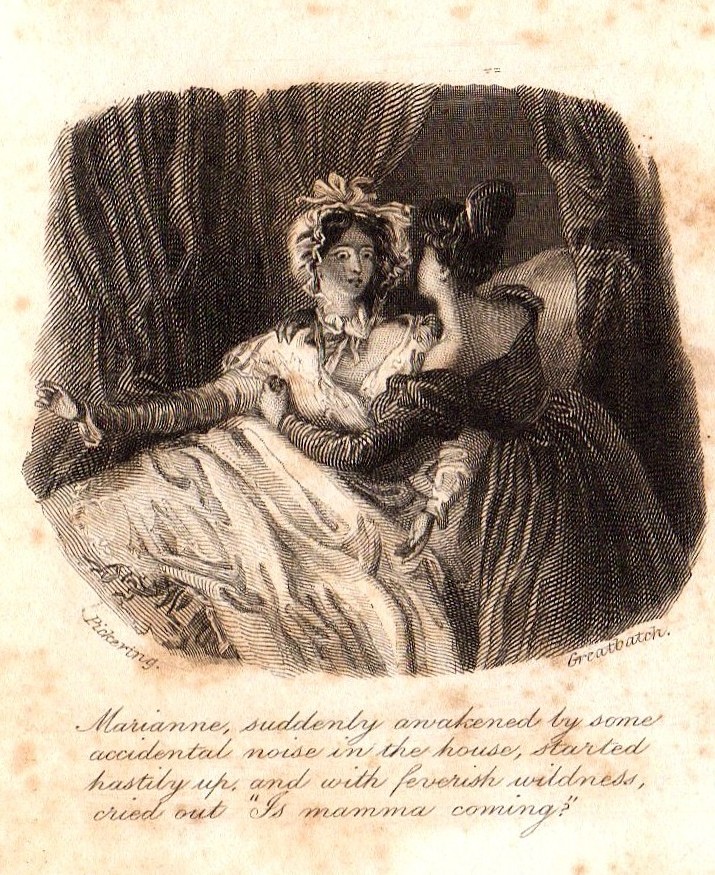
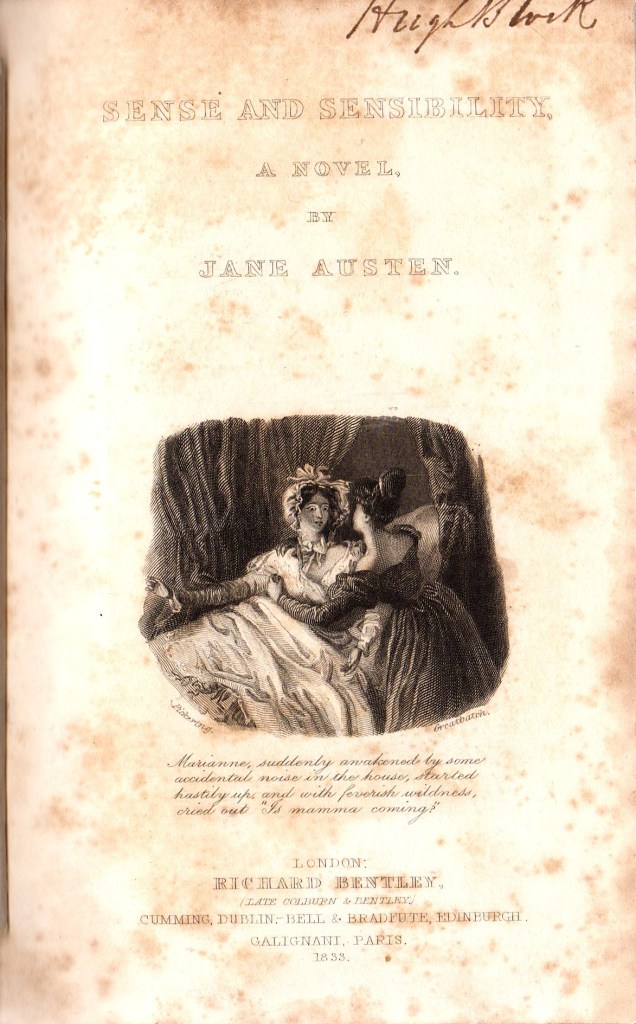
In Figure 2, the two illustrations for the Bentley edition of Sense and Sensibility are presented as the frontispiece on the left and the engraved title page vignette on the right. They are both drawn by Ferdinand Pickering and engraved by William Greatbatch, as is the case for all of the illustrated Bentley editions of Jane Austen’s novels. The images show figures in costumes appropriate to 1832, rather than to the earlier period when the book was written. The frontispiece shows the incident from Chapter 22 of Volume 1, where Lucy Steele is showing the miniature of Edward Ferrars to Elinor Dashwood. The text under the image reads as follows: Then taking a small miniature from her pocket, she added “To prevent the possibility of a mistake, be so good as to look at this face.” This is a slight misquotation of the original text on page 133 which reads “possibility of mistake”.
Figure 2. Frontispiece (left) and vignette (right) illustrations from Gilson D1
The vignette on the right of Figure 2 shows Marianne Dashwood suddenly awakening, startled and arising from her sickbed, held by her sister Elinor (from Volume 3, Chapter 7). The text reads: Marianne suddenly awakened by some accidental noise in the house, started hastily up, and with feverish wildness, cried out “Is mamma coming?”
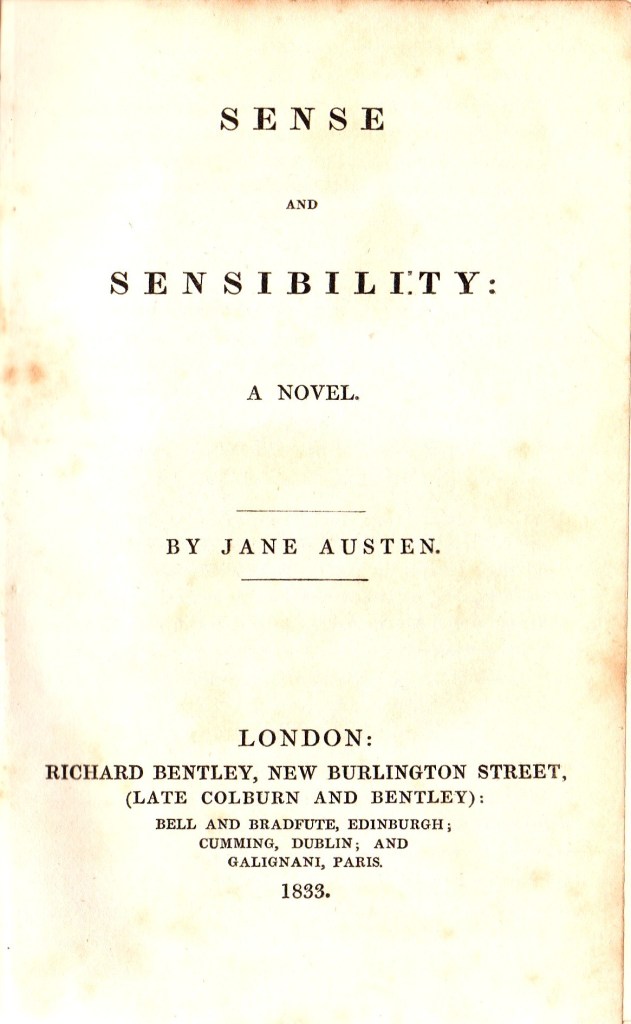
The full engraved title page and the letterpress title page are shown in Figure 3 below. Note that there are some small differences in the way that the publishers details are presented on these two pages. The dates on these pages shown in figures 1, 2 and 3 are all presented as 1833, rather than 1832. There is an inscription of a previous owner of the book, “Hugh Block”, on the top of the engraved title page.
Figure 3. The engraved (left) and printed title pages for Sense and Sensibility Gilson D1
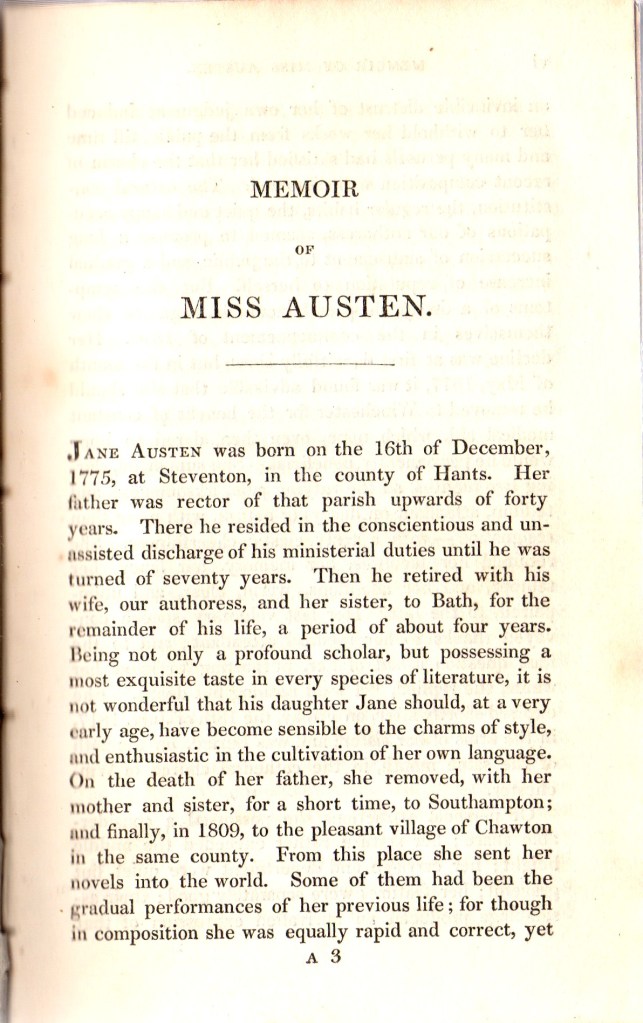
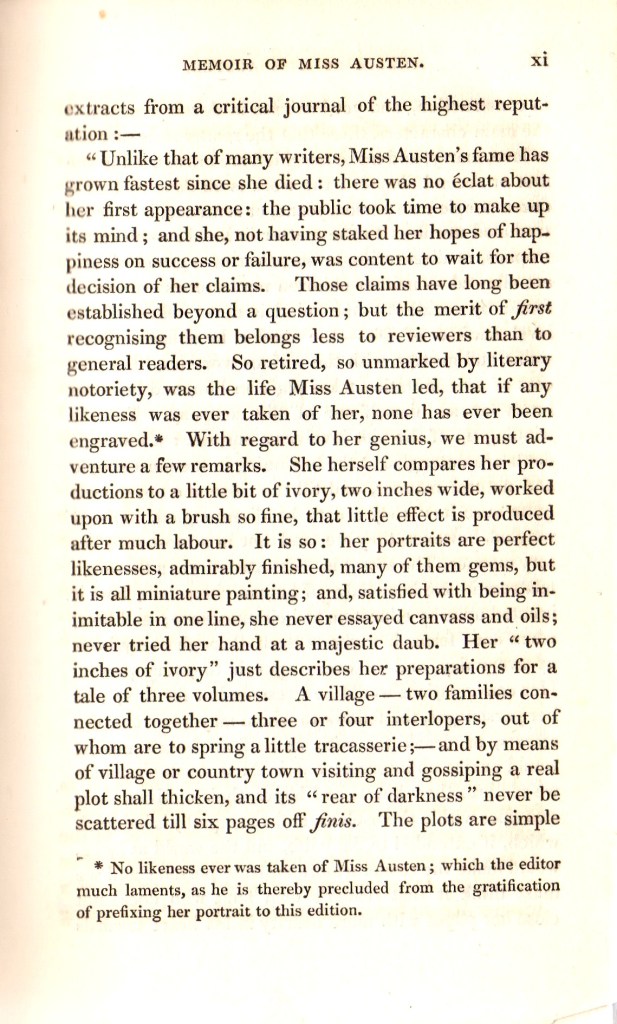
Immediately following the printed title page, Bentley presents a “Memoir of Miss Austen” which is on the preliminary pages (v) to (xiv), that is p5 to p14 in roman numerals. The memoir is unsigned and dated October 5th 1832. It has been described elsewhere as by “the Rev. Mr. Austen”, which would have been the author’s brother Henry Austen. The first part of the Memoir is an edited and revised version of the “Biographical Notice” published by Murray as a preface to the posthumous edition of Northanger Abbey/Persuasion in 1817, which is itself dated December 13th 1817. This was also generally agreed to have been written by Rev. Henry Austen. The second part of the Memoir, running from the bottom of page (x) to page (xiv), pages 10-14), are taken from a review of Northanger Abbey/Persuasion published in the Quarterly Review of January 24th 1821.
The final page of the “Memoir” is a note from the editor of Gilson D1, presumably Richard Bentley himself, which announces that the other novels of Jane Austen will follow in the Standard Novels series. The editor also comments on the importance of Jane Austen, cites the related novels of Madam D’Arblay (Fanny Burney), Miss (Maria) Edgeworth, Mrs. Opie and Miss Porter, and praises Jane Austen for “the truth, spirit, ease and refined humour of her conversations” , and her ability “to make the veriest every-day person a character of great interest.”
Figure 4 show three pages from the “Memoir” section of Gilson D1.
Figure 4. Pages v, x and xi from the Memoir of Miss Austen
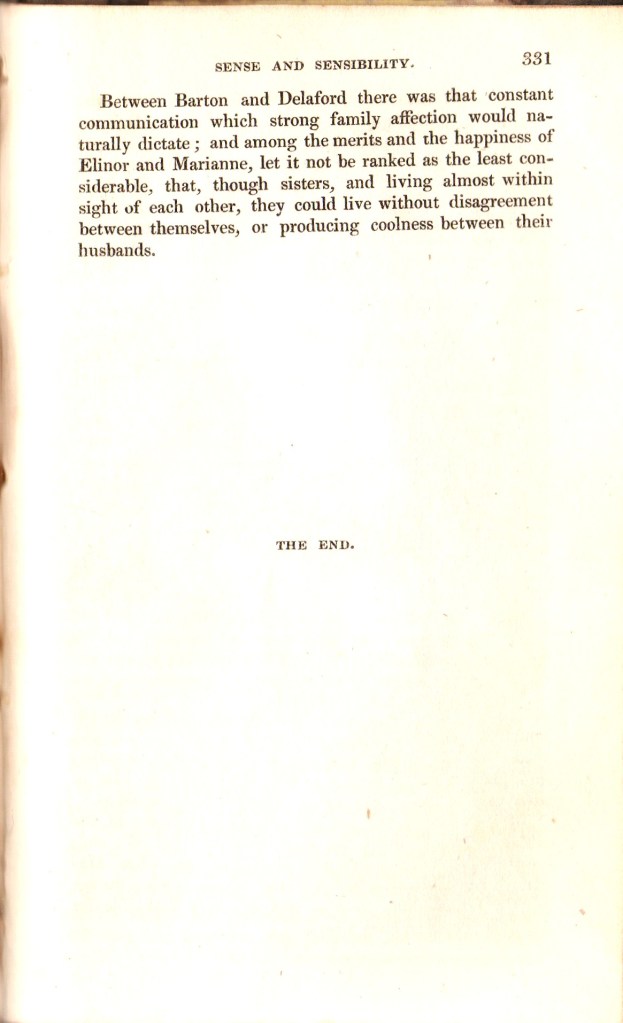
Richard Bentley arranged the text of Sense and Sensibility to correspond to the same chapter and volume arrangement as in the first and second editions. Accordingly, the book remains divided into 3 volumes, with Volume The First consisting of 22 chapters occupying pages 1-116; Volume the Second has 14 chapters running through pages 117-219 and Volume the Third also has 14 chapters running from page 220 to the final page 331. Throughout the book, most of the chapters do not start on a new page, and are separated by a simple centrally placed ruled line about half the width of the page. The chapters are numbered in large Roman numerals, whereas the page numbers are printed as Arabic numbers at the outer top corners of the pages. The first and last pages are shown in Figure 5 below.
Figure 5. Pages 1 and 331 of 1832 Bentley edition of Sense and Sensibility
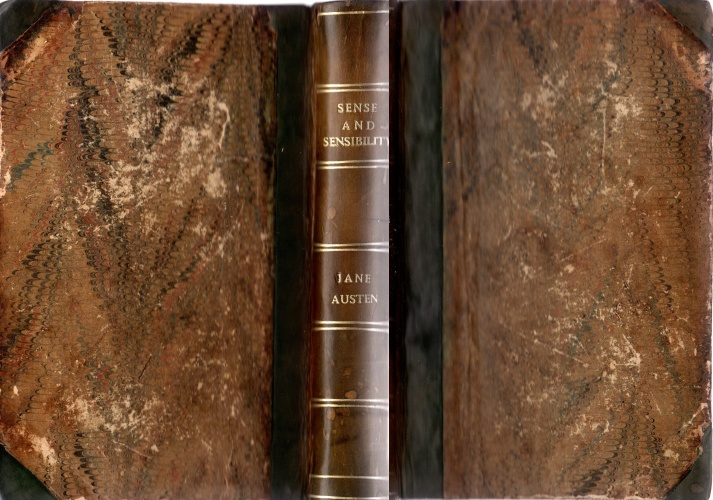
Gilson D1, Sense and Sensibility, would have been originally bound in plum-coloured, glazed linen boards, with black labels on the spine which were printed in gold. This binding was used by Bentley for the Standard novels issued between 1831 and 1838, and is generally called Sadlier style 1. Examples of this can be seen in my copies of Mansfield Park (Gilson D3) and Northanger Abbey/Persuasion (Gilson D4). However, my copy of Sense and Sensibility has been rebound in marbled paper-covered boards, half-bound in green morocco with gilt labelling on the spine in two gold lined compartments (Figure 6) . The spine has faded from green to light brown. The binding looks mid-19th century, but has recently been rebound, with the addition of new yellow endpapers.
Figure 6. Binding of my copy of the Bentley edition of Sense and Sensibility.
Later reprints of Bentley’s Sense and Sensibility Gilson D1
The 1832 issue of Bentley’s first edition of Sense and Sensibility shown in this article is the only issue that I currently have of this Standard Novels edition, I do also have a copy of the 1856 issue, which is as a part of a set of The Novels of Miss Austen (Gilson D6). There are other known reprinted issues of Bentley’s Sense and Sensibility that appeared in 1837, 1846, 1853, and 1854 in the Standard Novels series, all designated Gilson D7, and a further reprinted set of Gilson D6 in 1866. A “New Edition” of Sense and Sensibility is published by Bentley in 1970 as Gilson D8. That is the subject of a separate article in this series.
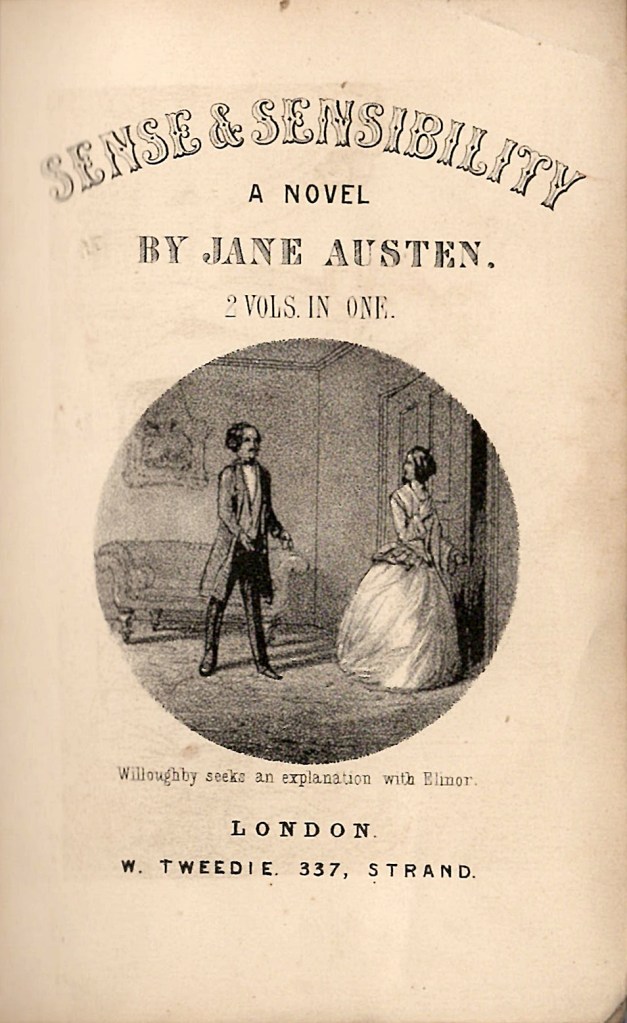
In this post, I am exploring the source and provenance of an early edition of Jane Austen’s Sense and Sensibility that I acquired a few years ago. It was published in London by W. Tweedie at 337, Strand and does not appear to be listed in any Austen bibliography. There is also no copy found on Worldcat.org. It is an interesting little book, 130 x 90 mm (5 3/8″ x 3 1/2″), whose engraved title page and frontispiece are shown below.
Figure 1. Frontispiece and title page of Tweedie’s edition of Sense and Sensibility
A brief publishing history of Sense and Sensibility
Sense and Sensibility was first published in London in 1811 in 3 volumes by T. Egerton. A second Egerton edition in 3 volumes followed in 1813, and the third English edition did not appear until a single volume edition was published by Richard Bentley as Volume XXIII (23) of his Standard Novels series in December 1832, dated 1833. He also reprinted Sense and Sensibility as Volume 1 of a 5 volume set called The Novels of Jane Austen published in October 1833. The first American edition of Sense and Sensibility was also published in 1833 by Lea and Carey in Philadephia. This was published as a two volume edition, with a novel pagination pattern.
Bentley continued to publish reprints of Sense and Sensibility in 1837, 1846, 1853 and 1854. All of these Bentley editions used the same stereotype plates as the 1833 edition, so the text blocks are all identical. The text in these single volume editions is divided into a three volume format, mimicking the first and second editions published by Egerton.
Richard Bentley had purchased the copyright of Sense and Sensibility from the Austen family in 1832. The first edition of Sense and Sensibility to be published by another British publisher after the expiry of the copyright in 1839 was an 1844 edition published in 2 volumes in London by H.G. Clarke. This first English two volume edition followed the same chapter arrangement as the Lea and Carey first American edition of 1833. David Gilson in A Bibliography of Jane Austen , 2nd edition 1997, designates the Lea and Carey edition as Gilson B6 and the Clarke edition as Gilson E2. Gilson gives a full bibliographic description for B6 but not for E2. The Lea and Carey edition, B6, was constructed as a first volume of 30 chapters in 195 pages and a second volume of 20 chapters in 185 pages. The Clarke edition, E2, was constructed as a first volume of 30 chapters in 239 pages and a second volume of 20 chapters in 224 pages. It was described as also having an exotically engraved title page in colour as well as a regular title page in letterpress. Neither B6 nor E2 was described as having a frontispiece.
The Tweedie edition of Sense and Sensibility
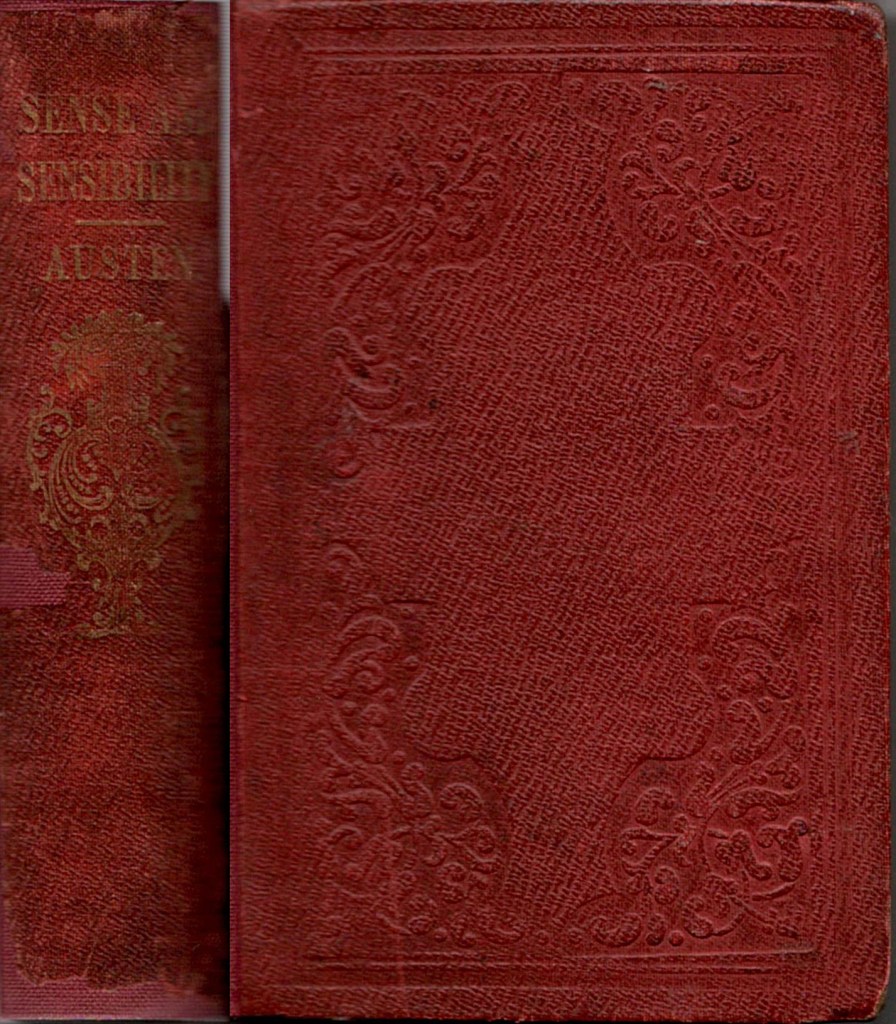
My copy of the Tweedie edition of Sense and Sensibility is bound in what appears to be its original blind-stamped red cloth binding with a rather faded gilt title and decoration on the spine, which has been re-backed. The title reads “Sense and | Sensibility |________ | Austen” with an ornamental urn below as decoration. All three edges of the pages have been gilded. The binding, which still has what seem to be the original pale yellow end-papers is shown below.
Figure 2 The cloth binding of Tweedie’s Sense and Sensibility
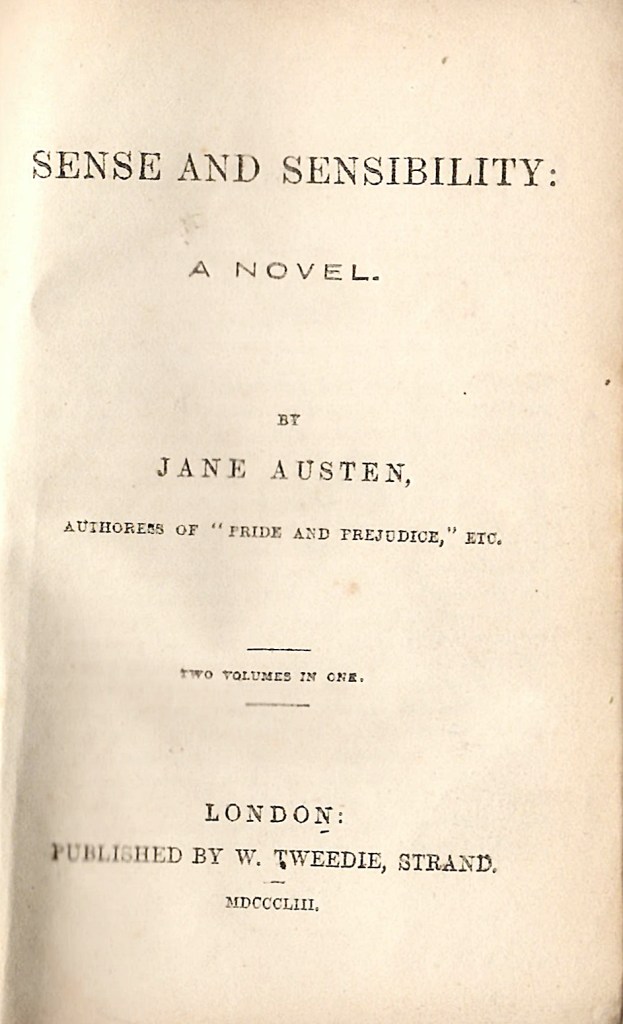
The engraved title page is followed by a printed title page that bears the date MDCCCLIII (1853) and repeats that this book is two volumes in one. Following page 239, the final page of chapter 30, we find a half title page that reads “Sense and Sensibility | Volume II”, which is immediately followed by a title page for volume II, which is dated MDCCCLII (1852). The text block numbering then starts again with “6” on the second page, which follows an unnumbered first page of chapter 1 , and ends with an unnumbered page 224, the last page of chapter 20 of volume II. THE END is printed half way down this page. Pictures of these two title pages are shown in Figure 3 below.
Figure 3. The two letterpress title pages from the Tweedie Sense and Sensibility
From the page counts given above, it is clear that the arrangement of the chapters and the page counts of the two volumes published by Tweedie exactly matches the chapter arrangement and the page count of the Gilson E2 H G Clarke edition of 1844. The Clarke edition is described as a 32mo, which implies that it is a small volume, and Gilson confirms this with his page height measurement of 12.8 cm for E2. The page height for the Tweedie volume is slightly larger at 13.0 cm. In the next figure, I compare one of the title pages from the Tweedie edition with the title page from the Clarke edition of 1844.
Figure 4 Title pages from the Tweedie edition and the Clarke edition.
Clearly the two pages differ in several respects in their layout and in the use of Roman or Arabic numerals to express the date. However, I find it interesting to note the similarity of the line following “Jane Austen” in both books. They both refer to her as “Authoress of “Pride and Prejudice” etc,” with Clarke adding an extra “etc.” This is unusual, as it is most common to find Jane Austen referred to as “Author” rather than “Authoress” on mid-19th century title pages. For example, the Lea and Carey 1st American edition of 1833 referred to above has the following line printed under the author’s name, which is expressed as Miss Austen: “Author of “Pride and Prejudice,” “Emma,” etc etc”.
It is clear to me that the Tweedie Sense and Sensibility is derived from the Clarke Sense and Sensibility. One would need to compare the texts directly in order to confirm this absolutely. There are two copies of the Clarke edition of 1844 currently on offer on Abe books, but at A$2,500, I am not inclined to buy either of them in order to complete the confirmation!
A brief account of HG Clarke and Co.
Henry Green Clarke (1816-1894) entered the London publishing scene in 1843, and only advertised in the official London book trade publication “The Publishers’ Circular and Booksellers’ Record” in issues which appeared in 1844 and 1845. He published a series of books, which he marketed as Clarke’s Cabinet Series at 32mo size, which he offered for sale at two shillings for a single volume and three shillings and sixpence or four shillings for 2 volume sets. They seemed to be aimed at a female clientele. Sense and Sensibility was advertised in May 1844 as no. 21 in the Cabinet Series, and was priced at 3/6. Clarke also published a two volume edition of Pride and Prejudice later in 1844 as number 34 of his Cabinet Series. Presumably this accounts for the mention of Pride and Prejudice on his title page shown in Figure 4 above. H.G. Clarke and Co went spectacularly bankrupt early in 1846 and its remaining assets were sold off in 1848. Undeterred, Henry Clarke re-entered the “book” trade in 1849 as a seller of books, maps and prints at a shop in the Strand which he ran successfully until about 1875.
In a reference to the Clarke Cabinet Series, David Gilson noted that Michael Sadlier had stated that “several of the titles in this series were reissued in 1849 and 1850 by George Slater bound in red or green morocco cloth with gold decoration and titling on the spine.” In addition, I have only found one reference to a Tweedie Sense and Sensibility. That was in Gilson’s list of corrections and additions on page xxxvi of the introduction to the second edition of his bibliography. Gilson states ” I recorded no editions first published in 1853, but an American collector has a two volume edition of SS published by W. Tweedie, London, 1853 (the second volume being in fact dated 1852).” That clearly sounds like a two volume edition of my book, which is two volumes in one. Perhaps George Slater acquired some stereotype plates from the bankruptcy sale of the assets of H.G. Clarke and Co in 1848, and the plates for Sense and Sensibility were eventually were passed on to W. Tweedie. There are no recorded editions of Jane Austen published by George Slater.
The next issue to address is who was W. Tweedie of the Strand?
William Tweedie (1821-1874)
William Tweedie was born on 9th July 1821 in Haddington, East Lothian in Scotland, a small town about 25 km east of Edinburgh. It currently has a population around 10,000, but in the Middle Ages was the fourth largest city in Scotland! I could find out nothing about William Tweedie’s parents or upbringing. The next record of him is his marriage in Edinburgh on 19th May 1848 to Mary Tapper (1816-1883) who was born and raised in Teigngrace, a small village west of Newton Abbot in Devon. How she came to be in Edinburgh and how they met is a mystery. Mary had been baptised in the Church of England, but William Tweedie was a Quaker.
William and Mary Tweedie had six children between 1849 and 1861, for whom I can find birth registrations, but no baptismal records, suggesting they were born and raised as Quakers. Interestingly, all four sons of this marriage were all married in Church of England ceremonies, suggesting that they did not embrace Quakerism. Both daughters of William and Mary Tweedie remained spinsters and became school teachers, working together to run a series of private schools.
William and Mary Tweedie arrived in London around 1850, along with their first son, William, who had been born in 1849 just outside York. York has traditionally been a strong centre for Quakerism, encouraged by the presence of Joseph Rowntree of chocolate fame, and by the early foundation of Quaker hospitals and Quaker schools. In the 1851 census William Tweedie is described as a bookseller, and his family are living at 18 Upper Wellington Street, Covent Garden, right in the heart of the book trade of mid-19th century London. To illustrate this, here is a short extract from a blog by Mary L Shannon:
“On Wellington Street, you could find the offices of some of the most well-known and influential newspapers, miscellanies, and serials of the mid-Victorian period. In the 1840s and ‘50s it was home to more than twenty newspapers or periodicals, and thirteen booksellers or publishers. The Punch office was at 13 Wellington Street South until January 1844. When Reynolds arrived at number 7 around 1846, number 14 was the office of the Athenaeum. This highly respected literary journal was published by John Francis, who helped to prop up the Daily News after Dickens had abandoned his ill-advised job as its editor. Until 1849, number 14 also contained the offices of the Railway Chronicle. This was edited by John Scott Russell, who had been railway editor for Dickens at the Daily News. A two-minute stroll away, at number 5 Wellington Street South was the office of the Examiner, edited by Dickens’s close friend and literary advisor John Forster. At 17 Upper Wellington Street lived briefly one of the most famous contributors to Household Words, G.A. Sala, while Henry Mayhew published the serial version of London Labour and the London Poor from an office in 16 Upper Wellington Street.”
The first recorded publication by William Tweedie on WorldCat.org is from 1853. Like all of his 66 books listed on WorldCat, it was issued from the address on my book, 337 Strand, London. He was mainly a publisher of books on abstinence from alcohol, together with religious-based advice for women. He also republished several American anti-slavery titles. He is mostly remembered now for creating and publishing the ABC Railway Guides, which he also started in 1853. These were a real rival to Bradshaw’s Guides, which have now regained fame due to Michael Portillo’s series of TV programs on railways. The ABC Railway Guides were still being published well into the 1930s and were the inspiration for Agatha Christie’s The ABC Murders (1936).
William Tweedie died on 27th October 1874 at his home, 4 Campden Hill Road, Kensington, a fairly up-market area of London. The W. Tweedie publishing business ceased trading in 1875, largely, I imagine, because none of his six children entered the book or publishing trade. I have been able to find a Carte de Visite of William Tweedie dated 1873. It is shown here below. I have to say he looks a bit older than 52!
Figure 5. William Tweedie in 1873
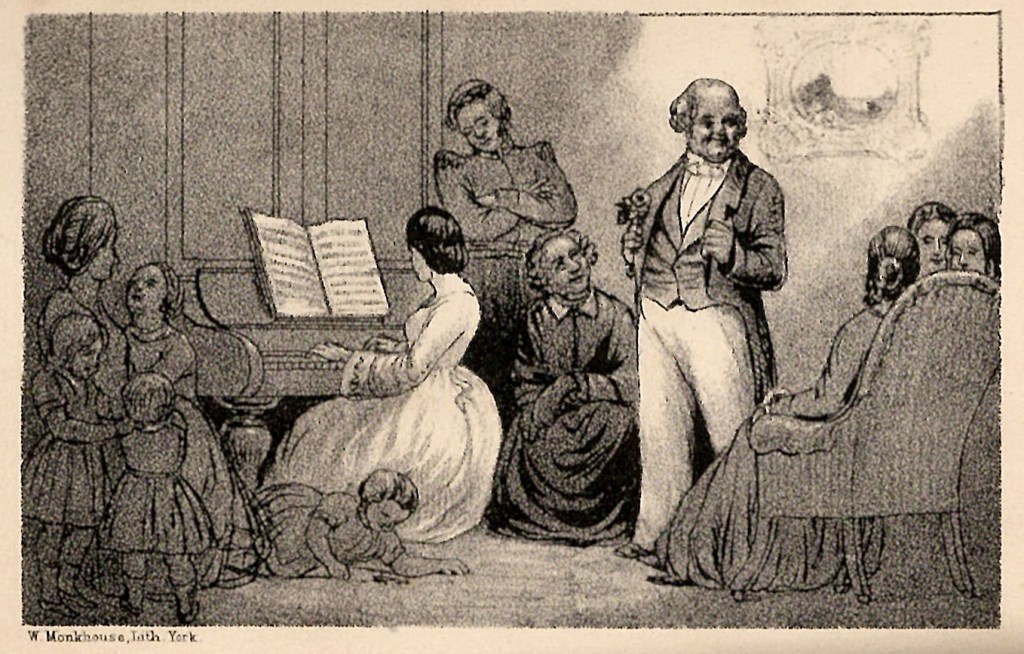
How William Tweedie came to publish an edition of Sense and Sensitivity remains a mystery. It is so atypical of his normal type of publications. It is also strange that the two title pages bear the dates 1852 and 1853. There is no record of any Tweedie publication in 1852 on WorldCat or in The Publishers’ Circular and Booksellers’ Record for 1852. The one puzzle I can offer a solution for is the origin of the frontispiece shown above in Figure 1. I have rotated and expanded the picture to display it again below. It depicts the visit of Mrs Dashwood and her daughters to Sir John Middleton.
Figure 6. Frontispiece of Tweedie’s Sense and Sensibility
In the bottom left corner of the image, “W. Monkhouse, Lith York” is printed. William Monkhouse (1814-1896) was a successful lithographer who worked in York from at least 1841 until the mid 1880s. At the peak of his career he employed ten people to work with him. He was quite well known for a series of fine lithographs of York Minster. Since William Monkhouse and William Tweedie were both in York around 1849-1850, I assume that they may have met during that period. I do not think that William Monkhouse was a Quaker, as he was married in a Church of England ceremony and was not buried in either of the two Quaker cemeteries in York. Perhaps William Tweedie commissioned the frontispiece from his lithographer friend in York. The quality of the work is not outstanding, and it is not clear who was responsible for the original drawing. Monkhouse was known to have collaborated with several artists and photographers during his long career. It is certainly better than the very stiff image of Willoughby and Elinor on the engraved title page (Figure 1.) I have not seen either of these images published anywhere else.
A possible provenance…
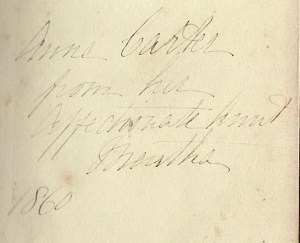
My Tweedie Sense and Sensibility does have an inscription on the free front end-paper. It reads “Anne Carter, from her affectionate Aunt Martha, 1860.” It is shown in Figure 7 below.
Figure 7. Inscription to Anne Carter
Anne Carter is a fairly common mid-19th century name, but on searching for an Anne Carter who was both living in the UK in 1860 and who had an Aunt Martha, I rather surprisingly could only find one, and that after some difficulty! The family has a rather compelling and complex story, so I will only summarise it here.
Anne Farr was born on 30th January 1825 in Chelsea, as the only daughter of Thomas Farr and Mary Ann Farr nee Dewin. On the 1851 census, Anne Farr is reported to be a school mistress living in Stanwell Moor, a small village in Middlesex, which in the 1850s would have been entirely rural, but today is the closest village to Heathrow airport, 250 metres beyond the western boundary fence, directly below the flight-path!
Anne presumably met her husband Robert Carter in Stanwell Moor, as he was a long time resident there, having been born in Stanwell Moor in late 1812 and baptised in the parish church at nearby Stanwell on 29 November 1812. Robert Carter was variously described as a publican and a victualler. I am pleased to say that the pub in Stanwell Moor, The Anchor, is still operating.
Anne Farr and Robert Carter were married at St Luke’s Church, Chelsea, which was Anne’s home parish, on 22nd December 1853. Over the next seven years, they had three sons, all of whom were born in Stanwell Moor: Robert John in 1854, Thomas Charles in 1856 and Richard in 1860. In the next census on 7th April 1861, Robert and Ann Carter are shown to be living in Stanwell Moor with their two oldest sons, Robert and Thomas, and a visitor, Martha Palmer. The 7 month-old Richard was staying with relatives William and Sarah Francis at nearby Cranford, which was then a 5km walk east from Stanwell Moor. Today the two villages are still separated by 5km, but the land is now taken up by the long axis of Heathrow airport, making the walk both hazardous and illegal.
Martha Palmer (1781-1872) was born Martha Gould, and had a sister, Miriam Gould (1776 -1844), who in 1808 had married John Carter (1783-1852) of Stanwell Moor. John and Miriam Carter were the parents of Robert Carter, husband of Anne Farr, and so the 1861 visitor to Robert and Anne, Martha Palmer, was their Aunt Martha. I find this compelling evidence that this must be the Aunt Martha who gave the Tweedie 1853 edition of Sense and Sensibility to Anne Carter in 1860.
Interestingly, Robert Carter had an older sister, Martha Carter (1809-1881), the first-born child of John and Miriam Carter, who had presumably been named after Miriam’s sister Martha Palmer nee Gould. Martha Carter married John Ebenezer Gillard in 1841 at St.Luke’s Church in Chelsea. This couple were to play an important role in the story of the Carter family.
Sadly, both Anne Carter nee Farr and Robert Carter died later in 1861, Anne in June and Robert in September, leaving their three sons, Robert John, Thomas Charles and Richard as orphans at ages of 6, 4 and 1 year old respectively. The boys’ own Aunt Martha, now Martha Gillard, took the two older boys into her family and raised them together with her two daughters, Martha Miriam Gillard, who had been clearly named for both Martha and Miriam Gould, and Sarah Emma Gillard.
Both Robert John Carter and Thomas Charles Carter grew up, married, and lived the rest of their lives in and around London. Robert John had no children, but Thomas Charles Carter, who followed in his father’s footsteps and became a publican in Camberwell, South London, had one son, Cecil Thomas Carter (1884-1861).
The youngest son, Richard Carter, had a less happy early life, spending several years in an Infant Orphan Asylum in Snaresbrook, North London. In 1881, he was living in a boarding house in Battersea, South London and working as a harness-maker. In the mid-1880s, he emigrated to Sydney Australia, where he married in 1890 and had four children before his death in 1902. Several of Richard Carter’s great-grandchildren are alive today in Australia.
So that completes the story of this little book and its previous owner. I don’t know what happened to the book after the death of Anne Carter. I bought it from a dealer in the far north of Scotland, so, ironically, it had returned to the birthplace of its publisher, William Tweedie, before making its way to me in Australia.
In the next of these posts, I plan to look at the first properly illustrated edition of Jane Austen’s Mansfield Park. This will be Price and Provenance 10.







 Book Collecting World