The Silent Traveller in Lakeland was published by Country Life in 1937 as the first of the “Silent Traveller” books by Chiang Yee. It was actually called “The Silent Traveller : A Chinese Artist in Lakeland” as the publishers thought that “The Silent Traveller in Lakeland”, the author’s prefered title, had somewhat of a sinister ring. It is a short book, only 67 pages long, with a frontispiece and 12 other full page black and white illustrations in Chiang Yee’s traditional painted black ink style. Unlike most of the subsequent books in the series, there are no watercolour paintings, nor are there any pen and ink line drawings embedded in the text. My copy of the first edition is shown below, with the dust jacket on the left and the grey cloth binding on the right. Chiang Yee dedicated the book to his sister, Tsui-Chen, who he missed very much.
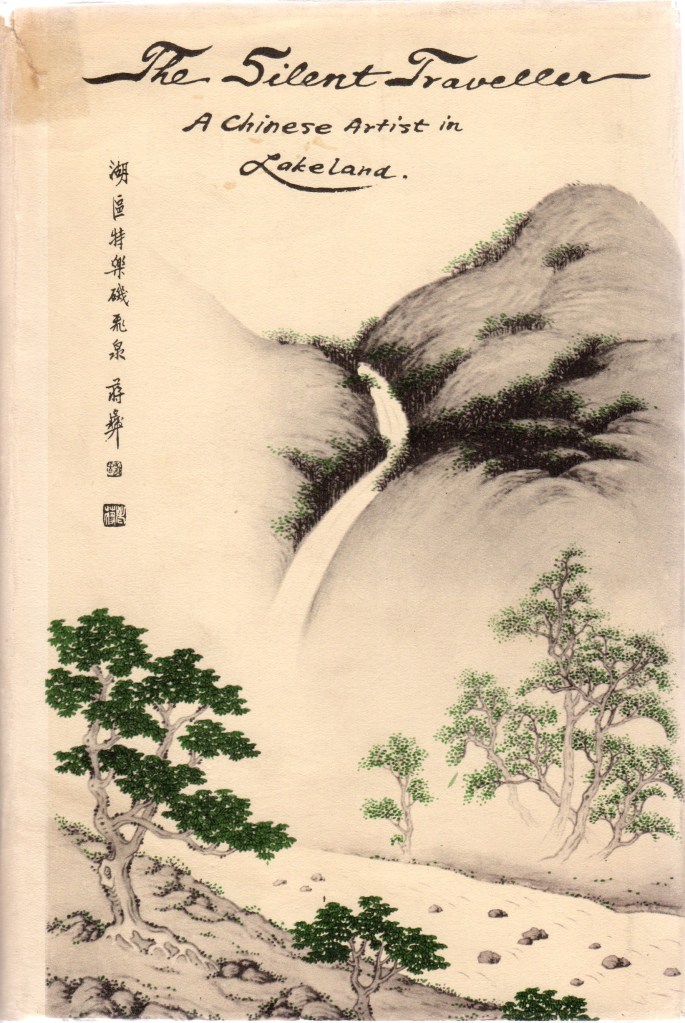
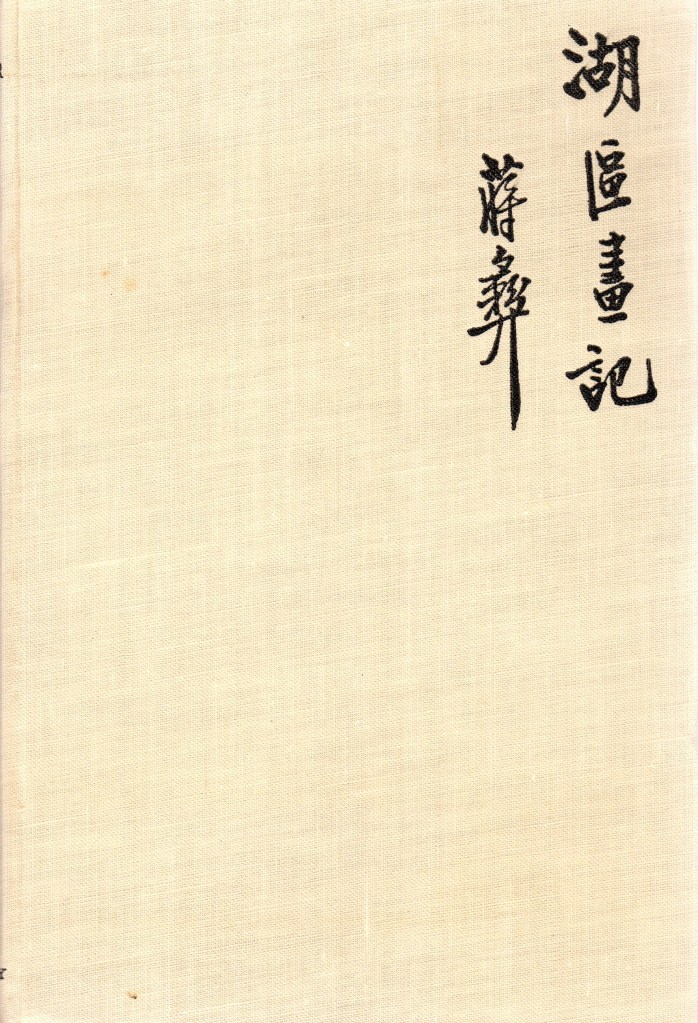
The styles of the dust jacket art and the binding and titling established here were retained for the whole series. The dust wrapper image of the stream flowing down from the hills is the only picture in the book to have any colour, with the leaves on the trees in the foreground painted in shades of green. The characters, rendered in one of Chiang Yee’s favourite “Grassy” styles of calligraphy, placed near the top right corner of the ivory cloth binding should be read from top to bottom, then right to left. The four right hand characters shows the book’s title as “Lakeland Silent Traveller”. For instance, the top character, 湖, is Hù which means “lake”, the second character is a phonetic rendering of “land”. The two left hand characters are Chiang Yee’s calligraphic signature. You will see the same four title characters running right to left on the title page, directly below the English title and subtitle.

You can see from the small text below the name “Chiang Yee”, that he is already credited with two other books “The Chinese Eye” (1935) and “Chinese Calligraphy” (1938). Both of these books were published by Methuen, who eventually became the UK publisher for the “Silent Traveller” books. They were books that Chiang Yee had been asked to write as guides for Chinese art, in association of exhibitions of Chinese paintings and calligraphy. “The Chinese Eye” was published on November 21st 1935 to co-inside with the opening of an exhibition of Chinese art at Burlington House in London. In his acknowledgements in “The Chinese Eye“, Chiang Yee thanks Miss Innes Jackson who “has rendered into lucid English my clumsy expressions”.
Chiang Yee had arrived in London in June 1933 with almost no written or spoken English. He stayed in Hampstead in London with some Chinese ex-patriot friends and started his working life by providing some line drawings to illustrate his then housemate, S. I. Hsiung’s “Lady Precious Stream” in 1934. In 1935, he taught Chinese to English students at The School of Oriental Studies in London. One of his pupils there was Miss Innes Jackson (1911-2008), a young recent Cambridge graduate who went on to a long academic career specialising in Chinese Literature. Innes Jackson and Chiang Yee remained life long friends, in spite of Innes Jackson’s feelings that she should have been named as a co-author of several of Chiang Yee’s early books, including this, the first Silent Traveller book. There is no acknowledgement of Innes Jackson in The Silent Traveller in Lakeland.
By July 1936, Chiang Yee had been living in London for three years and mentions in his introduction that, although he liked aspects of living in London, he disliked the noise and bustle of the traffic and the smokey and foggy atmosphere. Friends advised him to take a holiday in the countryside, so he decided to visit the English Lake District for a two week holiday in August 1936. On the last day in July, he boarded a train at Euston station for the seven hour journey to Seascale on the Cumberland coast, followed by a 13 mile car ride to his initial holiday accommodation, a small farmhouse in Wasdale Head, at the northern end of Wastwater. After two days walking in the hills and valleys close to Wastwater, he took a bus to Keswick, and stayed there for the remainder of his holiday. Keswick, on Derwentwater was much less isolated that Wasdale Head, and allowed him to visit Buttermere, Crummockwater, Lake Windermere and Grassmere, the site of Wordsworth’s Dove Cottage, by then already a museum.
In the book, Chiang Yee describes his rambles, illustrates some of the places he visited with black ink wash paintings and composes poems about the places and things that he has observed. He compares the English landscape with that in China, particularly with the region in Jiujiang around Mount Lu. He also comments on the English behaviour that he experiences, all the time making the point that England and China have much more in common than they have differences. In his introduction he remarks that “Last summer I had the opportunity of visiting the Lakes, and there I spent the most agreeable period of all my English experience.” He goes on to say ” I was almost entirely silent for my whole time in the lakes, and the joy born out of that tranquility in my mind will render unforgettable my years in England.”
Here are some of his paintings of Lakeland.


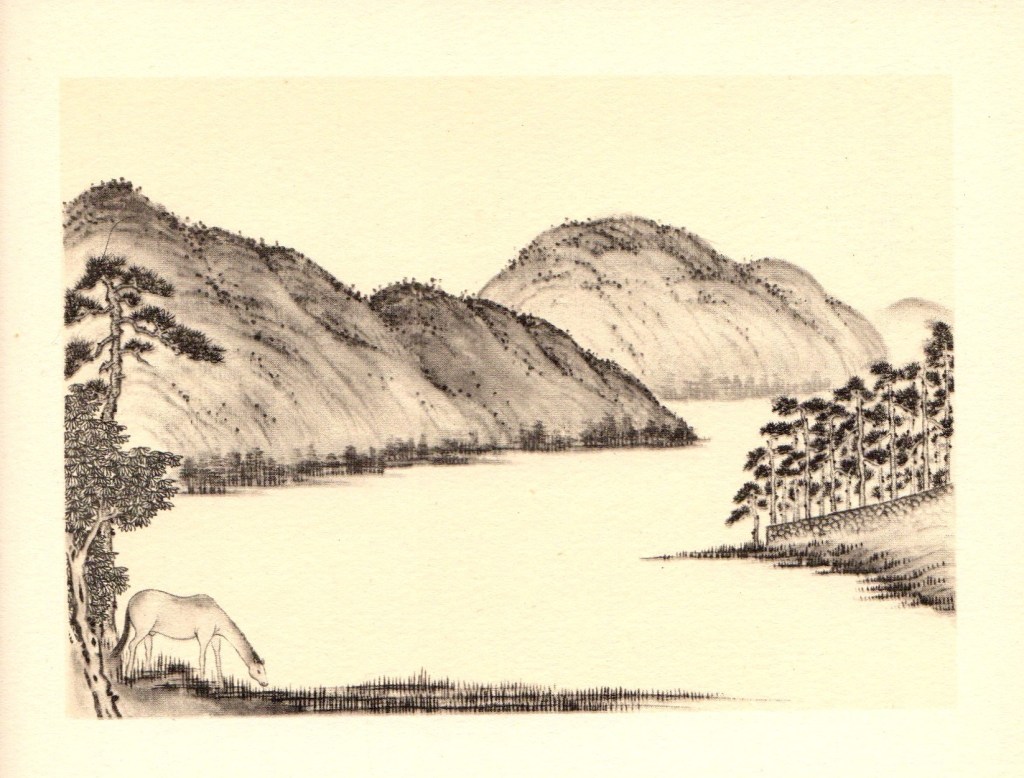

The classical Chinese landscape painting style of Chiang Yee is very evident in these pictures. Many of the pictures are also accompanied by poems printed in Chinese calligraphy. Two examples from the Wastwater region are shown below.


The page on the left shows the Wastwater view shown previously together with its Chinese poem. The page on the right shows the locals from Wasdale Head going to church in the rain, together with a short poem. The translation of this poem is given below.
"The Mountain is lofty and rugged,
I breast it smilingly - the white clouds clasped beneath my arm,
And Heaven looks down with envy on my peaceful wandering,
How rapidly the skies drop their wild torrents!
I lie upon a rock in leisure and thought,
Don't even know my clothes are wet."
Chiang Yee tells us that he had some difficulty in getting the book accepted by English publishers. He had had some of his paintings published in English magazines in the years 1934 to 1936, which prompted Country Life to approach him in late 1936 about him writing and painting his observations of his life in London as a book. He told them that he had already prepared notes on his recent trip to the Lake District, but after a brief inspection of his notes, Country Life told him that they felt that there would not be a market for a Chinese view of the English Lakes. Chiang Yee then showed his notes to a few other publishers and had the same negative responses. About six months elapsed before he was approached by Country Life again to have a second view of his notes and paintings of the Lake District. They were still not very optimistic, but offered to publish it in a small edition, but with no royalty. Sir Herbert Read, an expert on Chinese art prepared a brief preface for the book. It was published late in 1937 and to everyone’s astonishment, it sold out within one month. It was reprinted in August 1938, this time with royalties duly paid, and then again in 1942, 1944, 1946 and 1949. It has been more recently republished in paperback format by Mercat Press in 2004.
Interestingly, my first edition published in late 1937 has an inscription on the front endpaper from Johannesburg dated 30th January 1938. The “Silent Traveller” seems to have been quite a rapid traveller!
Chiang Yee concludes his English Lakeland book with comparisons between his feelings for the English lake and mountain scenery that he has experienced with his memories of his beloved Mount Lu in Jiangxi province. He expresses this most movingly in a final poem which I reproduce here.
“In my native country, there is the Mountain Lu,
It rises too beside the P’o-Yang Lake.
And my home stands upon its shore,
All night, and day, I see the changing colour of the mountain.
I leave this lakeland, and with longing seek to return,
With some sadness thoughts are born of my distant home.”

 Book Collecting World